


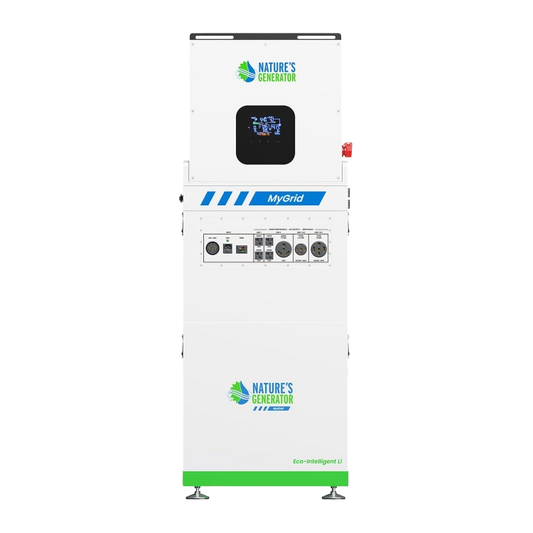
When engineering a modern residential energy strategy, achieving true resilience requires intelligent design. At Nature’s Generator, we believe systems should transcend basic emergency storage. Homeowners looking for a reliable backup power system often face a choice between an inflexible traditional solar power generator setup or a noisy fossil-fuel machine. The Nature’s Generator Lithium 6000 bridges this gap as a robust whole home power generator that also serves as high-capacity, portable backup power.
In this architectural deep dive, our team will explore how Smart Home Load Profiling maximizes your energy security by strategically Pairing the Lithium 6000 with Automatic Transfer Switches. We will answer exactly how to audit your electrical footprint, manage high-surge appliances, and integrate an automatic switch for zero-touch grid failover during an unexpected blackout.
How Smart Home Load Profiling Safeguards and Optimizes Your Backup Power Strategy
Smart home load profiling is the systematic process of tracking, categorizing, and calculating the electrical power consumed by your home’s various circuits over time. Based on our experience, many homeowners mistakenly calculate their backup needs using monthly utility bills alone. However, an aggregated monthly kilowatt-hour (kWh) value does not reveal peak demand periods or high-surge events. To design an effective backup system, you must understand your building's instant wattage requirements.
Distinguishing continuous versus surge loads
Electrical devices utilize power in two distinct ways: running (continuous) wattage and starting (surge) wattage. Continuous load represents the power an appliance requires to operate consistently after its initial startup. In contrast, surge load defines the brief, high-energy spike required by motorized or inductive loads—such as air conditioning compressors, well pumps, and refrigerators—to kickstart their motors. If your backup system cannot handle these momentary spikes, the internal safety mechanisms will trip, dropping your entire electrical panel even if your average continuous consumption is low.
Categorizing essential vs. non-essential smart loads
When constructing a load profile, we recommend splitting your smart home circuits into three tiers:
-
Critical Infrastructure (Tier 1): Medical equipment, refrigerators, freezers, security systems, water pumps, and network routers.
-
Operational Comfort (Tier 2): HVAC fans, targeted lighting zones, microwave ovens, and garage door openers.
-
Discretionary Loads (Tier 3): Clothes dryers, EV chargers, hot tubs, and ornamental accent lighting.
By tracking these tiers via smart circuit breakers or home energy monitors, you can map out exactly which breakers must be backed up when grid infrastructure fails.
How Does the Nature's Generator Lithium 6000 Handle High-Demand Household Electronics?
The foundation of any heavy-duty backup architecture is the inverter and the battery chemistry. The Lithium 6000 Power Station is engineered specifically to address the demanding real-world profiles compiled during smart home audits.
Reviewing the 6,000-watt continuous pure sine wave inverter specifications
Our engineering team designed this power station with a massive 6,000-watt continuous pure sine wave inverter capable of handling a 12,000-watt peak surge. This dual-voltage (120V/240V) split-phase output is a critical differentiator. Traditional portable power banks only supply 120V, leaving heavy-duty household appliances completely inoperable. Because the Lithium 6000 outputs native 240V, it easily powers high-draw appliances like well pumps, electric water heaters, and central air systems without requiring complex external step-up transformers.
Managing the 3,840Wh LiFePO4 battery base capacity
Energy delivery is driven by a high-performance Lithium Iron Phosphate (LiFePO4) battery core with a base storage capacity of 3,840Wh (51.2V, 75Ah). LiFePO4 chemistry provides significant safety advantages over traditional lithium-ion batteries, remaining thermally stable even under high continuous discharge conditions. Furthermore, it boasts an exceptional lifespan of over 3,000 complete charge-and-discharge cycles before experiencing nominal capacity reduction. This ensures years of reliable service during emergency situations.
How Do You Connect a Split-Phase Power Station to an Automatic Transfer Switch?
To safely route electricity from your power station to your home's breaker panel, a code-compliant physical link is mandatory. You must never attempt to "backfeed" your home via an outlet, as this presents severe electrocution risks to utility lineworkers. Instead, installing a dedicated transfer switch is the gold standard for residential integration.
The mechanics of 120V/240V dual-voltage system integration
An automatic transfer switch (ATS) continuously tracks the flow of electricity from the main grid. When the grid drops voltage, the ATS safely disconnects the home's selected circuits from the utility grid and reconnects them to the generator's inverter output. Connecting to a transfer switch (configured for 8 spaces or 12 circuits) via the Lithium 6000's 4-prong NEMA L14-30R outlet allows you to supply evenly distributed split-phase power to your home. This clean integration allows you to run both 120V circuits (like lights and Wi-Fi) and 240V appliances simultaneously from a single, clean energy source.
Leveraging the automatic-start ECO mode for zero-touch failover
One of the most powerful aspects of pairing this system with an automatic transfer switch is the integrated Auto-Start ECO Mode. When our team engineered this feature, we wanted to eliminate the need to fumble in the dark during a midnight blackout. When connected to a compatible ATS, the power station continuously monitors grid availability. The moment a power outage occurs, the system automatically activates its pure sine wave inverter and seamlessly restores energy to your critical circuits within seconds, offering true uninterruptible peace of mind.
What Does a Real-World Smart Home Load Profile Look Like During a Blackout?
To illustrate how the Lithium 6000 manages active home loads through an automatic transfer switch, let us evaluate a typical real-world emergency scenario. Customer feedback indicates that during extended blackouts, maintaining refrigeration, clean water, and communications are the highest priorities.
The table below outlines an optimized profile for critical smart home circuits connected to a 30A automatic transfer switch:
|
Circuit / Appliance |
Continuous Watts (Running) |
Surge Watts (Starting) |
Priority Level |
Management Strategy |
|
Smart Refrigerator & Freezer |
200 W |
800 W |
Critical |
Always On via ATS |
|
Deep Well Pump (1/2 HP, 240V) |
1,000 W |
3,000 W |
Critical |
Intermittent (Cycles automatically) |
|
Home Network (Router, Modem, Security) |
50 W |
50 W |
Critical |
Always On via ATS |
|
LED Lighting Zones (Kitchen/Main) |
120 W |
120 W |
High |
On as needed |
|
Microwave Oven (Intermittent) |
1,500 W |
1,500 W |
Medium |
Used manually for food prep |
|
Sump Pump (1/3 HP) |
800 W |
2,200 W |
High |
Cycles automatically as needed |
|
Total Coincident Peak Load |
3,670 W |
7,670 W |
— |
Fully supported by the Lithium 6000 |
In this scenario, even if every single appliance attempts to start up at the exact same fraction of a second, the total peak requirement of 7,670 watts sits comfortably below the 12,000-watt surge limit of the inverter. Under normal operating conditions, the system will cruise at a continuous draw of less than 2,500 watts, providing highly efficient battery management and prolonged runtimes.
How Can Homeowners Expand Their Energy Storage to Maintain Multi-Day Autonomy?
For brief power outages lasting an hour or two, a standalone power station handles household demands effortlessly. However, severe weather anomalies can knock out utility grids for days at a time. In these high-stakes scenarios, off-grid energy flexibility becomes vital.
Stacking dual units for a 12,000-watt system setup
If your load profiling reveals that your continuous power demands frequently bump against the 6,000-watt threshold—such as running multiple deep well pumps or heavy workshop equipment—the platform expands easily. By combining two Lithium 6000 units using a specialized combiner cable, you double your output capacity to a staggering 12,000 watts of continuous 120V/240V power. This massive overhead allows you to supply energy to a larger 50A automatic transfer switch, powering nearly every sub-panel circuit in a medium-sized smart home.
Coupling modular battery pods and rigid solar panels for sustained charging
To extend your runtime without buying a second full power station, you can add modular battery units known as Power Pods. Each pod expands your storage capacity by another 3,840Wh, allowing you to scale up system storage to match your exact home load profile.
To keep this expanded storage charged during an extended outage, you must leverage renewable inputs. The system features dual Maximum Power Point Tracking (MPPT) solar charge controllers that support up to 2,400W of direct solar panel input. By installing rigid or folding monocrystalline solar panels, you can feed up to 2,400 watts of clean solar power back into the battery array while simultaneously running your household loads through the transfer switch. This creates a fully self-sustaining, closed-loop microgrid.
For comprehensive backup kits that include pre-configured pairings, explore the Nature's Generator Lithium 6000 and Transfer Switch Bundle, which provides everything necessary for a seamless home installation.
Conclusion
Smart home load profiling eliminates guesswork from your emergency preparedness planning. By auditing your structural energy demands, distinguishing between running and starting wattages, and segregating critical circuits from luxury loads, you build an efficient plan that protects your household when the grid fails.
Pairing the massive split-phase output of the Lithium 6000 with a professional automatic transfer switch creates an automated, ultra-reliable home defense system. The Auto-Start ECO Mode guarantees that your high-demand appliances, medical equipment, and security arrays stay online without manual intervention. Should your energy demands grow over time, the modular nature of the ecosystem allows you to easily scale your storage and solar charging capacity. If you are ready to transition your home into an independent energy fortress, trust Nature’s Generator to deliver the clean, quiet, and robust power systems your family deserves


