


Setting up a solar power generator is great for going off-grid. However, relying on just one source can leave you in the dark. To secure reliable backup power or run a whole home power generator year-round, you need a backup plan. Many people rely on portable backup power during outages, but true off-grid freedom requires a system that works 24/7. In this guide, we will show you why solar power drops in winter and how adding a wind turbine solves this problem. At Nature's Generator, we know that combining wind and solar is the smartest way to keep your lights on.
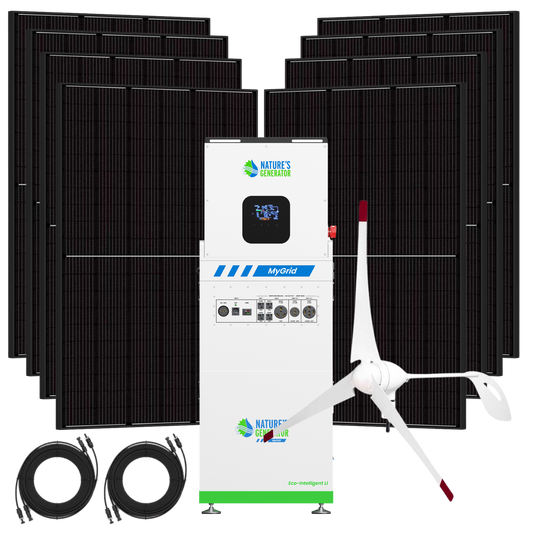
Why Does My Solar Array Fail to Meet My Energy Needs in Winter?
If you rely entirely on solar panels, you will likely notice a major drop in power during the colder months. This does not just happen because the days are shorter. It happens because of a concept called Peak Sun Hours.
The Peak Sun Hours Problem: Shifting from Summer to Winter
A peak sun hour is not just any hour when the sun is in the sky. It is an hour when the sunlight is strong enough (specifically, 1,000 Watts per square meter) to fully charge your system.
-
In the summer: You might get 5 to 6 peak sun hours a day.
-
In the winter: That number often drops to less than 2 peak sun hours because the sun sits lower in the sky and clouds block the light.
Let us look at a simple example. Suppose your home uses 15 kWh (kilowatt-hours) of electricity every day to run your appliances, lights, and water pumps. You have a standard 4-kilowatt (4 kW) solar panel setup. To keep things realistic, we will assume your system runs at 85% efficiency to account for power lost in wires and equipment.
In the summer, with 5.5 peak sun hours, your daily calculation looks like this:
Summer Power = 4 kW x 5.5 hours x 0.85 = 18.7 kWh
You are making 18.7 kWh of power, which is more than the 15 kWh you need. Your batteries stay fully charged.
Now, look at what happens in December when you only get 1.8 peak sun hours:
Winter Power = 4 kW x 1.8 hours x 0.85 = 6.12 kWh
Calculating the Seasonal Solar Deficit
During the winter, your system has a massive daily shortage:
Daily Shortage = 15 kWh - 6.12 kWh = 8.88 kWh
If you experience three cloudy days in a row, you will be short by more than 26 kWh of electricity. Based on our experience, simply buying more solar panels to fix this does not work well. If snow covers your panels or heavy clouds block the sun, doubling your panels still leaves you with very little power. Plus, you will end up with a massive amount of wasted energy in the summer.
How Much Power Can a Wind Turbine Actually Generate Off-Grid?
To understand how wind turbines help, we have to look at how wind makes energy. Wind power does not increase in a simple, straight line. Instead, it increases exponentially based on how fast the wind is blowing.
Understanding the Wind Power Equation
The physical power available in the wind is calculated using this formula:
Power = 0.5 x Air Density x Blade Area x (Wind Speed x Wind Speed x Wind Speed)
Here is what these terms mean in plain English:
-
Power: The total raw power produced in Watts.
-
Air Density: The weight of the air. Cold air is heavier and denser, which means it actually pushes harder on turbine blades than warm air.
-
Blade Area: The total circular area swept by the spinning blades.
-
Wind Speed: The velocity of the wind.
The most important part of this equation is that wind speed is multiplied by itself three times (cubed). Because of this mathematical rule, even a small increase in wind speed produces a massive leap in power.
Why Small Wind Shifts Make a Huge Difference
Let us compare a light breeze of 10 mph to a moderate wind of 15 mph using a standard home wind turbine with a typical blade sweep area:
-
At 10 mph (4.47 meters per second): Power = 0.5 x 1.225 x 2.54 x (4.47 x 4.47 x 4.47) = 139.1 Watts
-
At 15 mph (6.71 meters per second): Power = 0.5 x 1.225 x 2.54 x (6.71 x 6.71 x 6.71) = 470.1 Watts
By increasing the wind speed by only 50%, you get over 230% more power! Best of all, unlike solar panels that turn off when the sun goes down, a turbine can generate electricity 24 hours a day. The Nature's Generator Wind Turbine is designed to capture these overnight breezes and convert them directly into battery power.
Why is a Hybrid Solar and Wind System the Smartest Choice?
The real secret to off-grid success is that wind and solar are natural partners. When one is weak, the other is usually strong.
How Wind and Solar Work Together
-
Day vs. Night: Solar panels only work during the day. Wind speeds are often stronger at night because of temperature changes in the air as the earth cools.
-
Summer vs. Winter: Solar is highly productive in the summer when days are long. Wind resources are usually strongest in the winter and spring when cold weather fronts move through.
Why Buying a Wind Turbine is Better Than Just Buying More Batteries
When people realize their solar panels are not keeping up in the winter, their first thought is often to buy more batteries. Let us compare the costs and benefits of doing this.
To get through a 3-day winter storm with a solar-only system, you would need to store an extra 26.6 kWh of power. To do this safely without damaging your batteries, you would need to purchase about 33 kWh of high-quality lithium batteries. This can cost thousands of dollars.
More importantly, batteries do not make energy—they only store it. If a winter storm lasts for five or six days instead of three, even a giant battery bank will eventually run empty.
A wind turbine actively generates power during those cloudy, stormy days. This means you do not need to buy nearly as many batteries to keep your home running.
|
Feature |
Solar-Only System (4 kW) |
Hybrid Solar-Wind System (4 kW Solar + Turbine) |
|
Summer Daily Power |
18.7 kWh |
21.5 kWh |
|
Winter Daily Power |
6.12 kWh |
13.8 kWh |
|
Batteries Needed for Storms |
Very Large (and Expensive) |
Smaller (and Budget-Friendly) |
|
Storm Reliability |
High Risk of running out of power |
Low Risk; wind makes power during storms |
How Do I Set Up a Wind Turbine with My Existing Solar Power?
Setting up a hybrid system is simpler than you might think. It comes down to checking your local wind and plugging the turbine into the right equipment.
Checking Your Local Wind
Before you install a turbine, you need to know how windy your area is. You can look up local weather stations or government wind maps online.
It is also important to know that wind is much slower close to the ground because trees, houses, and hills block it. To figure out the wind speed at the top of your tower, engineers use the Log Law formula:
Wind Speed at Tower Height = Reference Wind Speed x [ natural log(Tower Height / Ground Roughness) / natural log(Reference Height / Ground Roughness) ]
To get the most power without dealing with this complex math, a great rule of thumb is to mount your wind turbine on a tower that stands at least 20 to 30 feet higher than any obstacles within 300 feet of the turbine.
Connecting the System Together
In the past, combining wind and solar required complicated wiring and multiple external control boxes to keep the different power sources from damaging each other.
Today, systems like the Powerhouse Gen 2 and the Elite make this incredibly easy. They come with separate, built-in ports designed specifically for solar and wind.
You simply plug your solar panels into the solar port and your wind turbine into the wind port. The internal computer manages the power from both sources and charges your batteries safely.
What Happens in Real Life When You Combine Solar and Wind?
We regularly look at real-world data from our customers to see how these systems perform. The results show exactly how valuable a hybrid setup can be.
Consider a family living off-grid in Ohio. They started with an 8 kW solar-only system. In late November, a massive winter storm brought heavy clouds and light snow that lasted for five days.
-
The Solar Problem: Because of the snow and thick clouds, their solar panels produced almost no power—less than 1.2 kWh per day.
-
The Wind Solution: However, the storm brought cold, steady winds averaging 14 mph. Because cold air is heavy and dense, it pushed their wind turbine easily. The turbine produced a steady stream of power day and night.
-
The Result: Over those five dark days, the wind turbine generated over 45 kWh of electricity. This was more than enough to keep their lights on, their refrigerator running, and their heaters working without draining their batteries.
Our customers frequently share that the best part of adding a wind turbine is the peace of mind. Instead of worrying about battery levels every time a storm rolls in, they can relax knowing that the same wind shaking the trees is keeping their home powered.
Conclusion
When you live off-grid, putting all your eggs in one basket is a risky strategy. Solar power is highly effective when the sun is shining, but it struggles during cold, dark winter months. Trying to fix this by simply buying more batteries or solar panels is expensive and inefficient.
By combining wind and solar, you create a balanced system that works day and night, summer and winter. A wind turbine turns stormy weather and nighttime breezes into a reliable stream of clean electricity, protecting your home when solar fails.
If you are ready to take control of your power and secure true energy independence, a hybrid system is the perfect solution. Explore how our plug-and-play systems at Nature's Generator can help you build a reliable, all-weather power setu


