


A small workshop does not need to power everything at once. But saws, compressors, shop vacuums, grinders, and other motor-driven tools can use a lot more electricity than lights or small electronics.
So, how do you calculate backup power for a small workshop?
The answer comes down to three numbers: running watts, starting watts, and watt-hours. Once you know those numbers, you can compare your needs with a backup system from Nature’s Generator and choose the right size instead of guessing.
In this guide, we explain how to calculate reliable backup power for a workshop, how a solar power generator can help during an outage, when portable backup power is enough, and when a larger whole home power generator may make more sense for both your workshop and home.
What is the best way to calculate backup power for a small workshop?
The simplest method is to calculate your workshop in three steps:
-
Add the running watts of the tools you may use at the same time.
-
Check the starting watts of equipment with motors.
-
Calculate how many watt-hours you need based on how long you plan to use each device.
The first number tells you how much power the generator needs to provide at one time.
The second tells you whether the generator can handle the brief surge when a motor starts.
The third tells you how much battery storage you need.
For example, suppose your workshop uses:
The maximum running load is 3,900W when everything operates together.
The total daily energy use is about 4,600Wh, or 4.6kWh.
That gives you a starting point for choosing a backup system.
How many watts does a small workshop need?
A small workshop may need anywhere from about 1,500W to more than 6,000W, depending on the equipment and how many tools are used at the same time.
A light-duty setup might include lights, battery chargers, a laptop, and one smaller power tool. That can keep the required output relatively low.
A more typical workshop may run a compressor, shop vacuum, drill press, and several chargers. In that situation, a system around 3,500W to 5,000W may be more appropriate, depending on the actual equipment ratings.
Heavy-duty workshops can require much more. Welders, large compressors, table saws, dust collection systems, and 240V equipment can quickly increase both the running load and startup demand.
There is no universal workshop generator size. The right size depends on your actual tools.
As a general rule, do not choose a generator whose continuous output is exactly the same as your calculated load. Leave room for normal changes in power demand and motor startup.
How do you calculate starting watts for power tools?
Starting watts are important because some tools need extra power for a few seconds when their motors turn on.
For example, a shop vacuum may use 1,200W while running but need considerably more power when its motor starts. An air compressor can have a similar issue.
To size your system correctly, check the tool manual or nameplate for both running and starting requirements when they are provided.
Then ask:
What is the highest startup demand that could happen while other tools are already running?
For example:
-
Lights: 100W
-
Battery chargers: 300W
-
Drill press: 800W
-
Air compressor: 1,500W running
-
Air compressor startup surge: additional 1,000W
Your normal load might be 2,700W, but starting the compressor could temporarily push the demand to about 3,700W.
That means a 3,000W generator would not be a good choice even though it might appear large enough based on the running load alone.
This is one reason our team recommends checking both continuous and peak output before buying a backup system.
How many watt-hours does a workshop need?
Watts tell you how much power your tools need right now. Watt-hours tell you how much energy they use over time.
Use this simple formula:
Watt-hours = watts × hours of use
For example, a 1,200W shop vacuum running for one hour uses:
1,200W × 1 hour = 1,200Wh
A 100W lighting system running for six hours uses:
100W × 6 hours = 600Wh
Add those numbers together to estimate your total daily energy requirement.
Using the example above, the workshop uses about 4,600Wh during the planned work period.
You should not expect a battery rated at 4,600Wh to deliver exactly 4,600Wh of usable AC electricity. Real-world efficiency, conversion losses, operating conditions, and other factors affect runtime.
For that reason, it is better to leave some extra battery capacity instead of choosing a system right at your calculated energy requirement.
Nature’s Generator provides runtime calculators on its product pages, but the company notes that runtime estimates are for reference and actual results can vary.
Should you power every tool during a power outage?
Usually, you do not need to.
The most practical approach is to decide which tools and equipment are truly important during an outage.
For example, a woodworking shop may need:
Priority 1: lights, battery chargers, computer, and Wi-Fi
Priority 2: shop vacuum and one saw
Priority 3: compressor and other larger tools
This lets you work around your available power instead of trying to recreate normal grid power.
You can also run tools at different times. For example, charge your batteries while the compressor is off, then use the compressor when the chargers are finished.
This matters because reducing the number of simultaneous loads can let you use a smaller and less expensive backup system while still keeping the workshop productive.
Is a 3,600W generator enough for a small workshop?
It can be, especially for a workshop with moderate loads that are carefully managed.
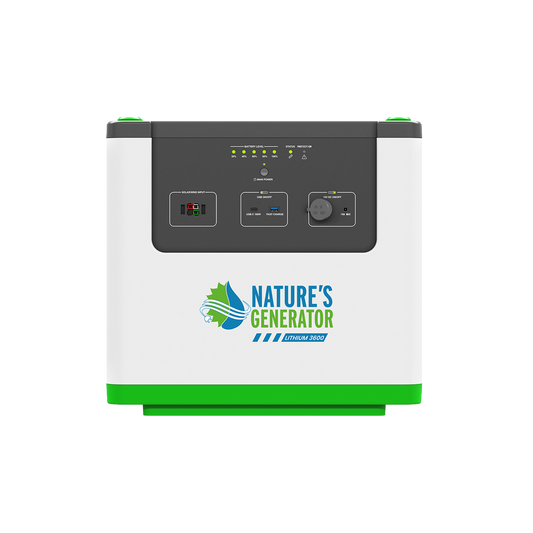
Nature’s Generator’s L3600 provides 3,600W of continuous output, 7,200W of peak output, and 3,072Wh of LiFePO₄ battery storage. It uses 120V single-phase output and can be expanded with additional battery storage.
That makes it worth considering for lighter workshop setups such as:
-
LED lighting
-
Battery chargers
-
Laptops and electronics
-
Small power tools
-
Selected workshop equipment used one at a time
It may not be the best match for a workshop that regularly runs several large motor loads simultaneously.
When should you choose a 7,200W system for a workshop?
A larger system makes more sense when your workshop regularly uses several high-power loads or needs 240V capability.
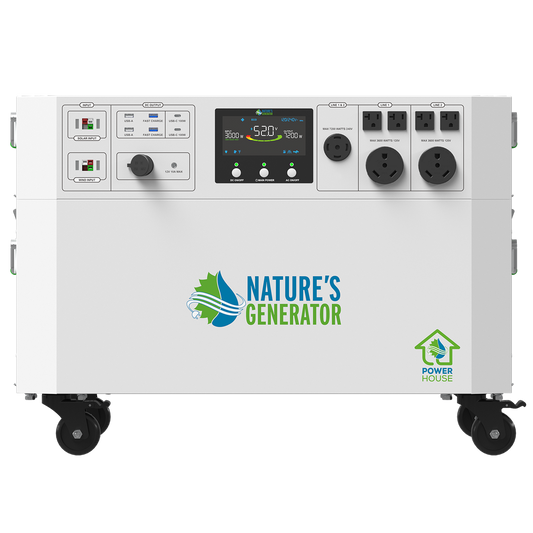
The Nature’s Generator Powerhouse Gen 2 provides up to 7,200W of output, 120/240V split-phase power, and a 4,800Wh battery. It can also be expanded with additional Power Pods for more stored energy.
For a workshop, this extra output can give you more flexibility when using equipment such as compressors, larger power tools, and other demanding loads.
The important distinction is that 7,200W of output does not mean the system will run a 7,000W workshop load for many hours. The battery capacity is 4,800Wh, so a heavy load can use that stored energy quickly.
Think of it this way:
Output answers: Can the system run my tools?
Battery capacity answers: How long can it run them?
When does a 10,000W system make sense for a workshop?
A 10,000W system is worth considering when the workshop has high starting loads, several large tools, or when you want one backup system to support both the workshop and important household circuits.
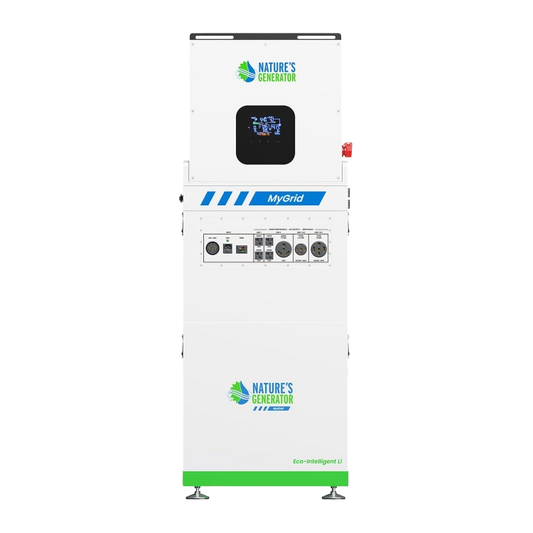
The Nature’s Generator MyGrid 10K Gen 2 provides 10,000W of continuous output, 20,000W of peak output, 10,496Wh of LiFePO₄ storage, and 120/240V split-phase output. Its battery capacity can also be expanded as energy needs increase.
For example, a home-based workshop might need power for a compressor and shop vacuum while the household still needs a refrigerator, internet equipment, lights, or other essential loads.
In that situation, a larger system may be more practical than trying to manage several small generators.
However, even a 10,000W system has limits. One recent MyGrid 10K customer said the system could not run both air conditioners and all critical household loads simultaneously. Nature’s Generator responded that the actual load depends on the appliances being powered and noted that the system can be expanded for higher capacity.
The same lesson applies to a workshop: do not size a system based on the generator's advertised number alone. Match it to your actual loads.
What should you check before buying workshop backup power?
Before choosing a system, write down your actual equipment and check five things:
1. Running watts
How much power does the tool use while operating?
2. Starting watts
Does the tool require a temporary surge when starting?
3. Total simultaneous load
Which tools might be running at the same time?
4. Energy use
How many hours will each load run?
5. Voltage
Does the equipment require 120V or 240V?
This last point is easy to overlook. A generator may have enough wattage but still not be suitable for equipment that requires a different voltage configuration.
Also think about how the system will connect to your workshop. Portable equipment may simply plug into the generator, while a system connected to selected circuits through a transfer switch requires proper electrical planning and installation.
What is a practical backup power setup for a small workshop?
Consider a small woodworking shop that normally works during business hours.
The owner needs lights, battery chargers, a computer, a shop vacuum, and a compressor. Instead of running everything continuously, they use the compressor only when needed and turn off other large loads when using a saw.
Their estimated maximum running load is around 4,000W, with a higher startup demand.
Their daily energy use is around 5kWh.
A system in the 3,600W class could work only if the owner manages the loads carefully. A 7,200W system provides more room for simultaneous loads and 120/240V capability. A 10,000W system becomes more attractive when the workshop is part of a larger home backup plan or has consistently demanding equipment.
This is the decision process we recommend: calculate first, then choose the product.
How to choose the right workshop backup system
To calculate backup power for a small workshop, start with the tools you actually plan to use during an outage. Add their running watts, check startup requirements, and calculate watt-hours based on your expected usage time.
Then compare those numbers with a generator's continuous output, peak output, battery capacity, voltage, and expansion options.
Nature’s Generator offers systems that can cover smaller workshop loads as well as larger setups that need more output and battery storage.
The right choice is not simply the biggest system you can afford. It is the one that can start and run your important tools, provide enough energy for your planned work period, and leave enough room for real-world changes in your power demand.
With the right calculation, you can avoid buying too little power—or paying for capacity you will rarely use.


