


A power outage does not have to last long to cause problems. Even a brief interruption can restart a computer, disconnect your Wi-Fi, interrupt a security system, or shut down sensitive electronics.
That is why choosing reliable backup power, a solar power generator, a whole home power generator, or portable backup power is about more than battery capacity. Switchover speed also matters.
In this guide, we’ll explain what a 10ms UPS switchover means, whether you really need that speed, how solar generators connect to a home, and what to consider when choosing the Nature’s Generator MyGrid 10K.
What does 10ms UPS switchover time mean?
A 10ms UPS switchover means the system can transfer power in about 10 milliseconds, or 0.01 seconds.
When the grid fails, the backup system detects the outage and moves the connected load to battery power. The shorter that gap is, the less likely connected electronics are to experience a noticeable interruption.
The process is simple:
Grid power → outage detected → backup power takes over → equipment continues running
Not every device reacts to a brief power interruption in the same way. Some equipment can handle a short gap, while other electronics may shut down or restart.
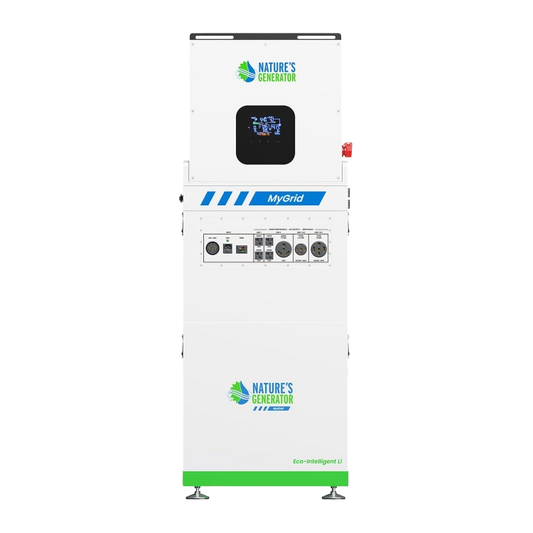
The MyGrid 10K Gen 2 lists an automatic switching time of less than 20ms. Nature’s Generator says its system can provide backup power to connected AC devices within 20ms when utility power suddenly fails.
The key point: faster switching can reduce interruptions, but it does not guarantee that every device will stay on.
Is 10ms fast enough for computers and sensitive electronics?
For many devices, a sub-20ms transfer may be fast enough. However, the exact requirement depends on the equipment.
A home office might include a desktop computer, two monitors, a router, modem, and external drives. Even a short interruption can disconnect a video call or cause a computer to restart.
Before buying a backup system, check the power requirements of your most sensitive devices. Nature’s Generator specifically recommends checking the required switching time of individual equipment.
For equipment that requires uninterrupted power, a dedicated UPS may still be appropriate.
So, do you need exactly 10ms? Not necessarily. What matters is whether the backup system's transfer time meets the requirements of the equipment you need to protect.
How fast does the MyGrid 10K switch during an outage?
As previously mentioned, the MyGrid 10K Gen 2 features sub-20ms automatic switching. This allows the system to quickly move connected loads to backup power when utility power fails.
It is also designed for much larger loads than a typical desktop UPS.
Key specifications include:
These features make the MyGrid 10K more than a backup battery for a single computer. It is designed for larger home backup applications.
Learn more about the MyGrid 10K Whole Home Generator.
How do you connect a solar generator to a whole home?
A whole-home battery backup system typically connects to the home's electrical system through a transfer switch.
The transfer switch manages the connection between utility power and the backup system. Nature’s Generator offers automatic transfer switch options for the MyGrid 10K that can move selected home circuits between the grid and backup power during an outage.
The sequence looks like this:
Normal operation: Your home runs on utility power.
Power outage: The system detects the loss of grid power.
Transfer: The selected circuits move to the MyGrid 10K.
Backup: The battery supplies power to those circuits.
Power returns: The system transfers the circuits back to utility power.
This setup removes the need to manually move appliances to extension cords or separate backup outlets.
Electrical connections should be installed according to the manufacturer's instructions and applicable electrical requirements, with a qualified electrician used where necessary.
Which electronics benefit most from fast backup switching?
Fast switching is most useful for devices that are important or sensitive to power interruptions.
Computers and workstations
A computer may restart and cause you to lose unsaved work. For remote workers, that can mean a dropped meeting or interrupted task.
Routers and modems
Networking equipment uses relatively little power, but keeping it online can be very useful during an outage.
Security equipment
Cameras, alarms, access systems, and network video recorders can continue operating when backup power is available.
Smart-home and home office equipment
Monitors, printers, smart-home hubs, and network storage can also benefit from a quick transfer.
Refrigerators and essential appliances
The MyGrid 10K's 10,000W continuous output allows it to support larger household loads, although actual performance depends on the total load and startup requirements.
Fast switching helps, but the system must also have enough power to carry your loads.
How is the MyGrid 10K different from a small UPS?
A small UPS is generally designed to protect a few electronics. A whole-home battery system is built for much larger loads.
The two approaches can also work together. A whole-home battery can power the house, while a dedicated UPS provides extra protection for equipment with very strict power requirements.
Can the MyGrid 10K recharge during an outage?
Yes. Nature’s Generator states that the MyGrid 10K can power connected devices while it is being recharged. It supports solar and AC charging, among other charging methods.
The system supports up to 12,000W of solar charging input.
This can be especially useful during longer outages.
For example, solar panels can recharge the battery during the day while essential circuits remain powered. At night, stored energy can continue supplying those loads until solar production starts again.
For households dealing with extended outages, recharge capability can be just as important as initial battery capacity.
What should you check before buying a fast-switching solar generator?
Start with four questions.
1. Which devices need backup power?
List your essential equipment, such as your refrigerator, router, computer, security system, lights, or medical equipment.
2. How much power do they use?
Add the running wattage of the devices you expect to use at the same time.
3. How much transfer time can they handle?
Check your equipment's specifications to see how much interruption it can tolerate.
4. How long do you need backup power?
Battery capacity determines how much energy you can store, while your actual load determines how quickly you use it.
For example, a home powering a router, refrigerator, lights, and laptop will use much less energy than one running air conditioning, pumps, cooking appliances, and multiple large electronics.
The MyGrid 10K starts with 10,496Wh of battery capacity and can be expanded up to 73.4kWh.
Is the MyGrid 10K suitable for sensitive electronics and whole-home backup?
It can be a strong fit for homeowners who need more than a small UPS can provide and want automatic backup, solar charging, and substantial battery capacity.
Its less-than-20ms automatic switching, 10,000W continuous output, 10,496Wh battery, and expandable design make it suitable for many whole-home backup scenarios.
The important step is matching the system to your actual needs.
A home office with a few sensitive devices may need a smaller UPS. A home looking to keep essential circuits, appliances, and electronics running during an outage will likely need a much larger backup system.
Does UPS switchover speed matter?
Yes. A fast transfer can reduce the interruption between grid power and backup power, which is important for computers, routers, security systems, and other sensitive electronics.
Before buying, check three things: your equipment's transfer requirements, your total running and startup loads, and the amount of backup time you need.
Nature’s Generator offers the MyGrid 10K as a whole-home backup option for homeowners who want battery storage, solar charging, and automatic transfer in one system.


