


A hybrid microgrid lets you use more than one renewable energy source to keep your battery charged. By combining solar panels and a wind turbine, you can create reliable backup power that works across more weather conditions and times of day. A solar power generator can collect energy during daylight, while wind can add power when the air is moving. Together, they can support a whole home power generator setup or provide portable backup power for essential devices.
In this guide, we’ll answer the questions homeowners ask before building a hybrid system: Can solar and wind charge the same battery? How should they be wired? How much battery storage do you need? When does wind actually make sense? And when is an integrated system easier than building everything from scratch?
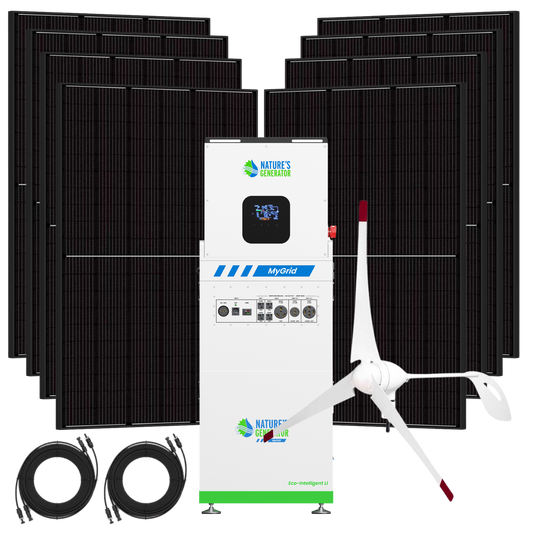
Can solar panels and a wind turbine charge the same battery?
Yes. Solar panels and a wind turbine can charge the same battery bank when the system is built to handle both inputs.
The important part is how those sources connect to the battery.
Solar panels normally run through a solar charge controller. Wind turbines need their own compatible controller because their electrical output behaves differently from solar. You should not simply connect the raw output of both sources together and send it straight to the battery.
A typical hybrid setup looks like this:
Solar panels → solar charge controller → battery
Wind turbine → wind controller → battery
Battery → inverter → appliances
The battery acts as the energy hub. Solar and wind charge it through their proper control systems, and the inverter turns stored DC power into the AC power used by many household appliances.
For DIY projects, this is one of the most important rules to remember: the two renewable sources can share a battery, but they should not be treated as the same type of input.
For homeowners who want less wiring and fewer compatibility questions, an integrated system can be easier. Nature’s Generator systems are built around a battery-based power station with dedicated charging options, which can simplify a solar-and-wind setup.
How do you wire solar and wind to one battery safely?
The safest approach is to use a system designed to accept both charging sources rather than trying to combine them yourself.
For example, Nature’s Generator systems with dedicated solar and wind inputs allow each source to use the charging pathway it was designed for. This means you do not have to build a custom battery-charging setup from separate controllers unless your project specifically requires one.
When planning a DIY hybrid system, check these specifications before connecting anything:
-
Maximum solar input voltage
-
Maximum solar charging current
-
Maximum wind input
-
Battery voltage
-
Battery chemistry
-
Charge-controller requirements
-
Cable size and cable length
-
Fuse and disconnect requirements
-
Grounding requirements
These details matter because exceeding an input limit can damage the equipment.
The same rule applies to the battery. A larger battery does not automatically mean you can send unlimited charging power into it. The battery management system, charge controller, and generator must all support the charging current.
For permanent home installations, especially systems connected to a breaker panel, follow local electrical requirements and use a qualified electrician where required.
How much battery storage do you need for a solar-and-wind system?
Your battery should be sized around how much electricity you need during an outage, not simply how many watts your solar panels or turbine can produce.
First, make a list of the appliances you need to power.
Use this basic calculation:
Watts × hours of use = watt-hours
For example:
That gives you about 2.5kWh of daily energy use before accounting for inverter losses, battery limits, startup loads, and extra backup capacity.
For a short outage, you may only need enough storage to get through the night.
For a multi-day outage, you need more battery capacity because solar and wind production can change from day to day.
This is where expandable battery systems become useful. Rather than buying a huge battery on day one, you can start with the capacity you need and add storage later when your backup requirements grow.
Nature’s Generator offers expandable systems designed for this type of setup, including battery expansion options for compatible models.
Is solar or wind better for charging a home battery?
For most homes, solar should be the main charging source, while wind works best as a supplement.
Solar tends to be easier to plan around. You can estimate production using panel size, sun exposure, season, shading, and location.
Wind is much more dependent on the property itself.
A turbine rated at 150W, for example, does not produce 150W all day. Its output changes with wind speed. The published rating represents performance under specific wind conditions, not constant production.
That means a wind turbine can work very well in one location and provide disappointing results in another.
A good wind site usually has open exposure and regular wind. A backyard surrounded by tall buildings, trees, or other obstacles may produce turbulent airflow that reduces useful generation.
Before buying a turbine, ask a simple question:
Does my property actually have enough usable wind to make the turbine worthwhile?
If the answer is uncertain, put more of your budget into solar and battery storage first.
Why combine solar and wind instead of using solar alone?
The biggest reason is availability.
Solar only produces meaningful power when sunlight is available. Wind can produce energy at other times, including some periods when solar output is low.
Consider these examples:
Sunny afternoon: Solar does most of the charging.
Cloudy, windy afternoon: Solar output falls, but wind can continue producing power.
Clear, calm night: Neither source may contribute much.
Windy night: The turbine may continue charging while the solar panels are inactive.
This does not mean wind will always solve a charging problem. It means you have another possible source of renewable energy.
That can be useful during long outages, especially when weather conditions change over several days.
How do you connect a wind turbine to a solar generator?
Do not assume a wind turbine can plug into any solar input.
A wind turbine should connect to a dedicated wind input or a compatible wind charge controller unless the manufacturer specifically says otherwise.
A typical setup is:
Wind turbine → wind controller → battery charging input
The controller helps manage the turbine's variable output and protects the charging system.
Cable length is another detail that is easy to overlook. A turbine installed far from the battery or generator may require a longer cable run, which can increase voltage drop. The cable should therefore be sized for the distance and expected current.
The turbine installation itself also matters. The tower or mounting point needs to be suitable for the wind conditions and the mechanical loads created by the turbine.
In other words, a wind system is not just an electrical project. It is also a structural installation.
Can solar and wind charge the battery at the same time?
Yes, a properly designed hybrid system can accept solar and wind charging at the same time.
This is one of the main advantages of combining the two.
For example, imagine your battery is being charged during the day. The solar panels provide most of the energy, while a moderate breeze adds energy from the turbine.
The battery does not need to choose between the two sources. The charging system simply manages the incoming power within its operating limits.
The real benefit is not necessarily maximum charging speed. It is more opportunities to collect energy.
Solar gives you a strong daytime source.
Wind can provide additional generation when conditions allow.
Battery storage ties the two together.
That combination can make more sense than trying to make either source handle every part of your backup plan.
Where does a hybrid solar-and-wind system work best?
A hybrid setup makes the most sense where both renewable resources are available.
Rural homes
Rural properties often have fewer obstructions, which can improve both solar exposure and wind availability. A hybrid system can be especially useful for homes that experience grid outages and want to reduce dependence on fuel generators.
Cabins and off-grid properties
A cabin may have good sunlight during the day but useful wind after sunset. Having two charging sources gives the battery more ways to recover energy.
Farms and remote properties
A hybrid system can help support refrigerators, lights, communications equipment, pumps, security systems, and other essential equipment during outages.
Emergency backup
During a prolonged outage, renewable charging can help replenish the battery without constantly refueling a gas-powered generator.
Customer feedback on Nature’s Generator systems also shows that users have put solar and wind setups to work on farms and other remote properties. Some customers have highlighted easy setup and useful runtime for essential loads, while other feedback shows that wind performance can vary significantly depending on location and weather.
That mix of feedback is worth paying attention to: the quality of the wind resource matters just as much as the turbine's rated wattage.
Should you build a custom hybrid microgrid or buy an integrated system?
A custom system gives you more control, but it also gives you more decisions to make.
A fully DIY setup may require you to choose:
-
Solar panels
-
Solar charge controller
-
Wind turbine
-
Wind controller
-
Battery bank
-
Inverter
-
Fuses and disconnects
-
Cables and connectors
-
Grounding equipment
-
Transfer equipment
You also need to make sure every component works with the others.
That flexibility can be worthwhile for experienced DIY users or specialized off-grid projects.
For homeowners who mainly want dependable backup power, an integrated battery generator may be the simpler choice.
Nature’s Generator products are built to combine battery storage with renewable charging options, reducing the number of separate components you have to match yourself.
The right choice depends on your goal.
Choose a custom system when you need specialized equipment or want complete control over every component.
Choose an integrated system when you want easier setup, fewer compatibility issues, and a clearer path to expanding your backup system.
What mistakes should you avoid when wiring solar and wind together?
Avoid the most common mistakes by checking compatibility before connecting anything.
Do not connect a wind turbine to a solar input unless the manufacturer specifically allows it.
Do not exceed the input limits of your charge controller or generator.
Do not size the battery based only on panel wattage. Start with your actual energy use.
Do not assume a turbine's rated output is constant. Wind generation changes continuously.
Do not ignore cable length. Long runs can cause voltage drop.
Do not forget startup power. Refrigerators, pumps, air conditioners, and other motors can draw more power when they start than they use during normal operation.
Do not connect a backup generator directly to household wiring without the correct transfer equipment and installation method. Improper connections can create dangerous backfeed conditions.
Good hybrid systems are built around compatibility, realistic energy estimates, and safe installation—not simply adding as many renewable sources as possible.
How do you choose the right solar-and-wind backup system?
Start with four questions.
1. How much power do I need?
List the appliances you want to keep running and calculate their energy use.
2. How long should the battery last?
Decide whether you need overnight backup, one full day, or several days.
3. How much solar do I have?
Check roof space, shading, orientation, and available sunlight.
4. Do I have useful wind?
Look at your property's actual wind conditions rather than relying only on general regional wind data.
From there, decide whether you need more battery storage, more solar generation, wind charging, or a combination of all three.
For example, a suburban homeowner with excellent sunlight but little wind may get better value from additional solar panels and battery storage.
A rural homeowner with strong year-round wind may benefit from adding a turbine to the solar setup.
Someone preparing for long outages may place the highest priority on battery capacity because generation can vary from one day to the next.
Is a solar-and-wind battery system worth it?
A solar-and-wind hybrid microgrid can be a practical way to make backup power more flexible. Solar provides predictable daytime charging, while wind can add another source when conditions are right. Both can feed the same battery when the system is designed with the correct charging equipment.
For most homeowners, the best approach is to start with actual energy needs, choose enough battery storage for the outage you expect, and then size solar and wind around the resources available at the property.
Nature’s Generator offers an easier path for homeowners who want solar, wind, and battery storage working together without having to design every component from scratch. For many backup-power projects, that balance of simplicity, expandability, and renewable charging can be more useful than building a complicated system from the ground up.


