


When the power goes out, running central heat or air conditioning from a battery backup takes more than matching the AC's advertised wattage to a generator. Your backup system needs enough power to keep the HVAC running and enough surge power to start the compressor.
A reliable backup power system needs to handle both demands. A solar power generator or whole home power generator may be able to support major appliances, while portable backup power can handle smaller essential loads.
In this guide, we'll explain what LRA means, how it differs from running watts, how to estimate HVAC startup demand, and what to look for when choosing an inverter for central heating or AC.
What is LRA on a central air conditioner?
LRA stands for Locked Rotor Amps. It describes the current a compressor can draw when it is energized but the motor has not started turning.
In simple terms, LRA helps show how much electricity a compressor may need during startup.
That's important because an air conditioner can use far more power for a few seconds when the compressor starts than it uses during normal operation.
For example, an AC unit might have:
-
Running current: 12A
-
LRA: 45A
-
Voltage: 240V
The 12A figure is much closer to the system's normal operating demand. The 45A LRA shows the potential startup current.
This is why an inverter may run an AC normally but shut down when the compressor cycles back on.
The simple takeaway: Running amps tell you what the system needs while operating. LRA helps you understand its potential startup demand.
How do I convert LRA into watts?
The basic electrical formula is:
Watts = Volts × Amps
So, if a compressor has an LRA of 45A at 240V:
45 × 240 = 10,800W
This gives you a theoretical watt equivalent for the locked-rotor current.
However, don't assume that 10,800W is the exact amount of startup power your inverter will always need.
LRA is a compressor rating, not a direct measurement of every real-world startup. Actual demand can vary depending on the compressor, controls, voltage and operating conditions.
Use LRA as an important sizing reference, but also check the HVAC manufacturer's specifications and the inverter's peak-output rating.
How do running watts and startup watts differ?
Running watts are the power an appliance typically draws during everyday use.
Starting watts, also called surge or peak watts, are the extra power needed for a short period when a motor or compressor starts.
A central AC generally works like this:
Compressor off → compressor starts → startup surge → compressor reaches operating speed → normal running power
Once the compressor is up to speed, the electrical demand normally drops.
This creates two separate requirements for your backup system:
Continuous output: Enough power to run the HVAC and everything else you need.
Peak output: Enough short-term power to start the compressor.
Nature's Generator also separates continuous and peak wattage in its whole-home backup guidance because motor-driven appliances can require much more power during startup than while running normally.
How do I calculate the inverter size for central AC?
Start with the HVAC's running load, then add your other appliances and account for compressor startup.
Step 1: Calculate the AC's running watts
If the AC uses 12A at 240V:
12 × 240 = 2,880W
This puts the estimated running load at around 2,880W.
Step 2: Check the compressor's LRA
If the compressor has an LRA of 45A:
45 × 240 = 10,800W
Again, this is a theoretical locked-rotor calculation, not necessarily the exact startup wattage.
Step 3: Add other loads
Your AC probably won't be the only appliance running during an outage.
For example:
Your inverter therefore needs to supply around 3,780W continuously in this example, while also having enough peak capacity for the compressor's startup.
This is one of the most common sizing mistakes: calculating the AC by itself rather than looking at the total household load.
Can a 5,000W inverter run central AC?
It depends on the HVAC system and what else you are running.
A 5,000W inverter could potentially run an AC that needs around 2,000–3,000W once operating. The bigger concern is whether it has enough peak output to start the compressor while other appliances are already using power.
For example, imagine:
-
AC running: 2,880W
-
Refrigerator: 300W
-
Lights and electronics: 500W
-
Other loads: 300W
You're already at roughly 3,980W.
If the compressor cycles off and then starts again while those loads are active, there may not be enough headroom.
That's why you should compare the HVAC's running demand and startup requirements against both the inverter's continuous and peak ratings.
Does central HVAC need 240V backup power?
Often, yes.
Many central air conditioners and heat pumps use 240V circuits. A smaller power station that only provides 120V output may therefore not be suitable for connecting directly to the HVAC circuit.
This is where 120/240V split-phase output matters.
The Nature's Generator Powerhouse Gen 2 is rated for 7,200W of continuous output and 14,400W of peak output, with 120/240V split-phase capability.
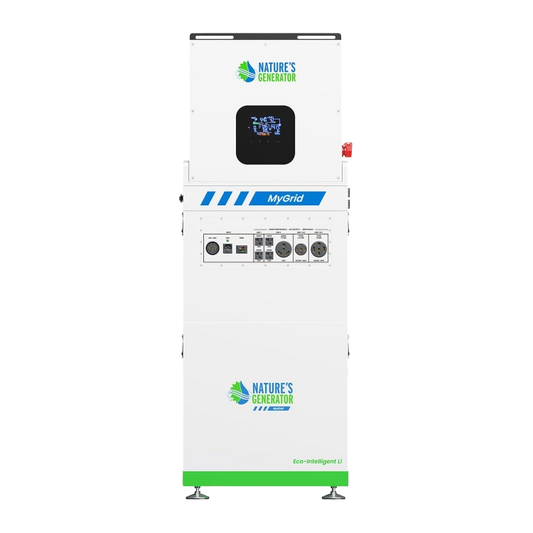
The MyGrid 10K provides 10,000W continuous output and 20,000W peak output, also with 120/240V split-phase power.
When comparing systems for central HVAC, voltage and peak output can be just as important as battery capacity.
Does central heating need the same amount of power?
Not necessarily. It really depends on what type of heating system you have.
Gas furnace
A gas furnace typically uses electricity for its controls and blower. Its electrical demand can be much lower than that of electric heat.
If your home has gas heat and central AC, the AC compressor may be your main startup concern.
Heat pump
A heat pump uses a compressor for both heating and cooling.
That means startup demand matters in both seasons.
Electric resistance heat
Electric resistance heating can require a lot of continuous power.
In this case, the bigger issue may be the amount of power needed to keep the heating elements running rather than compressor startup.
Always identify your exact HVAC type before sizing your backup system.
Can a soft starter reduce AC startup demand?
Yes. A soft starter can reduce the current needed when an AC compressor starts.
Instead of allowing the compressor to demand a large amount of current immediately, the soft starter controls the startup more gradually.
That can lower the peak demand seen by the inverter and may make an HVAC backup setup easier to manage.
However, a soft starter doesn't remove the need for proper sizing.
You still need to check:
-
HVAC running watts
-
Compressor LRA
-
Inverter continuous output
-
Inverter peak output
-
Other loads
-
Voltage requirements
For a permanent central HVAC installation, have a qualified electrician confirm the setup and transfer-switch configuration.
What happens when an inverter is too small for central AC?
The most common problem is an overload.
The AC tries to start, but the inverter cannot provide enough short-term power. The inverter may then shut off its AC output or show an overload warning.
You may notice:
-
The compressor fails to start
-
The inverter trips
-
The system repeatedly tries to restart
-
Smaller appliances work while the AC does not
-
Other devices temporarily lose power
That’s why it’s a good idea to have some extra power available. You don't want the inverter operating at its limit every time the compressor starts.
How much backup power will I need when the power goes out?
Let's look at a typical example.
Suppose your home has:
-
Central AC: 2,500W
-
Refrigerator: 300W
-
Lights: 200W
-
Internet equipment: 50W
-
TV: 150W
-
Microwave: 1,200W when used
Your normal running load is around 3,200W.
When the microwave is running, that increases to about 4,400W.
Now imagine the AC compressor starts while those appliances are active. Your backup system needs enough continuous capacity for the combined load and enough peak capacity for the compressor.
This example also shows why battery capacity and inverter output are different things.
A bigger battery means more stored energy and can keep things running longer.
A bigger inverter means you can run more power-hungry appliances at the same time.
For central HVAC, you need to consider both.
Is the Nature's Generator Powerhouse enough for central AC?
The Powerhouse Gen 2 is designed for larger home loads, including air conditioning, as long as the total electrical demand stays within its limits.
It can therefore be a potential option for homes where central HVAC is included in a properly calculated essential-load setup.
The system can also be expanded by connecting additional Power Pods for higher output.
When should I consider the MyGrid 10K?
The MyGrid 10K offers 10,000W continuous output and 20,000W peak output, plus 120/240V split-phase power. It has a 10,496Wh LiFePO4 battery, and you can add more battery capacity if needed.
That can come in handy if your central HVAC is running along with other high-power appliances.
For example, a larger home might need to run:
Central AC + refrigerator + lights + Wi-Fi + kitchen appliances + other essential circuits
during an outage.
What should I check before buying an inverter for central HVAC?
Before buying, collect these numbers from your HVAC equipment:
Voltage: Confirm whether the system requires 240V.
Running amps or watts: This shows normal operating demand.
LRA: This helps you understand potential compressor startup current.
Other household loads: Add everything you expect to run during an outage.
Continuous inverter output: Make sure it handles the combined running load.
Peak inverter output: Make sure it can handle startup demand.
Also confirm how the backup system will connect to your electrical panel and whether you need a transfer switch.
Don't rely on average AC wattage alone. Your actual nameplate data is far more useful for choosing the right system.
What is the simplest way to understand LRA vs. running watts?
Here's the easiest way to remember the difference:
Running watts = what the AC needs while operating.
LRA = the compressor's locked-rotor current rating and a key indicator of startup demand.
Peak inverter watts = how much short-term power the inverter can provide.
For central HVAC, you need all three pieces of information.
A system with enough running power but not enough peak power may fail when the compressor starts. A system with plenty of peak power but a small battery may start the AC but run out of stored energy sooner. And a system without 240V capability may not work with a typical central HVAC circuit.
Making the right backup power choice
Sizing backup power for central heat and AC is about more than matching one wattage number. Check the HVAC's running watts, find its LRA, confirm the required voltage, and add the appliances you expect to use during an outage.
The basic idea is:
Total running load + HVAC startup demand + inverter headroom
For homes with central HVAC, look for the right combination of continuous output, peak output, battery capacity and 120/240V capability.
Nature's Generator offers systems such as the Powerhouse and MyGrid 10K with substantial output and 120/240V capability for larger backup loads.
The best starting point is your home's actual electrical data. Check the nameplate, do the math, and choose a backup system around the loads you genuinely need to keep running when the grid goes down.


