


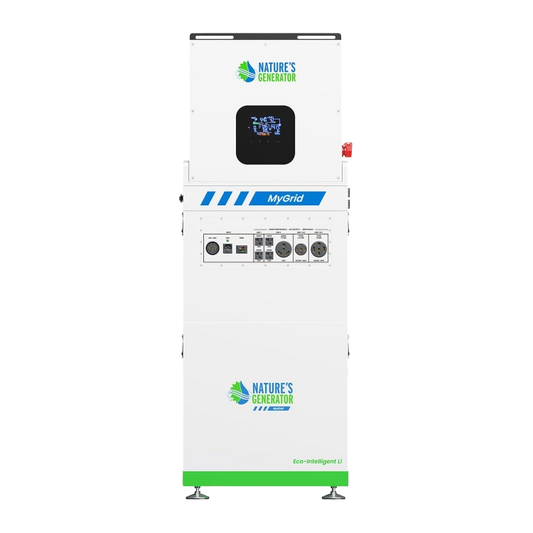
When choosing an emergency backup solution, homeowners prioritize continuous reliability, longevity, and scalable storage. Our team has spent years reviewing advanced energy options, and based on our experience, having a whole home power generator that can adapt to changing conditions is the MyGrid 10K Whole Home Generatortrue standard of grid independence. The Nature’s Generator MyGrid 10K delivers an incredible foundation for modern energy needs, operating as a top-tier solar power generator that provides clean, silent, and reliable backup power. However, what happens when your backup demands grow due to prolonged utility blackouts, seasonal storms, or an increasing number of household electrical loads?
This comprehensive guide will explicitly answer how to safely expand the capacity of your MyGrid 10K to secure a truly resilient, scalable portable backup power architecture. We will cover the specific technical steps, safety precautions, hardware options, and calculation methods needed to increase your energy storage without compromising the system.
Why should you consider expanding your system storage?
Before adding physical hardware to an energy platform, it helps to understand how your real-world usage scenarios dictate your system parameters. Out of the box, the base unit comes equipped with a highly robust 10,496 Wh (10.5 kWh) Lithium Iron Phosphate (LiFePO₄) battery pack paired with a massive 10,000W continuous pure sine wave inverter. For many standard residential properties, this configuration comfortably carries critical loads through a multi-hour outage.
Customer feedback indicates that expanding system capacity moves a home from simple short-term triage to true long-term operational survival during extended utility failures. Based on our experience, properties that experience frequent severe weather events, or homeowners running high-draw appliances like central air conditioning, well pumps, or electric vehicle chargers, rapidly realize the immense value of scalable battery capacity. Expanding your reserve ensures you can run heavy loads simultaneously without facing the anxiety of a depleted system before the sun rises the next morning.
What hardware is needed to increase the capacity safely?
Safely multiplying your total available watt-hours requires components designed precisely for this specific power architecture. To increase storage, our team recommends integrating the MyGrid Solar Battery.
This purpose-built expansion chassis adds another matching 10,496 Wh of premium LiFePO₄ chemistry to your setup. Because these modular additions utilize the exact same structural voltage architecture (51.2V, 205Ah) as the core unit, they integrate smoothly without causing voltage mismatches or dangerous cell imbalances.
The expansion process utilizes high-gauge heavy-duty battery terminals and proprietary communication ports located directly on the unit panel. This interface links the internal microprocessors, allowing the main unit to read the combined state of charge and manage optimal energy distributions.
How does the integration of a modular battery impact safety?
When working with large-scale residential power storage, safety remains the highest priority. One of the principal benefits of utilizing the official expansion battery is the native integration with the core system's Battery Management System (BMS).
The integrated BMS continuously observes individual cell strings for metrics such as:
-
Over-voltage protection
-
Under-voltage cutoffs
-
Thermal regulation during intensive charging cycles
-
Current bottlenecks
Because the expansion unit communicates directly with the primary inverter, the overall system slows or accelerates charging inputs dynamically based on real-time thermal profiles. This keeps the lithium iron phosphate cells operating within their optimal temperature windows of 32°F to 113°F for charging, and 14°F to 113°F for discharging. Trying to adapt generic, third-party off-the-shelf batteries without matching smart communication protocols circumvents these safeguards, risking irreversible cell degradation or total system failure.
What are the step-by-step instructions for physical connection?
When our team assists with system setups, we emphasize a methodical approach to installation. Since this platform features an installer-friendly, plug-and-play profile that avoids invasive residential construction or deep trenching, you can execute the scaling process cleanly by following these specific deployment steps:
Step 1: Power Down and Disconnect
Ensure that the main unit is completely powered off. Shut off all active output circuits and disconnect any active charging sources, including rigid solar panels, wind turbines, or AC wall charger plugs.
Step 2: Position the Units Strategically
Place the expansion battery adjacent to the primary generator. Choose a clean, dry, climate-controlled or well-ventilated area that maintains an optimal operating temperature range between 68°F and 86°F. Avoid damp basements or tight, unventilated enclosures.
Step 3: Attach the Heavy-Duty Expansion Cables
Locate the dedicated battery terminals on both units. Using the official high-gauge expansion cable kit provided with your expansion battery, connect the corresponding positive (+) and negative (-) terminals firmly. Check that all terminal nuts are tightened securely to prevent electrical resistance, which can cause localized heat buildup.
Step 4: Link the Communication Interfaces
Connect the data cable into the matching communication ports of both enclosures. This link allows the main unit to accurately read and manage the auxiliary system's state of charge.
Step 5: Power Up and Verify System Status
Turn on the primary system. Observe the main generator LCD display panel. The onboard monitoring system will automatically detect the expanded battery framework, adjusting the total calculated capacity available across the combined system network.
How high can you scale the storage and output?
One of the standout features of this generation of backup hardware is its high ceiling for total capacity growth. Depending on your home's unique footprint and off-grid goals, your capacity options scale across several configurations:
|
System Setup Configuration |
Continuous Output Power |
Total Stored Energy Capacity |
|
Base Main Unit Only |
10,000 Watts |
10,496 Watt-Hours |
|
Main Unit + 1 Expansion Battery |
10,000 Watts |
20,992 Watt-Hours |
|
Fully Expanded Single Unit System |
10,000 Watts |
Up to 73,742 Watt-Hours |
|
Dual Linked Inverter System |
20,000 Watts |
Multiplied Base Storage Capacity |
If your household electrical panels contain heavy 240V dual-phase demands—such as multi-ton heat pumps or complex workshop machinery—you can link two separate main generator units together. This configuration doubles your continuous output capacity to a massive 20,000W while simultaneously aggregating your baseline battery banks. This modular architecture allows the system to easily grow along with your home's energy footprint.
What are the optimal charging methods for expanded battery banks?
Adding more storage capacity means you also have a larger battery bank to recharge. If you rely solely on a standard 120V AC wall outlet, recharging a heavily expanded system can become a slow process. To maximize your system's utility, it helps to take advantage of its versatile, multi-input charging architecture:
-
High-Input Solar Charging: The system includes a built-in Maximum Power Point Tracking (MPPT) solar charger that handles up to a massive 12,000W input array (operating between 120Vdc and 550Vdc). This lets you connect multiple high-efficiency rigid solar panels to capture enough clean energy to replenish your expanded battery bank quickly.
-
Hybrid Wind Integration: For properties experiencing seasonal storms or dark, overcast days, you can supplement your solar array by connecting a 350W wind turbine. This hybrid approach charges your system day or night, rain or shine.
-
Super Charging via Fast AC Inputs: When utility power is active or if you utilize an external generator, the system supports high-amperage 208Vac or 240Vac charging at up to 4,500W. This advanced input capability can charge the system up to 80% capacity in roughly 2 hours, drastically reducing system downtime.
Real-world scenario: Preparing a rural homestead for winter storms
To see the value of an expanded system in action, consider a real-world scenario involving a family homestead located in a rural area prone to heavy winter ice storms. During typical winter grid failures, downed power lines often take utility crews three to four days to repair.
The homeowners initially used a single base unit to keep their emergency wood-stove blower, kitchen refrigerator, deep freezer, and basic LED lighting circuits active. Realizing that a single long storm could test the limits of a single charge if heavy overcast weather limited solar production, they added a matching expansion battery to their system.
By upgrading their storage capacity to over 20 kWh, the family safely extended their runtime to several consecutive days of continuous use without needing to ration their power usage. They could comfortably use their microwave, keep their internet communication lines active, run their well pump, and even plug in their electric vehicle for short-range top-offs. The expanded battery system provided a reliable safety net, transforming a potentially hazardous utility blackout into a manageable, stress-free event.
Summary of safe management practices for your system
To ensure your expanded system performs reliably over its lifetime, keep these clear maintenance and operation principles in mind:
-
Maintain Clean, Rigid Terminals: Periodically check your physical expansion cables to ensure that all connection points remain clean and tight. Loose connections introduce electrical resistance, which lowers system efficiency and generates unnecessary heat.
-
Avoid Mixing Different Battery Chemistries: Never attempt to chain older sealed lead-acid (AGM) or traditional lithium-ion batteries into this dedicated LiFePO₄ infrastructure. Doing so will cause severe system imbalance and void your product warranty.
-
Execute Regular Cycle Exercises: The premium cells used in this hardware are rated for over 6,000 complete operational charge cycles. For long-term storage health, check the system status regularly and ensure the units receive a top-off charge at least once every six months if left in continuous standby mode.
-
Utilize Smart Scheduling: Take advantage of the system's smart plug scheduling features. If your local utility uses time-of-use pricing, program the system to charge from the grid during cheap, off-peak hours and use your stored energy during expensive peak times to maximize your electricity savings.
Scalable Power for Lasting Security
Expanding the battery capacity of your backup system is a safe, highly effective way to achieve true energy independence and protect your home during extended power outages. By adding a dedicated expansion battery, you smoothly double your available runtime while allowing your system's built-in smart management features to keep your home running safely.
Whether you are preparing for seasonal storms, transitioning a cabin completely off-grid, or looking to lower your monthly utility bills through smart energy management, a scalable solar power generator system provides the security your home needs. Investing in matching, modular components ensures your system can easily scale to meet your growing energy demands for years to come.


