


When building a reliable off-grid or emergency backup solution, the veins of your system—the electrical wiring—are just as critical as the battery or the solar panels themselves. Choosing the correct electrical wire sizing is the difference between a system that runs at peak efficiency and one that poses a significant fire hazard or suffers from massive power loss.
At Nature’s Generator, we believe that empowering our community starts with providing the technical expertise necessary to build safe, high-performance energy ecosystems.
This comprehensive guide will answer exactly how to determine the correct wire gauge for your specific setup, the physics behind voltage drop, and how our team approaches wiring for high-output Nature’s Generator systems. Whether you are connecting a small portable array or wiring a whole-home backup solution, this article provides the technical depth and practical scenarios needed to make an informed decision.
Why Does Electrical Wire Sizing Matter for Your Home Backup System?
The primary reason wire sizing is a non-negotiable factor in electrical design is the relationship between resistance, heat, and safety. Every piece of wire has a specific amount of internal resistance. As electricity flows through the conductor, this resistance converts some of that electrical energy into heat. If the wire is too thin for the amount of current (amperage) passing through it, the heat can build up to the point of melting the insulation, leading to short circuits or electrical fires.
In our experience, many DIY enthusiasts focus heavily on the wattage of their solar panels but overlook the gauge of the cables connecting them to the generator. In a home backup scenario, where you might be pulling thousands of watts to power a refrigerator or a sump pump, the demand on your wiring is intense. Using an undersized wire is essentially like trying to force the water volume of a fire hose through a garden straw; the pressure builds, and the system fails.
Beyond safety, there is the issue of efficiency. Thick wires allow electricity to flow more freely. When you use the correct gauge, you ensure that the maximum amount of energy harvested by your solar panels actually reaches your battery storage. Our team often sees systems underperforming by 10% to 20% simply because the owner used standard extension cords instead of heavy-duty, appropriately gauged solar cables.
How Do You Choose the Correct Wire Gauge for Solar Panels?
Choosing the right wire starts with understanding the American Wire Gauge (AWG) system. In this system, the larger the number, the thinner the wire. For example, a 14-gauge wire is much thinner than a 4-gauge wire. When you are looking at high-quality solar panels, you must calculate the total amperage the panels will produce to select the right AWG.
Understanding the Amperage Load
To find the required gauge, you first need to know the Maximum Power Current (Imp) of your panels. If you have multiple panels wired in parallel, you add the amperage together. For instance, if you have four 100W panels each producing roughly 5.8 amps, your total current is 23.2 amps.
Based on our testing and standard electrical codes, a 10-gauge wire is the best choice for many portable solar setups because it can safely handle up to 30 amps in most conditions. However, as you scale up to professional-grade systems like the Powerhouse V2, which can handle significantly higher inputs, our team recommends moving toward 4-gauge or even 0-gauge wiring for the main battery-to-inverter connections to accommodate the massive surge demands.
Practical Example: The Summer Cabin Setup
Consider a customer who recently contacted us about wiring their off-grid cabin. They were using a Nature’s Generator Elite and wanted to mount their panels 40 feet away on a sunny hillside. Initially, they considered using standard 12-gauge wire. After our team calculated the 40-foot distance and the current load, we advised them to move to an 8-gauge wire. This shift ensured that the voltage didn't drop significantly over that 40-foot run, keeping their charging speeds high even during peak sun hours.
What Is the Impact of Wire Length on Voltage Drop and System Efficiency?
One of the most common mistakes in electrical wire sizing is ignoring the distance between the power source and the load. This is known as voltage drop. Electricity loses "pressure" as it travels over distance due to the resistance of the wire. If the voltage drops too low by the time it reaches your generator, the charge controller may not even recognize that the panels are connected, or the charging rate will slow to a crawl.
The 3% Rule of Thumb
In the renewable energy industry, the gold standard is to keep your voltage drop below 3%. If your panels are outputting 24V, a 3% drop means you are losing about 0.72V just in the wires. While that sounds small, it represents a direct loss of charging power.
To combat this, if you must place your solar panels far from your unit, you have two choices:
-
Increase the Voltage: Wiring your panels in series increases the voltage while keeping the amperage low, which allows for thinner wires over longer distances.
-
Increase the Wire Diameter: If you prefer a parallel setup (which is better for partial shade), you must use a much thicker wire gauge to offset the distance.
Our team frequently uses specialized voltage drop calculators to ensure that every installation maximizes every watt. For a 100-foot run, we might jump from a standard 10 AWG to a 6 AWG or 4 AWG just to maintain that 3% efficiency threshold.
Should You Choose Copper or Aluminum Wire for High-Output Power Stations?
When browsing the hardware store for wiring, you will encounter both copper and aluminum options. While aluminum is lighter and cheaper, our team almost exclusively recommends copper for home backup power systems and solar installations.
Why Copper is Superior for Solar
Copper is a much better conductor than aluminum. This means that for the same amount of current, an aluminum wire must be significantly thicker than a copper one. Copper is also more resilient to "cold flow"—a phenomenon where metal expands and contracts with heat, eventually loosening the connections. In a solar system, where current fluctuates constantly and components heat up during the day, loose connections are a major safety risk.
Real-World Usage Scenario
A customer recently shared feedback regarding a DIY wind turbine project they integrated with their Nature’s Generator system. They initially used aluminum wiring to save on costs for a long run from the turbine tower. Within six months, they noticed the connections at the terminals had begun to oxidize and heat up, causing the system to shut down intermittently. After switching to tinned copper marine-grade wire, the heat issues vanished, and their power consistency improved by 15%.
For the internal connections of our transfer switches, we rely on high-purity copper to ensure that when your home switches to backup power, there is zero bottleneck in the energy delivery.
How Does Our Team Calculate Wire Requirements for the Nature’s Generator Powerhouse?
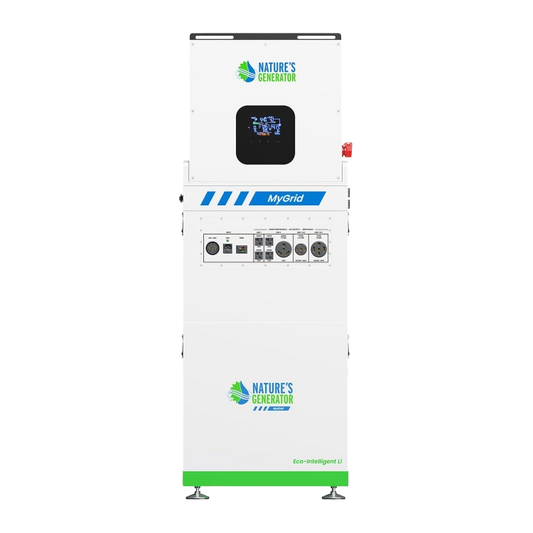
The Nature’s Generator Powerhouse is a heavy-duty system capable of outputting 120V/240V split-phase power. Because it is designed to run large appliances like well pumps and central AC units, the wiring requirements are much more stringent than those of a small portable power station.
Calculating the Inverter-to-Battery Link
The most intense current flow in your system occurs between the battery cells and the inverter. If the Powerhouse is pulling 7,200W of surge power, the DC current from the batteries can exceed 150 amps. For these high-current paths, our team utilizes extremely thick, multi-stranded 00 AWG (2/0) or even 0000 AWG (4/0) cables. These cables are roughly the thickness of a thumb and are designed to handle massive energy transfers without breaking a sweat.
Wiring the Transfer Switch
When connecting the Powerhouse to your home’s existing electrical panel via a Transfer Switch, we follow strict NEC (National Electrical Code) guidelines. Typically, this involves using 10-gauge or 8-gauge copper wire for the individual circuits, depending on whether they are 20-amp or 30-amp breakers. By using the correct gauge during this installation, you ensure that your home backup system feels no different than being on the grid—your lights don't flicker, and your motors run cool.
What Are the Risks of Using Undersized Wiring in a Solar Setup?
The dangers of incorrect electrical wire sizing range from frustrating to catastrophic. Understanding these risks is the best motivation for doing the job right the first time.
-
Component Damage: Low voltage caused by thin wires can cause sensitive electronics and motors to work harder, leading to premature failure of your appliances or even the generator's internal inverter.
-
Thermal Runaway: As resistance creates heat, the wire becomes even more resistant, which creates even more heat. This runaway effect is what leads to melted plastic and fires.
-
Voided Warranties: Many high-end solar components specify minimum wire gauges in their installation manuals. Using undersized wiring can void your warranty because it indicates an unsafe installation environment.
-
Energy Poverty: You might buy a 400W solar panel but only see 250W of actual charging. You aren't losing that power to the clouds; you are losing it to the heat in your wires.
Securing Your Energy Future with Proper Wiring
Mastering electrical wire sizing is one of the most impactful steps you can take toward energy autonomy. By selecting the correct gauge based on amperage and distance, prioritizing copper conductors, and accounting for voltage drop, you ensure your system is safe, efficient, and ready for any emergency.
At Nature’s Generator, we provide the foundation for a more resilient lifestyle. Our team is dedicated to ensuring that every system is supported by the right technical knowledge. When you invest in a home backup solution, remember that the quality of your wires is just as important as the quality of your generator.


