


When the grid goes down, the ability to provide a hot, nutritious meal for your family becomes a top priority. Maintaining a sense of normalcy during a crisis starts in the kitchen, but traditional electric stoves and ovens are notorious energy hogs that can quickly deplete a reliable backup power source. This is where the efficiency of modern pressure cooking meets the sustainability of a solar power generator.
Let us answer exactly how to integrate these technologies, ensuring your whole home power generator strategy includes a robust plan for food preparation.
Emergency meal planning with an instant pot and solar requires an understanding of energy density, appliance wattage, and battery capacity.
This blog will dive into the most critical questions regarding power consumption, system sizing, and strategic meal prep to ensure you never have to rely on cold canned goods during an extended outage.
Can a Solar Power Generator Actually Run an Instant Pot During an Outage?
One of the most common questions our team receives is whether a portable power station can handle the "heavy lift" of a heating appliance. The short answer is yes—but the technical details matter. An Instant Pot is essentially a high-wattage heating element controlled by a microprocessor.
Most standard 6-quart Instant Pots pull between 1,000 and 1,200 watts during the initial "heating" phase. Once the unit reaches pressure, the heating element cycles on and off to maintain that pressure, significantly dropping the average power consumption over the duration of the cook cycle. Based on our experience, a typical 20-minute pressure cooking session (including the 10-minute pressurization time) consumes approximately 150 to 250 Watt-hours (Wh).
To run this safely, your solar generator must have an inverter capable of handling the continuous draw of 1,000+ watts. If your inverter is rated too low—for example, a 500W unit—the Instant Pot will trigger an overload protection circuit, and the system will shut down. This is why we emphasize checking the "Continuous Power" rating of your system before planning your emergency menu.
Which Nature’s Generator System Is Best for High-Wattage Kitchen Appliances?
To successfully execute, you need a system that offers both high output and deep storage. Using a system that is too small will result in "range anxiety," where you fear cooking a second meal because the battery is too low.
Based on our testing and customer feedback, we recommend the following configurations:
-
The Nature’s Generator Elite: This system features a 3600W peak / 2880W continuous inverter. It handles the 1000W-1200W draw of an Instant Pot with ease, leaving plenty of overhead for a refrigerator or LED lighting. You can explore the Nature’s Generator Elite to see how it fits into a modular backup plan.
-
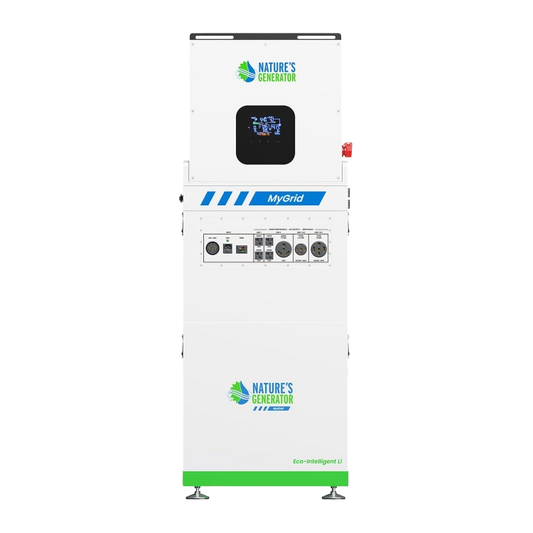
The Nature’s Generator Powerhouse: For those looking for a true whole home power generator experience, the Powerhouse V2 system can deliver 120V or 240V power. This is ideal if you want to run your kitchen through a transfer switch, allowing you to use your Instant Pot at its usual counter space without moving equipment around.
|
Appliance Component |
Wattage (Peak) |
Wattage (Maintenance) |
|
6-Qt Instant Pot |
1,000W - 1,200W |
0W - 50W (Cycling) |
|
8-Qt Instant Pot |
1,200W - 1,500W |
0W - 75W (Cycling) |
|
Small Air Fryer |
1,200W - 1,700W |
Constant while running |
How Do I Calculate the Battery Drain When Cooking Emergency Meals?
Understanding the math of a meal is essential for long-term survival. We suggest using the Watt-hour (Wh) formula to map out your daily energy budget.
Formula: (Appliance Watts x Hours of Use) = Total Watt-hours consumed.
However, because an Instant Pot cycles its heat, we use an "Effective Use" multiplier of 0.4 for pressure cooking.
-
Example: A 1,000W Instant Pot used for 45 minutes (0.75 hours).
-
Calculation: 1,000W x 0.75 hours x 0.4 (cycling factor) = 300 Wh.
If you are using a Nature’s Generator Elite with a 1,200Wh internal battery, one meal consumes about 25% of your total capacity. This highlights why solar recharging is non-negotiable. If you cook two meals a day, you are using 50% of your storage. To stay even, you must be able to pull 600Wh back from your solar panels during the daylight hours.
What Are the Most Efficient Emergency Recipes for Instant Pot Cooking?
When relying on a solar power generator, the goal is to minimize "Time to Pressure." Every minute the heating element is glowing red, it is draining your battery. Our team suggests prioritizing recipes that use natural release and avoid long sauté steps.
1. The "Dump and Start" Rice and Beans
Dried beans are a staple of emergency prep, but they take hours to simmer on a stove. In an Instant Pot, unsoaked black beans take 30 minutes of high pressure.
-
Energy Tip: Use warm water (if available from a solar shower or sun-warmed jug) to start. This reduces the time the heating element needs to bring the pot to a boil.
2. One-Pot Pasta and Jarred Sauce
Pasta is calorie-dense and easy to store.
-
Method: Add pasta, water (just enough to cover), and sauce. Pressure cook for half the time listed on the pasta box.
-
Efficiency: This uses significantly less water than traditional boiling, which is vital if your water supply is also limited.
3. Steaming Root Vegetables
Potatoes, carrots, and beets store well without refrigeration. Steaming them under pressure takes a fraction of the time of roasting or boiling, preserving both nutrients and battery life.
How Can I Maximize My Solar Recharging While Using Cooking Appliances?
The best strategy is to cook with the sun. This means timing your heaviest energy usage for the peak of the day—usually between 10:00 AM and 2:00 PM.
By cooking your largest meal at noon, the energy being pulled by the Instant Pot is often coming directly from the solar panels rather than draining the battery. We call this passthrough optimization. If your solar panels are bringing in 400W and your pot is pulling 1,000W, you are only netting a 600W drain on the battery.
To increase your recharging speed, we recommend adding Power Pods to your system. The modular nature of Nature’s Generator allows you to expand your storage capacity without buying a whole new system. This ensures that even on cloudy days, you have enough "buffer" to keep the kitchen running.
How Families Used Nature’s Generator During Extended Grid Failures
Someone shared that their Nature’s Generator Elite was the heart of the home.
"We didn't just use it for lights," they told us. "We used the Instant Pot to make a big batch of chicken stew on day three. It boosted everyone's morale to have a hot meal that wasn't cooked over a charcoal grill in the rain."
Another user in the Pacific Northwest utilized their system during a winter ice-pocalypse. Because they couldn't safely use a gas stove indoors without proper ventilation, the electric Instant Pot coupled with their solar backup allowed them to cook inside a sealed, warm environment safely. These examples prove that a reliable backup power system is more than just a utility—it's a tool for maintaining quality of life.
What Critical Mistakes Should I Avoid When Relying on Solar for Cooking?
In our experience, most failures in emergency cooking aren't caused by the equipment, but by preventable oversight.
-
The Sauté Trap: The "Sauté" function on a pressure cooker is an open-top, high-heat setting. It keeps the heating element on constantly. Avoid browning meat or sautéing onions for long periods. If you must, do it quickly or skip it to save 100-200 Wh.
-
Ignoring the "Keep Warm" Setting: Once the food is done, the Instant Pot automatically switches to "Keep Warm." While this uses low power, it is a constant "phantom drain." Unplug the unit as soon as the pressure has dropped to conserve every watt.
-
Under-Paneling: Many people have enough battery but not enough solar panels. If you plan on cooking daily, you should have at least 200W-400W of solar panels to ensure you can recover from a 300Wh cooking session while also running other essentials.
Securing Your Kitchen's Future
Pairing solar power with an Instant Pot offers a streamlined, high-efficiency solution for maintaining food security during a crisis. By combining the energy-efficient logic of pressure cooking with a Nature’s Generator system, you create a closed-loop system that doesn't rely on external fuel like propane or gasoline.
When choosing your setup, prioritize an inverter that can handle the 1,000W+ spikes and a battery capacity that allows for multiple cycles. Whether you are looking for a portable solar power generator for camping or a whole home power generator for total security, Nature’s Generator provides the modularity needed to customize your response.


