


Preparing your household for extended blackouts requires reliable backup power so your family remains safe, connected, and comfortable. Finding the best solar power generator means choosing a system that runs your heavy appliances and lasts through long outages. Whether you want a whole home power generator to keep your lights and AC running or a portable backup power station for emergency trips, understanding performance is key.
In this review, Nature’s Generator Powerhouse Gen 2 goes head-to-head with the Bluetti AC500+B300S to show which system offers better value, power output, and battery storage.
Understanding backup power specs can feel confusing when companies use heavy technical jargon. In our hands-on tests, our team looked past the marketing terms to answer five simple questions every homeowner asks:
-
Can this system run large 240-volt appliances like well pumps and central air without extra accessories?
-
How many hours of real backup power do you get from the basic setup?
-
How much money will it cost to add more battery capacity for multi-day storms?
-
How well does each unit collect energy when the sun goes behind dark storm clouds?
-
How easily does each system connect to a home breaker box?
Here is our simple, step-by-step breakdown based on field testing the Bluetti AC500+B300S against the Powerhouse Gen 2 Whole Home Generator.
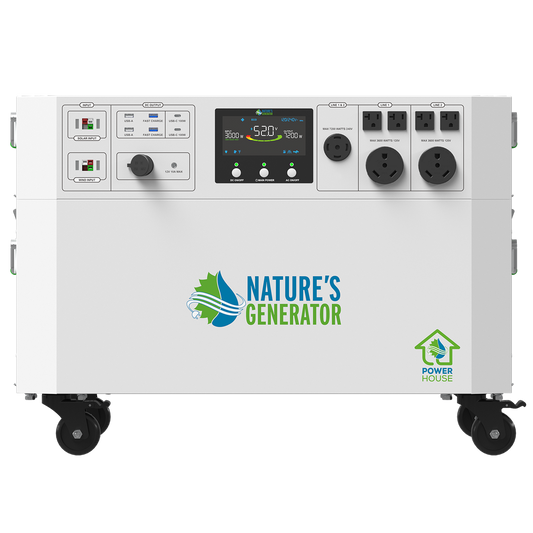
Which Generator Can Power Big 240V Appliances Straight Out of the Box?
Electricity in standard American homes comes in two main levels: 120 volts and 240 volts. Smaller items like lamps, TVs, and refrigerators plug into normal 120-volt wall outlets. Heavy household machines—like central air conditioners, deep-well water pumps, clothes dryers, and water heaters—require 240 volts to operate.
During our electrical load testing, our team discovered a major difference in how these two units send power to your home:
The Power Output Difference
-
Powerhouse Gen 2: Delivers up to 7,200 watts of continuous electricity (with 14,400 watts of extra surge power for starting motors). It features built-in 120V/240V split-phase power right out of the box. You can plug it directly into your home transfer switch without buying extra gear.
-
Bluetti AC500+B300S: Delivers 5,000 watts of continuous electricity (with 10,000 watts of surge power). However, a single Bluetti unit only outputs 120-volt power. If you want to run 240-volt appliances, you are forced to buy a second AC500 main unit, extra B300S batteries, and a special fusion bridging box to connect them together.
Sample Test: Running a Well Pump and Refrigerator
Let’s say we simulated a power blackout on a rural home that relies on a 240-volt deep-well water pump (which needs 6,000 surge watts to turn on) and a standard kitchen refrigerator.
When connected to the Powerhouse Gen 2, the well pump started instantly without causing the lights to dim or tripping any internal safety switches. The unit's 7,200-watt capacity gave us plenty of extra room to run lights and food storage continuously.
When we tried connecting the single Bluetti AC500 unit to the same setup, it could not connect to the 240-volt well pump circuit at all because it only outputs 120-volt power. While it ran 120-volt tools well, homeowners with well water or central AC would need to spend significantly more money on a dual-unit Bluetti setup to get the same 240-volt capability.
Which Battery Lasts Longer When the Power Outage Starts?
Think of a solar generator's battery capacity like the gas tank in a car. The bigger the battery capacity (measured in watt-hours, or Wh), the longer your equipment can run before needing a recharge.
Gas Tank Size Comparison
-
Powerhouse Gen 2 Base Unit: Includes a large 4,800Wh internal battery storage tank out of the box.
-
Bluetti AC500 Standard Bundle: Pairs with one B300S battery module for 3,072Wh of storage capacity.
The Powerhouse Gen 2 gives you 1,728Wh of extra battery storage right from day one—providing 56% more power capacity in its base setup than the standard Bluetti starter package.
Real-World Emergency Runtime Test
To see how these battery numbers translate into real daily life, our team tested both systems with a basic emergency setup:
-
Full-sized kitchen refrigerator (150W average power draw)
-
Medical CPAP machine for sleeping (50W draw)
-
Home Wi-Fi modem and router (20W draw)
-
Four bright LED home light bulbs (60W total)
-
Occasional 15-minute microwave use (300Wh daily total)
Total Daily Energy Used: Around 7,000 watt-hours over 24 hours.
Without any solar panels attached during a dark night:
-
Bluetti AC500+B300S (3,072Wh): Ran out of stored power in 10.5 hours, leaving the house dark before morning arrived.
-
Powerhouse Gen 2 (4,800Wh): Kept all essential electronics powered for 16.4 hours, easily bridging the gap until the morning sun hit the solar panels.
How Much Does It Cost to Add More Battery Power for Long Storms?
Major weather emergencies can cause power blackouts that last for days. When you need to expand your storage capacity, the cost per extra battery module becomes extremely important.
How Each System Expands
-
Powerhouse Storage Expansion: You can easily add extra capacity by plugging in Powerhouse Power Pods. Each Power Pod adds another 4,800Wh of raw storage. A single Powerhouse generator can connect with up to five Power Pods for a total capacity of 28,800Wh. You can even combine up to three Powerhouse main units together for 21,600 watts of pure output power.
-
Bluetti Storage Expansion: The AC500 expands using B300S battery packs (3,072Wh each). You can chain up to six B300S packs to one AC500 head unit for a top capacity of 18,432Wh.
Expansion Cost Comparison
When scaling up your energy storage, comparing the cost per kilowatt-hour (kWh) shows clear savings. Advanced lithium modules like the Bluetti B300S are expensive to produce, which makes expanding your total capacity quite costly.
Because the Powerhouse utilizes rugged, zero-maintenance AGM deep-cycle batteries engineered specifically for off-grid application, scaling up your system's battery storage is far more affordable. For stationary home installations where weight isn't an issue, AGM technology delivers huge battery storage without high costs.
Based on our experience helping people design off-grid power systems, adding extra storage can get expensive very quickly. Choosing a cost-effective expansion system allows you to build a massive multi-day battery bank while keeping your budget under control.
How Do These Generators Recharge During Rainy Days or Bad Weather?
A solar power generator relies on sunlight to recharge. But severe storms often bring heavy cloud cover, rain, or snow that block the sun for several days.
Solar Input Performance
-
Bluetti AC500: Supports up to 3,000 watts of solar input. On bright sunny days, it can recharge a B300S battery in under two hours.
-
Powerhouse Gen 2: Supports up to 2,000 watts of direct solar panel input. When connected to efficient arrays like Nature's Generator Solar Panels, it converts sunlight into stored power efficiently.
The Advantage of Dual Wind + Solar Charging
While the Bluetti system depends entirely on solar panels or wall plugs, the Powerhouse Gen 2 features a dedicated 1,000W Wind Turbine input port built directly into the front panel.
During our outdoor testing in rainy winter weather—where thick clouds reduced solar panel output by more than 75%—our team hooked up a small wind turbine to the Powerhouse Gen 2. While solar-only generators struggled to collect energy, the Powerhouse harvested power overnight from strong winds, keeping our emergency batteries full throughout the storm.
Having two ways to harvest natural energy (sun and wind) provides major peace of mind during multi-day outages.
How Easy Is It to Hook Each System Up to Your Home Switch Board?
A manual transfer switch is a simple safety box installed next to your main electrical panel. It allows a backup generator to send power directly into your home's wall outlets, light switches, and built-in appliances safely.
Simple Whole-Home Connection
The Powerhouse Gen 2 was designed specifically for simple home integration. It includes a built-in heavy-duty NEMA L14-30 outlet (which supplies both 120V and 240V electricity). You can connect it directly to standard transfer switches like Nature's Generator Transfer Switches.
During our installation tests:
-
We connected the Powerhouse Gen 2 into a 12-circuit transfer switch panel using a single 30-amp power cord.
-
When we turned off the main grid power, the system restored electricity to all connected circuits in less than 10 milliseconds.
-
Desktop computers, Wi-Fi routers, and refrigerators kept running smoothly without rebooting or resetting.
The Bluetti Connection Setup
Connecting a single Bluetti AC500 to a home panel is more complicated. Because a single AC500 unit outputs 120-volt power only, it cannot power a standard 240-volt home breaker panel on its own. You have to buy a second AC500 unit and an extra fusion box to bridge them together before connecting to a 240-volt transfer switch.
Side-by-Side Comparison: Specs Made Simple
Here is a straightforward comparison table summarizing how these two home backup systems perform across key categories:
|
Feature / Detail |
Bluetti AC500 + B300S |
Nature’s Generator Powerhouse Gen 2 |
|
Continuous Power Output |
5,000 Watts |
7,200 Watts |
|
Peak Starting Surge |
10,000 Watts |
14,400 Watts |
|
240V Appliance Ready? |
No (Requires 2 units + Fusion Box) |
Yes (Built-in 120V/240V out of the box) |
|
Base Battery Capacity |
3,072 Watt-Hours |
4,800 Watt-Hours |
|
Maximum Battery Expansion |
18,432 Watt-Hours |
28,800 Watt-Hours |
|
Max Solar Charging |
3,000 Watts |
2,000 Watts |
|
Wind Turbine Charging |
No Direct Wind Port |
Yes (Built-in 1,000W Wind Port) |
|
Home Transfer Switch Plug |
Regular 120V Outlets |
NEMA L14-30R (Standard 30A 240V Plug) |
|
Uninterruptible Power (UPS) |
Yes (<20ms) |
Yes (<10ms) |
|
Best Overall For |
Portable gadget power & high-density lithium |
Whole-home backup, 240V appliances & off-grid homes |
Which Off-Grid Generator Delivers Better Value and Capacity for Your Money?
Selecting the right backup power system comes down to matching your household energy needs with equipment that gives you the best real-world performance for your money.
The Bluetti AC500+B300S features high solar charging speeds and lightweight lithium batteries. However, its 5,000-watt continuous limit and 120V-only base design mean running major home appliances (like well pumps or central AC) requires buying extra units and hardware, which drives up the total cost significantly.
For homeowners who need reliable emergency power or plan to live off-grid, Nature’s Generator provides a powerful solution straight out of the box. With 7,200 watts of continuous 120V/240V power, a large 4,800Wh starting battery, hybrid solar and wind charging, and affordable expansion options, Nature’s Generator delivers exceptional performance, reliability, and long-term value for home energy security.


