


An electric vehicle gives you convenient transportation, but a long power outage can create a problem: how do you charge it when your home loses grid power?
A reliable backup power system can do more than keep your refrigerator, lights, and Wi-Fi running. A solar power generator, whole home power generator, or portable backup power system can also help provide energy for an EV when the utility is unavailable.
With Nature’s Generator MyGrid 10K, homeowners can keep important household appliances running while also charging a compatible EV during a power outage. This guide explains how EV charging works during an outage, how much power it can use, whether you can charge the car while running your home, and how solar can help during longer blackouts.
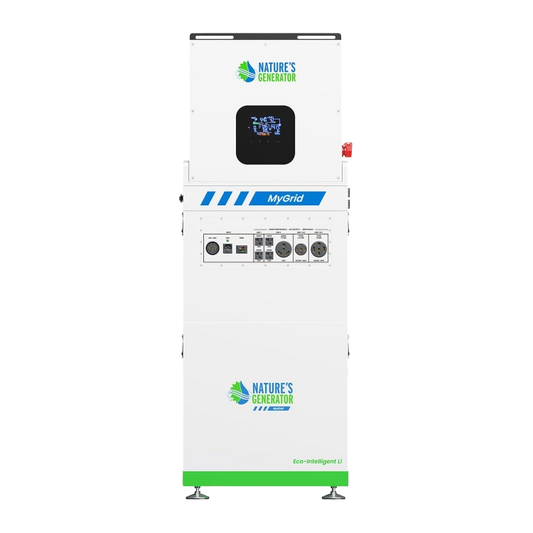
Can MyGrid 10K charge an EV during a power outage?
Yes. MyGrid 10K can provide 120/240V power for compatible EV charging equipment when utility power is unavailable.
The system has a 10,000W continuous output, a 10,496Wh LiFePO4 battery, and a NEMA 14-50R outlet in its base configuration. These features make it suitable for compatible EV charging setups, including certain Level 2 chargers.
The main thing to understand is that EV charging is a large electrical load. An EV can use several thousand watts while charging, so you need to consider the vehicle alongside everything else connected to the backup system.
Your refrigerator, internet equipment, lights, security devices, and other essential appliances may all need power at the same time.
That is why the goal during an outage should not always be to fully recharge the EV. In many situations, adding enough energy for an important trip is more useful than trying to take the battery from nearly empty to full.
Learn more about MyGrid 10K Gen 2
How much power does an EV charger use?
The amount of electricity an EV needs depends on the charging method and current setting.
Level 1 charging uses 120V and typically draws less power, but it is slower. Level 2 charging uses 240V and can add significantly more energy in less time.
For a MyGrid 10K setup, example Level 2 loads include:
This shows why the fastest charging setting is not always the best choice during a blackout.
A 40A charger using about 9.6kW would leave very little output for other high-demand equipment. Start a large air conditioner, well pump, electric water heater, or similar appliance and the total load can rise quickly.
For a longer outage, a lower charging rate may give you a better balance between transportation and household power.
How long can MyGrid 10K charge an EV?
How long an EV takes to charge depends on its charging speed, the vehicle itself, and how much electricity the home is using.
MyGrid 10K starts with 10,496Wh (about 10.5kWh) of battery storage. You can use that figure to make a rough energy estimate.
For example, if an EV charger draws 7.6kW:
10.5kWh ÷ 7.6kW = about 1.4 hours
This is only a basic calculation. Actual results can vary because of charging losses and other devices using the battery at the same time.
A better way to plan is to start with the amount of driving range you actually need.
Let’s say your EV already has enough charge for your normal daily driving. If the power goes out, you may only need to charge it enough to get to work, pick up groceries, make an appointment, or reach a public charging station.
That is much different from trying to charge the battery all the way back to 100%.
Instead of asking, “How fast can I fully charge my EV?”, ask, “How much driving range do I need until the power comes back?”
Focusing on the range you actually need can help you make better use of your backup power.
Can you charge an EV while powering your home?
Yes, as long as the combined load stays within the available output.
MyGrid 10K is rated for up to 10,000W of continuous output. Every device operating at the same time contributes to that total.
For example:
-
EV charger: 7.6kW
-
Refrigerator: 0.5kW
-
Lighting: 0.3kW
-
Wi-Fi equipment: 0.1kW
-
Small electronics: 0.5kW
Estimated total: 9kW
That leaves about 1kW before adding another major appliance.
If an air conditioner or pump starts, the demand can increase quickly. Because of this, it’s better to treat EV charging as a load you can adjust when the power is out.
You can reduce the charging rate when household demand rises and increase it again when the home is using less electricity.
A simple schedule could look like this:
Morning: Prioritize essential household loads.
Midday: Take advantage of daytime solar generation to add charge to your EV without putting as much demand on the backup battery.
Evening: Slow down or pause EV charging so more battery power is available for the rest of the night.
This gives you more control over your available energy rather than allowing the EV charger to use as much power as possible at all times.
Is Level 1 or Level 2 charging better when the power is out?
The best choice depends on how much range you need and how much power is available.
Level 1 charging is slower but uses less electricity. It can make sense when your vehicle can charge for several hours and conserving battery capacity is important.
Level 2 charging is much faster and can restore useful driving range more quickly. MyGrid 10K provides 120/240V split-phase output, allowing it to work with compatible Level 2 EV charging setups.
A simple way to decide is:
Choose Level 1 when you have plenty of time and only need a limited amount of additional range.
Choose Level 2 when you need more range quickly and have enough power available for both the vehicle and essential home loads.
During a power outage, charging speed is only one part of the decision. It may be more important to save enough battery power to keep the rest of your home running.
Can solar help charge an EV during a long outage?
Yes. Solar can help replenish MyGrid 10K after your home and EV use stored energy.
MyGrid 10K Gen 2 supports up to 12,000W of solar input through dual MPPT charge control, giving homeowners the option to build a larger solar setup around the system.
The basic energy flow is:
Solar panels → MyGrid 10K → home + EV
Consider a two-day outage.
During the morning, the battery supplies energy to your refrigerator, Wi-Fi, lights, and other important devices. As the sun comes up, the solar array starts producing electricity and helps replace some of that energy.
When household demand drops, you can use available capacity to charge the EV.
In the evening, you can reduce or stop charging and preserve the remaining battery for household needs.
The next day, the solar panels can begin replenishing the system again.
This does not mean every solar setup can continuously charge an EV. Actual performance depends on solar production, weather, panel capacity, vehicle efficiency, home demand, and driving habits.
The advantage is that solar gives you a way to recover energy instead of depending entirely on the battery charge you had when the outage began.
What equipment do you need for EV charging with MyGrid 10K?
The exact setup depends on your EV, charger, and home's electrical system.
A typical setup may include:
-
MyGrid 10K
-
Compatible EV charging equipment
-
A suitable 120V or 240V connection
-
Correctly sized wiring and circuit protection
-
A backup system that can handle both your home’s needs and your EV’s charging demand.
A transfer switch may also be part of a whole-home backup installation.
Nature’s Generator offers a 50A Automatic Transfer Switch for 120/240V systems.
For a hardwired Level 2 charger or other major electrical work, a qualified electrician should review the setup. They can inspect your electrical panel, breakers, wiring, grounding, and backup setup to make sure everything works together properly.
This is particularly important with EV charging because the charger may draw several kilowatts continuously for an extended period.
The goal is not simply to connect the car. The goal is to create a setup where the charger, backup system, and household loads work safely together.
How should you manage EV charging during a long outage?
A good outage plan starts with priorities.
First, identify the household equipment that must keep running. This may include refrigeration, communication equipment, security devices, lighting, and other critical loads.
Next, think about how much energy you need overnight. You do not want to use most of your stored power during the day and have little left once the sun goes down.
Then consider when solar production is strongest. Daytime can be a useful window for energy-intensive activities when the system is receiving fresh solar input.
Finally, decide how much EV range you actually need.
For example, during a 24-hour outage, you may only need enough charge for the following day's commute. During a multi-day outage, you may choose to add smaller amounts of range each day while protecting your home battery reserve.
This way, EV charging becomes part of your home backup plan instead of something you have to figure out separately.
Is MyGrid 10K a good fit for EV charging during an outage?
The answer depends on four main factors:
Your EV's energy needs: How much driving range do you need during the outage?
Your charging rate: How much power does your charger require?
Your household load: Which appliances need to operate at the same time?
The outage length: How long do you expect to be without grid power?
MyGrid 10K combines 10,000W of continuous output, a 10,496Wh battery, 120/240V split-phase power, and solar charging capability. Additional battery capacity can also be added when more stored energy is needed.
Before choosing a charging setup, make a simple list of your essential home loads and your expected EV driving needs.
Then match the charging rate and backup capacity to those requirements.
Plan your EV charging before the next outage
EV charging does not have to stop when the grid goes down. With the right backup system and a sensible energy plan, you can continue adding driving range while keeping essential parts of your home powered.
For homeowners looking to combine home backup with EV charging, Nature’s Generator provides a flexible foundation for building a system around actual household and transportation needs.


