


A home battery can do more than keep your lights on during a blackout. When connected to a Virtual Power Plant (VPP), it can also help support the grid and potentially earn you utility credits.
For homeowners comparing reliable backup power, a solar power generator, a whole home power generator, or portable backup power, VPPs offer another reason to consider battery storage. Instead of sitting idle between outages, your battery can become part of a larger network that helps balance electricity demand.
In this guide, we’ll explain what VPPs are, how homeowners get paid, whether you need solar, how much battery capacity you may need, and what to check before joining a program.
What is a Virtual Power Plant, and how does it actually work?
A Virtual Power Plant is a network of connected home energy systems that work together like one large power plant.
A VPP can combine home batteries, solar panels, electric vehicles and other flexible energy resources. Software coordinates these systems and responds when the grid needs more or less electricity.
For a homeowner, the process is simple:
Your battery stores energy → the VPP monitors the grid → the system requests energy during a high-demand period → your battery responds → you receive an incentive.
The U.S. Department of Energy estimates that commercially available VPPs already represent around 30–60 GW of capacity.
The idea is straightforward: instead of relying only on large power plants, utilities can coordinate thousands of smaller energy systems spread across local neighbourhoods.
Why are utilities interested in home batteries?
Electricity demand changes throughout the day. Hot afternoons, cooking at night, running the AC, and charging an EV can all increase your power use.
A VPP gives utilities access to stored energy without needing to build all-new generation capacity for every peak period.
In practical terms, your home battery becomes a small part of a much larger grid resource.
How do homeowners earn utility credits from a VPP?
VPP programs compensate homeowners for allowing their batteries to support the grid.
The payment structure varies by utility and program. Some offer monthly bill credits, while others provide annual payments, upfront incentives or compensation based on performance.
There is no standard VPP payment that applies everywhere.
A program might pay you simply for keeping an eligible battery available. Another may pay according to how much energy your system provides during grid events.
That means the important question is not simply, How much does a VPP pay?
Instead, ask:
How much does my local program pay, and what does it require from my battery?
Before enrolling, check the incentive amount, event frequency, battery reserve rules, participation period and opt-out conditions.
Can you join a VPP without having solar panels?
No. Solar is not always required.
Some VPP programs can use batteries charged from the grid, while others are built around solar-plus-storage systems.
Solar can still make a battery more useful because it allows you to store excess daytime generation and use it later. During a VPP event, that stored energy can potentially support the grid instead of increasing your home's grid demand.
Think of the difference this way:
Battery only:
Grid → Battery → Home or VPP event
Solar plus battery:
Solar → Battery → Home, backup power or VPP event
For homeowners who already have grid-tied solar, AC coupling can also be worth considering. Nature’s Generator explains how its AC-coupled solution can add battery storage to an existing solar setup while retaining the existing solar inverter, depending on system compatibility.
However, having a battery does not automatically make it VPP eligible. Your utility may require specific equipment, software, communications technology and interconnection approvals.
Will a VPP use all of your battery during a grid event?
Usually, VPP programs have rules that limit how much battery energy can be made available.
Be sure you know how it works before you sign up.
Imagine you have a 10 kWh battery and want to keep 30% available in case the power goes out. You need to know whether the VPP will protect that reserve or use more of the battery during an event.
Depending on the program, the minimum reserve may be fixed, adjustable or managed automatically.
Before joining, find out:
-
How much battery capacity must remain in reserve?
-
How long can a VPP event last?
-
How often can events occur?
-
Can you opt out of an event?
-
What happens if the grid goes down immediately afterward?
For us, this is critical. A VPP incentive should add value to your battery, not undermine the backup protection you bought it for.
How much battery storage does a suburban home need?
The battery size you need depends on which appliances you want to power.
A smaller system may be enough for a refrigerator, Wi-Fi router, lights, phones and a few work devices. A larger system makes more sense when you want to support major appliances or more of the house during an outage.
Nature’s Generator recommends looking at both energy capacity and power output when choosing a system. Its Lithium 1800, for example, provides 1,440Wh of storage and 1,800W of output, while the Lithium 3600 increases capacity and output for larger backup needs.
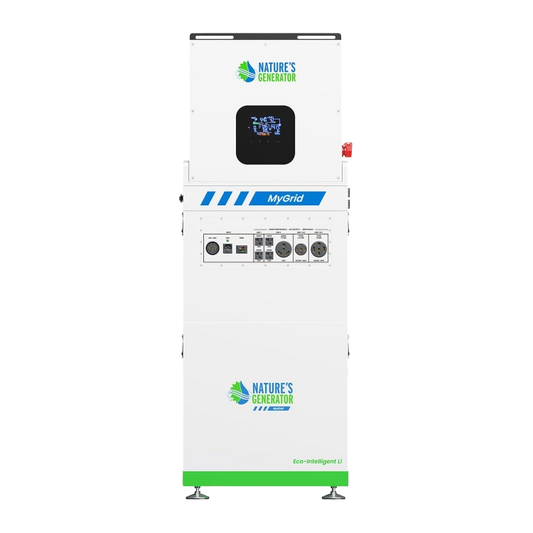
For larger homes, the MyGrid 10K provides 10,496Wh of LiFePO₄ battery storage and 10,000W of continuous output, with additional storage expansion available.
Why does power output matter?
Battery capacity tells you how much power a battery can store.
Power output tells you how much electricity you can use at once.
That distinction matters because high-demand appliances such as air conditioners, pumps and some kitchen equipment can require significant power.
When comparing systems, look at both numbers instead of choosing based on battery capacity alone.
Is a VPP better than using a battery only for backup?
It can be, depending on your priorities.
A backup-only battery gives you one clear benefit: protection when the grid goes down.
A VPP-connected battery can potentially provide three types of value:
Backup power: Keep critical appliances operating during outages.
Energy savings: Store solar energy or shift consumption away from expensive periods.
VPP incentives: Earn credits or payments by helping support the grid.
The trade-off is control.
Depending on the program, you may have less freedom over when the battery charges or discharges. If you always want your battery at 100%, a VPP may not be the best fit.
If you're comfortable allowing controlled use of your battery in exchange for financial incentives, the economics can be more attractive.
What should you check before buying a VPP-ready battery?
Start with your utility, not the battery brand.
VPP programs are location-specific, and eligibility can change. Once you've confirmed that a program is available in your area, check five things.
1. Is your home eligible?
Confirm that your address is within the utility or VPP service area.
2. Is the battery approved?
Some programs only accept specific battery and inverter models.
3. How much capacity do you need?
The program may require a minimum battery size or power output.
4. What backup reserve can you keep?
Understand exactly how much energy remains available for your home.
5. How are you paid?
Compare monthly credits, annual payments, performance incentives and upfront rebates.
FERC Order 2222 has helped create a framework for distributed energy resources to participate in organised electricity markets through aggregations, but local program rules still determine what homeowners can actually enroll in.
What does VPP participation look like in a real home?
Consider a suburban family with rooftop solar, a refrigerator, Wi-Fi equipment, lights and a home office.
During the day, solar produces electricity. Some of that energy powers the house while excess generation charges the battery.
In the evening, the family can use stored energy rather than relying entirely on the grid.
When electricity demand rises and a VPP event begins, the system may discharge some available energy to support the grid. The homeowner receives the program incentive while maintaining the required backup reserve.
Then a storm causes a blackout.
At that point, the VPP payment is no longer the priority. The family needs to know whether its battery can keep essential appliances running through the outage.
That's why we recommend sizing your battery around your real household needs first and treating VPP income as an additional benefit.
Can a whole-home battery also lower your electricity bill?
Yes. VPP income is only one possible source of savings.
A battery can shift when you use electricity. For example, you can store solar energy during the day and use it later. Depending on your electricity plan, you may also charge during cheaper periods and use stored energy when electricity costs more.
Nature’s Generator's MyGrid 10K is designed for applications that combine backup power, solar storage and energy management. It can also be expanded with additional battery capacity for homeowners who need longer runtime or greater energy storage.
Your actual savings will depend on your electricity rates, solar generation, household consumption and how the battery is operated. A VPP credit should be viewed alongside those factors rather than as guaranteed income.
Is a VPP battery worth it?
A Virtual Power Plant gives homeowners another way to get more value from battery storage. Instead of using the battery only during blackouts, you may also use it to reduce grid demand and earn utility incentives.
The smartest approach is to make the decision in this order:
First, size the system around your backup needs. Decide what you want to run and how long you need it operating.
Next, consider energy savings. Solar storage and time-of-use charging may help reduce your grid electricity use.
Then, evaluate VPP income. Check your local program's eligibility rules, reserve requirements and exact payment structure.
Nature’s Generator offers battery and solar-ready systems ranging from portable backup to expandable whole-home energy storage.
For larger residential applications, the MyGrid 10K combines high power output with expandable LiFePO₄ storage, giving homeowners more flexibility as their energy needs change.
A VPP can make a home battery work harder for you. But the best system is one that already makes sense for your home before the incentives are added.


