


Power bills are going up everywhere. If you want a reliable backup power source or a clean solar power generator setup, you are not alone. Investing in a whole home power generator or versatile portable backup power can change how you manage your daily budget.
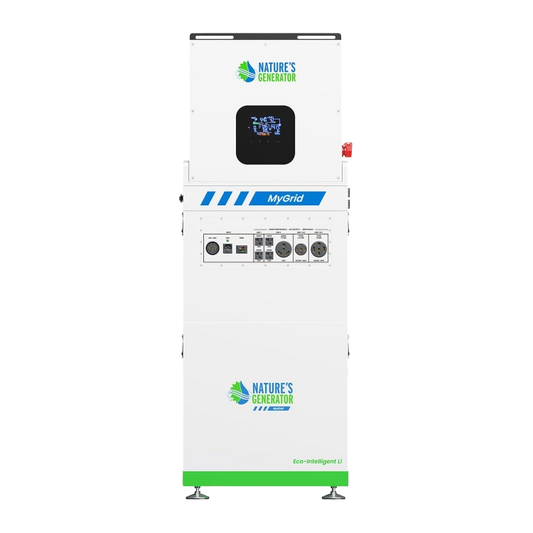
When you connect your electric car’s massive battery to a dedicated house system like the Nature's Generator MyGrid10K, you unlock an amazing shortcut to lower bills. Combining these two tools gives you the fastest path to total energy independence.
How Does Combining an EV Battery with a Home Battery Lower Your Electric Bill?
To understand why this setup saves so much money, we have to look at how power companies charge you. Most companies now use what is called Time-of-Use (TOU) rates. This means the price of electricity changes depending on the time of day.
What are peak utility rates and Time-of-Use plans?
During peak hours—usually in the late afternoon and evening—electricity costs the most. This happens because everyone comes home from work, turns on the air conditioning, cooks dinner, and runs the clothes dryer.
When demand goes up, the power company raises prices. In many places, buying power during peak hours can cost three to four times more than buying it late at night. If you pull all your power from the grid during these expensive hours, your monthly bill will skyrocket.
How do bidirectional charging and a home battery work together?
Bidirectional charging is just a fancy way of saying two-way power. Instead of electricity only going into your car, a bidirectional setup lets electricity flow out of your car and back into your house.
When you combine a two-way car charger with a stationary home battery, you build a smart defense system against high power bills:
-
Midnight Charging: Late at night, electricity is cheap because most people are asleep. Your system automatically uses this cheap power to fill up both your home battery and your electric car.
-
Evening Shifting: When peak hours start in the afternoon and prices jump, you stop buying power from the grid. Instead, your house automatically runs on the cheap energy stored inside your car and your home battery.
-
Zero Peak Rates: By running your home on your own stored power during expensive hours, you never have to pay peak prices again.
Our team often gets asked: Why do I need a home battery if my electric car already holds so much energy? The answer is simple. If you need to drive your car to the store or to work during peak hours, your house loses its power source. Having a dedicated home battery ensures your house stays powered and protected even when your car is gone.
Why is the MyGrid10K the Best System to Pair with Your Electric Vehicle?
Choosing the right battery system for your home can feel overwhelming. Many old-style options are too small, too expensive, or difficult to upgrade. Based on our experience, we designed the MyGrid10K to be the perfect control center for your home's energy.
What makes the MyGrid10K different from standard backup batteries?
Many basic backup systems only provide 120-volt power. This means they can run smaller items like lamps and laptops, but they cannot start heavy appliances. The MyGrid10K delivers strong 120V and 240V power at the same time, giving you 10,000 watts of continuous power. This is more than enough strength to run your central air conditioner, well pump, or large kitchen appliances during expensive peak hours.
|
System Feature |
What It Means for You |
|
10,000-Watt Output |
Runs large appliances like AC units and refrigerators easily. |
|
120V / 240V Power |
Matches the exact power needs of your home's main breaker panel. |
|
Modular Design |
Lets you add more batteries over time as your family grows. |
|
Multiple Inputs |
Accepts power from solar panels, wind turbines, cars, or the grid. |
How does this system grow with your energy needs?
We believe that home energy should be flexible. The MyGrid10K uses a building-block design. If you only want to protect a few kitchen appliances at first, you can start with a smaller setup.
As you get used to saving money, you can easily plug in more battery smart-pods to expand your storage. This modular system links directly to your home panel through a transfer switch, perfectly balancing the power coming from your solar panels, your electric car, and the utility grid.
How Much Money Can You Actually Save by Shifting Your Power Use?
Let us look at a real-world example to see how much money this strategy can put back into your pocket. Imagine you live in an area with high electricity rates.
A simple look at a daily savings math example
Suppose your family uses about 30 kilowatt-hours (kWh) of electricity every day. Your power company uses a standard evening peak rate plan:
-
Cheap Night Rate (12 AM to 6 AM): $0.20 per kWh
-
Normal Day Rate (6 AM to 4 PM): $0.35 per kWh
-
Expensive Peak Rate (4 PM to 9 PM): $0.65 per kWh
If your home uses 10 kWh of power during those five expensive evening hours, drawing that power straight from the grid costs you $6.50 every single day. Over a month, that adds up to $195 just for those five hours.
Now, let us use the MyGrid10K energy-saving architecture. Your system fills up your batteries at night using the cheap $0.20 rate. When 4 PM arrives, your home automatically stops buying power from the grid and switches over to your stored energy.
By shifting your power use away from peak hours, you save over $135 every month. Over a few years, the system easily pays for itself.
How does this strategy actually play out for everyday homeowners?
Families who use this setup tell our team that it changes how they live. Before using this system, many homeowners felt stressed when peak hours started. They would turn off their AC units and sit in a warm house just to avoid a massive bill.
One customer shared that combining their car's battery with our home system completely flattened their summer electricity bills. They loved that when a major heatwave caused local power outages due to grid overload, their lights stayed on without a single flicker. They did not even notice the neighborhood power was out until they looked out the window.
What Do You Need to Set Up This System in Your Own Home?
Setting up a two-way power system is simple when you know what parts are required. You cannot just plug a normal extension cord from your car into a wall outlet. You need a few specific pieces of equipment to make everything safe and legal.
Does your electric car and charger support two-way power?
First, your electric vehicle must have built-in two-way charging features. Many modern electric cars now come with this software ready to go.
Second, you need a special bidirectional charger installed on your garage wall. Normal chargers only push power into a car. A bidirectional charger knows how to safely pull power out of the car and send it to your house.
How does the system connect to your main electrical panel safely?
To connect everything together, a licensed electrician will install a transfer switch next to your main electrical breaker box. The Nature's Generator equipment plugs directly into this switch.
The transfer switch is very important for safety. It acts like a one-way gate. When your home is running on car or battery power, the transfer switch disconnects your house from the city power lines.
This prevents a dangerous problem called backfeeding. If your home accidentally pushed electricity out into the street wires during a blackout, it could badly injure utility workers who are trying to fix the power lines. Our system stops this from happening automatically, keeping your home and your community safe.
Shift Your Power and Lower Your Energy Costs Now
Beating high utility rates does not mean you have to live in the dark. By combining a bidirectional electric car charger with a reliable home battery, you take control of your own power. You can store cheap electricity, skip high evening rates, and keep your home comfortable during unexpected blackouts.
When you are ready to stop worrying about your power bill, investing in the right setup is key. Our team at Nature's Generator is always here to help you build a modular system that fits your home perfectly.


