


Winter is when a home backup system gets put to the test. The days are short, snow can cover solar panels, and a stretch of cloudy weather can leave your batteries waiting for a recharge. Wind might help, but only if your property gets enough of it.
So, should you go with solar, micro-wind, or both?
Nature’s Generator offers options for homeowners looking for reliable backup power, from a solar power generator to a whole home power generator and solutions for portable backup power. The trick is figuring out how much energy your setup can actually produce when winter conditions aren't doing you any favors.
This guide breaks down the math behind daily watt-hour production, with examples you can work through yourself. We'll compare solar and micro-wind using the same units, look at what winter weather does to their output, and show how to use those numbers when choosing a battery backup system.
Is Solar or Micro-Wind Better for Winter Power Generation?
It depends on where you live and what your property is like. Solar is usually the more straightforward choice when you have a sunny, relatively unshaded roof or a suitable ground location. Micro-wind can make sense on open properties with steady winds, particularly where winter weather brings stronger and more consistent airflow.
Neither technology automatically comes out ahead just because it's winter.
Solar panels still generate electricity on cold days. In fact, cold temperatures can help panels operate efficiently when sunlight is available. The bigger problems are shorter days, a low sun angle, heavy cloud cover, and snow that blocks the cells.
Wind has a different set of challenges. A turbine can generate electricity after dark, which is useful during long winter nights. But a property that feels windy at ground level might not have a strong enough wind resource where the turbine would actually sit. Trees, buildings, and nearby terrain can disrupt the airflow, too.
Here's the practical difference:
|
What matters |
Solar panels |
Micro-wind turbine |
|
What drives production |
Sunlight reaching the panels |
Wind reaching the rotor |
|
Biggest winter problems |
Short days, clouds, snow, shading |
Inconsistent wind, turbulence, poor placement |
|
Best location |
Open roof or ground space with good sun exposure |
Open property with a suitable wind resource |
|
When it can generate |
During daylight |
Day or night, when wind conditions allow |
|
What you need to estimate output |
Winter sunlight and system losses |
Wind data and the turbine's power curve |
Picture two homeowners in northern states. One has a south-facing roof with little shade. The other lives on open land where strong winds are common. Solar might be the better investment for the first homeowner, while the second has a reason to investigate wind.
The US Department of Energy's Small Wind Guidebook explains why wind conditions, turbine height, and nearby obstacles matter. It's worth reading before spending money on a turbine.
The goal isn't to choose the technology with the biggest number on its label. It's to find out which one can produce useful energy at your property during the months you care about most.
How Do You Calculate Daily Solar Output in Watt-Hours?
You don't need complicated math to get a first estimate of solar production. Start with the total rated wattage of your panels, multiply it by your location's equivalent hours of full sunlight, and account for energy losses.
Use this formula:
Daily solar yield (Wh) = Array wattage (W) × Peak sun hours × Performance factor
Here's what each part means:
-
Array wattage: The combined rated output of all your panels.
-
Peak sun hours: The equivalent number of hours when solar irradiance averages 1,000 watts per square meter. This isn't the same as total daylight hours.
-
Performance factor: A decimal that accounts for losses from things such as wiring, conversion equipment, shading, and other operating conditions.
Let's put those numbers to work.
Step 1: Add up your solar panel wattage
Say you're planning to install eight 440W panels.
Eight panels × 440W = 3,520W, or 3.52kW.
Nature’s Generator sells 440W rigid bifacial solar panels. Their rated wattage gives you a starting point for sizing an array. It doesn't mean they'll produce 440W each for every hour of the day.
Step 2: Use a realistic winter sunlight estimate
For this example, let's assume the array receives 1.5 peak sun hours on a winter day.
That's an example for the calculation, not a figure you should automatically use for every northern US location. Winter sunlight in Maine can look very different from winter sunlight in Colorado. Even within the same state, elevation, weather, and shading can change the result.
For a more location-specific estimate, try the PVWatts Calculator. It lets you model expected solar production using your location and system details.
Step 3: Account for energy losses
We'll use a performance factor of 0.75, meaning the system delivers 75% of the calculated energy after the losses included in this simplified example.
Now do the math:
3,520W × 1.5 hours × 0.75 = 3,960Wh per day, or 3.96kWh.
That's the estimated daily output under those assumptions.
What happens if the array gets 2.5 peak sun hours instead?
3,520W × 2.5 hours × 0.75 = 6,600Wh, or 6.6kWh.
Same panels. Different sunlight. A difference of 2.64kWh in estimated daily generation.
That's why sizing a winter backup system around a sunny summer day can lead to disappointment. Use winter conditions when winter reliability is what you're after, and remember that actual production will change from day to day.
How Do You Calculate Daily Micro-Wind Output?
Wind needs a slightly different approach. A turbine's rated wattage tells you what it can produce under specified conditions, not how much electricity it will generate over a typical winter day.
For a simple estimate, use:
Daily wind yield (Wh) = Average electrical output (W) × Operating time (hours)
The important part is getting a believable average output figure. Ideally, that comes from the turbine's power curve and wind data for the proposed installation site.
Here's a made-up example to show how the calculation works.
Suppose a turbine produces an average of 100W for eight hours, 20W for the next eight hours, and nothing for the remaining eight hours.
|
Period |
Calculation |
Energy produced |
|
First 8 hours |
100W × 8 hours |
800Wh |
|
Next 8 hours |
20W × 8 hours |
160Wh |
|
Remaining 8 hours |
0W × 8 hours |
0Wh |
|
Daily total |
960Wh |
The result is 960Wh, or 0.96kWh, for the day.
These are hypothetical output figures. They're not a prediction for a particular turbine, and you shouldn't use them to size a system without real wind data.
Why can a small change in wind speed make such a big difference?
Wind power rises sharply as wind speed increases. The Department of Energy describes the theoretical power available to a turbine using this formula:
P = ½ × Cp × ρ × A × V³
Here, P represents the estimated power captured from the wind, Cp is the turbine's power coefficient, ρ is air density, A is the rotor-swept area, and V is wind speed.
You don't need to calculate all of this just to compare products. The key takeaway is that wind speed matters a lot. Small differences can have a substantial effect on the energy available to the turbine.
And there's another catch: the theoretical formula doesn't tell you exactly what comes out of the wires. Turbine design, electrical losses, operating limits, and the controller all affect actual generation.
For a buying decision, look for the manufacturer's power curve and use wind-speed information for the intended turbine location. The Department of Energy's wind guidance is a useful starting point.
Which Produces More Electricity on a Winter Day: Solar or Wind?
Let's put the two earlier examples side by side.
|
Measurement |
Solar array |
Micro-wind turbine |
|
Rated equipment capacity |
3,520W of panels |
Depends on the turbine |
|
Winter assumptions |
1.5 peak sun hours, 0.75 performance factor |
100W for 8 hours, 20W for 8 hours, then no output |
|
Estimated daily production |
3,960Wh |
960Wh |
|
Energy in kWh |
3.96kWh |
0.96kWh |
In this particular example, solar generates a little over four times as much energy as wind.
But don't take that as a general rule. We chose specific assumptions to demonstrate the calculations. Change the property, weather, or turbine performance and the result could be very different.
Imagine a run of cloudy winter days. Solar production could fall well below the estimate, while a turbine on a windy, open property might keep generating overnight. Now imagine a sheltered suburban lot where trees and houses interrupt the wind. A turbine there could underperform, even if its rated capacity looks impressive.
For a useful comparison, model both systems for the same location and winter period. Use daily watt-hours for both, account for the losses that apply to each setup, and don't compare a turbine's maximum rated power with a solar array's estimated daily energy.
Those numbers measure different things.
What Can Reduce Solar and Wind Output in Winter?
A spreadsheet can give you a neat number. The weather rarely cooperates quite so neatly.
Before relying on your estimate, look at the conditions that could pull production down.
Snow and ice on solar panels. When snow covers the cells, production may drop until enough of the panel is exposed. How quickly that happens depends on snowfall, panel angle, temperature, and other conditions. Don't plan on clearing snow from an icy roof yourself just to get the system producing again.
Short days and heavy cloud cover. Solar has less time to generate electricity in winter, and overcast weather can reduce output further. If you're planning for outages, think about several poor solar days in a row, not just the average.
Shading around the house. Trees, chimneys, neighboring buildings, and other obstructions can block winter sunlight. Even deciduous trees can cast shadows when the sun sits low in the sky.
Wind that's weaker or more turbulent than expected. A weather station might report strong winds, but that doesn't guarantee the same conditions around your house. Buildings and trees interfere with airflow. Turbine height and placement matter, and local restrictions may limit where you can install one.
Losses between generation and storage. Electricity generated by a panel or turbine doesn't automatically become usable battery energy. Wiring, controllers, conversion equipment, and system operating limits all play a part. Your estimate needs to account for the losses relevant to your setup.
For solar, PVWatts can help you test different production assumptions. For wind, you'll need information about the actual site and the specific turbine you're considering.
Be conservative. A backup system that works only when the weather is favorable isn't much help when an outage lasts through a rough winter week.
How Much Energy Does Your Home Need During a Winter Outage?
Before you decide how much solar or wind generation to install, figure out what you're trying to power. Otherwise, you could spend money on generation capacity without knowing whether it'll cover your needs.
Start with the essentials.
Here's an example of a household's daily energy use during an outage:
|
Essential appliance or device |
Example daily energy use |
|
Refrigerator |
1,200Wh |
|
Lights |
300Wh |
|
Internet equipment |
200Wh |
|
Phone charging and small electronics |
200Wh |
|
Water pump or selected circulation equipment |
800Wh |
|
Total |
2,700Wh (2.7kWh) |
These are sample figures, not standard consumption values for every household. A refrigerator's actual use depends on its size, age, temperature settings, and how often its compressor runs. A well pump can also use considerably more or less energy depending on its motor and operating time.
Now compare the household's estimated demand with the earlier solar example:
-
Estimated daily solar generation: 3.96kWh
-
Estimated daily energy use: 2.7kWh
-
Difference: 1.26kWh
On paper, generation exceeds consumption by 1.26kWh. But that's before accounting for any additional losses not already included in the solar estimate, charging limits, changes in demand, and other system-specific factors.
And what if the next day is cloudy and your array produces only 1kWh? The house still needs 2.7kWh. The battery has to cover the shortfall, or you need another source of energy.
That's the part people sometimes overlook: generation and storage aren't the same thing.
A solar array might produce plenty of electricity on one day, but you'll need enough battery capacity to carry essential loads when generation drops. You also need an inverter that can handle the appliances running at the same time, including the brief startup surge from equipment such as pumps and refrigerators.
For a whole-home setup, check the high-draw appliances carefully. Electric heating, water heaters, ovens, air conditioners, and EV chargers can push demand much higher than a basic essentials-only plan.
Can You Combine Solar and Micro-Wind With Nature’s Generator?
You can build a hybrid setup around solar and wind, but the equipment has to be compatible. Don't assume that any turbine can plug into any battery system.
The appeal is easy to understand. Solar can charge the battery when sunlight is available. A suitable wind turbine may contribute at night or during periods when solar output is low. When the two resources have different production patterns, using both can help reduce dependence on a single source.
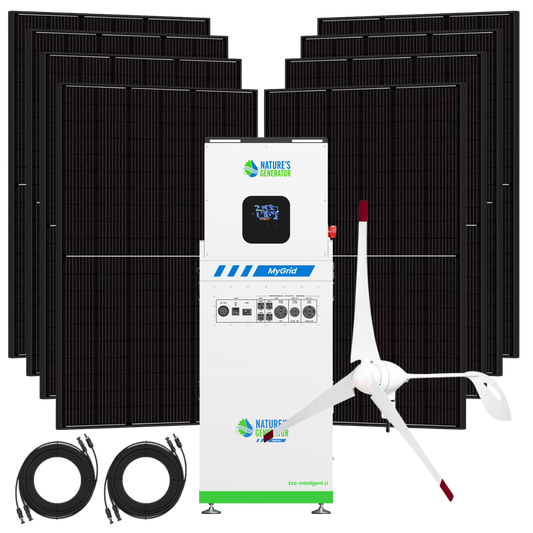
Nature’s Generator lists the MyGrid 10K Gen 2 Whole Home Generator with a 10,496Wh LiFePO₄ battery, 10,000W continuous output, solar charging support, and a specified 350W wind-charging input. Its listed solar input capacity is up to 12,000W, subject to the product's electrical specifications and connection requirements.
Those ratings are useful starting points, but they don't answer every installation question.
Before choosing a wind turbine, check its output voltage, controller requirements, electrical characteristics, and any protection equipment it needs. Confirm that the turbine can work with the generator's specified wind input. Follow the manufacturer's instructions and have a qualified installer assess the connection and applicable electrical requirements.
Questions displayed on the MyGrid 10K product page also touch on practical buying concerns, including powering a 50-amp camper, figuring out how many solar panels to use, and dealing with cloudy weather. These are the kinds of details that matter once you move beyond product ratings and start planning an actual setup. They're useful examples of customer questions, not proof of a particular winter performance result.
If you're comparing whole-home backup options, MyGrid 10K Gen 2 is worth evaluating for its combination of battery storage, solar input, and specified wind-charging support. Just make sure the full configuration works for your property, your loads, and the renewable sources you plan to use.
What Should You Check Before Buying a Winter Backup System?
Before spending money on panels, a turbine, or a larger battery, work through a few things.
1. Work out your daily energy use. List the appliances you need during an outage. Multiply each appliance's wattage by the hours you'll use it, then add the results in watt-hours. Check real equipment specifications where possible instead of relying on rough guesses.
2. Estimate winter solar output. Use your location's winter sunlight data. Account for shade, snow, panel orientation, and system losses. Don't base your decision on summer production figures.
3. Check the wind at the proposed turbine location. Look beyond your general area's reputation for being windy. Consider the wind resource at the planned rotor height, nearby obstructions, the turbine's power curve, and local installation restrictions.
4. Match generation with storage. Check the battery's usable capacity and charging limits. Make sure the inverter can support the loads you plan to run, including startup surges. Think about how long you need to get through poor weather before the next useful charging window.
5. Confirm that the components work together. Review the manufacturer's specifications for panels, turbines, charge controllers, batteries, and inverters. Have a qualified installer check wiring, grounding, overcurrent protection, permits, and local requirements.
One final point: plan for a stretch of bad weather. If your backup system needs to carry the refrigerator, internet, lighting, and water pump through a prolonged outage, use a conservative estimate of winter generation. You can always treat extra production as a bonus. It's much harder to make up for a system that was sized too optimistically.
Should You Choose Solar, Micro-Wind, or Both?
For many homes with good sunlight exposure, solar is the simpler place to start. Micro-wind deserves a closer look when a property has a strong, consistent wind resource and enough space for a properly installed turbine. Using both can help, but the added equipment only makes sense when the site and electrical setup support it.
The important part is doing the math before buying. Estimate daily winter generation, compare it with the energy your household needs, and make sure your battery can cover the gaps when the weather turns against you.
Nature’s Generator offers backup power equipment with solar charging and, on compatible systems such as MyGrid 10K Gen 2, specified wind-charging support. Choose your setup based on realistic winter output, usable battery capacity, and the needs of your home—not just the wattage printed on the box.


