


Harnessing the breeze isn't a new trick. For centuries, we used wooden sails to grind grain and pump water. However, the modern wind turbine is a different beast entirely. It’s a marvel of aerospace engineering and electromagnetic physics designed to turn the chaotic, invisible kinetic energy of moving air into a steady flow of electrons.
If you’ve ever wondered how a spinning blade translates into a charged smartphone, you’re looking at a chain of energy transformations. Let’s get started.
1. The Starting Line: Solar Energy Creates the Wind
It might seem strange, but wind energy actually starts with the sun. As solar radiation hits the Earth, it warms the surface unevenly. Forests, oceans, and deserts absorb heat at different rates, causing the air above them to warm and expand at different speeds.
As warm air rises, it creates a pocket of low pressure. Cooler, denser air rushes in to fill that gap. This movement of air is what we call wind. The air molecules possess kinetic energy, defined by the formula:
Ek = 12 mv2
In this equation, m is the mass of the air and v is its velocity. Because velocity is squared, even a small increase in wind speed results in a massive jump in available power. This is why solar and wind powered generators are so often discussed together; one creates the conditions for the other to thrive.
2. Aerodynamics: Capturing the Flow
The turbine’s blades are the "harvesters." They aren't just flat paddles; they are sophisticated airfoils, shaped like the wings of an airplane.
When wind flows over the blade, it travels faster over the curved top surface than the flatter bottom. This creates a pressure differential:
-
Lift: The low pressure on the top "pulls" the blade forward.
-
Drag: The resistance of the air "pushes" against the blade.
Because the blades are anchored to a central hub, they can't fly away. Instead, that lift forces them to rotate, converting linear kinetic energy into rotational mechanical energy.
3. The Nacelle: Inside the "Heart"
The blades are connected to a hub, which sits in front of a large housing called the nacelle. While it looks small from the ground, the nacelle is often the size of a school bus and contains the most critical components of the conversion process.
How Fast Does a Wind Turbine Spin?
A common question people ask is: how fast does a wind turbine spin? On a large utility-scale turbine, the blades usually rotate at a surprisingly slow 10 to 20 revolutions per minute (RPM). While this looks leisurely, the torque (turning force) is immense.
However, 15 RPM is far too slow to generate high-frequency electricity. This is where the gearbox comes in. Using a series of planetary gears, the gearbox "steps up" the rotation, taking that slow, heavy turn and converting it into a lightning-fast 1,500 to 1,800 RPM.
4. The Magic of Induction: The Generator
At the end of the high-speed shaft sits the generator. This is where the most significant scientific leap happens: the transition from mechanical motion to electrical energy.
This process relies on Faraday’s Law of Induction. Inside wind generators, powerful magnets spin inside a stationary cylinder lined with copper wire coils (the stator).
-
As the magnets spin, they create a changing magnetic field.
-
This changing field "pushes" the electrons in the copper wire.
-
This movement of electrons is electricity.
Specifically, turbines produce Alternating Current (AC), where the flow of electrons constantly changes direction as the magnetic poles flip past the copper coils.
5. Refining the Current: The Transformer
The electricity generated in the nacelle is usually at a relatively low voltage. If we tried to send this power across long distances as-is, most of it would be lost as heat due to the resistance of the wires.
To prevent this, the electricity travels down cables inside the turbine tower to a transformer. This device "steps up" the voltage to tens of thousands of volts. By increasing the voltage, we can transmit the power efficiently over miles of cable with minimal loss.
6. The Grid: Distribution to Your Home
Now that the wind is high-voltage AC electricity, it leaves the wind farm via underground cables. These lead to a substation, which acts as a traffic controller for the local electrical grid.
At the substation:
-
The electricity is integrated with power from other sources.
-
The voltage is adjusted to match regional transmission lines.
-
Inverters and controllers ensure the frequency is a perfect 60 Hz (or 50 Hz depending on your region) to avoid damaging household electronics.
Finally, the power travels through distribution lines on your street, passes through one last "step-down" transformer on a utility pole, and enters your home at a safe 120 or 230 volts.
7. Smart Controls: Maximizing Efficiency
Modern turbines aren't just passive objects; they are smart machines. To keep things running smoothly, three key systems are always at work:
-
Anemometer and Vane: These sensors measure wind speed and direction.
-
Yaw Drive: If the wind changes direction, the yaw motor rotates the entire nacelle to face the wind head-on.
-
Pitch Control: If the wind is too strong (which could snap the blades), the turbine "feathers" the blades—turning them edge-on into the wind to slow them down.
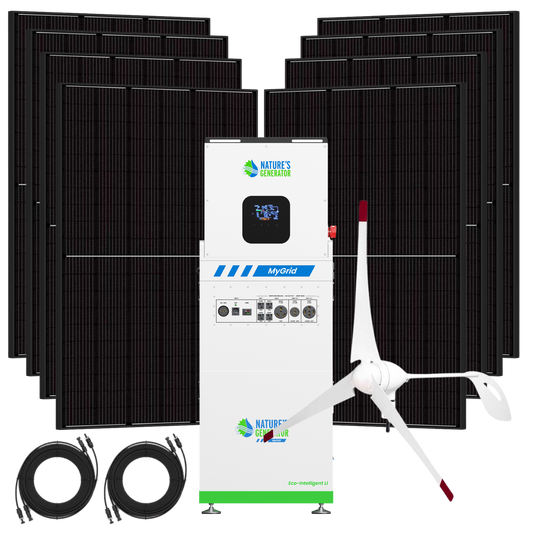
If you’re inspired by the large-scale physics of wind farms and want to bring that independence to your own property, Nature’s Generator offers a practical way to harness these forces. Their systems integrate the power of solar and wind powered generators, allowing you to capture energy from the sun during the day and the wind at night.


