


The landscape of home energy is shifting rapidly. As more homeowners move toward energy independence to combat rising utility rates and frequent grid instability, the financial barriers to entry are simultaneously lowering.
Recently, our team has observed a massive surge in interest regarding the Federal Solar Tax Credit, officially known as the Residential Clean Energy Credit. This incentive is perhaps the most significant tool available to help you transition to a reliable home backup power system.
We will try out best to answer the critical questions you need to ask before investing: What equipment qualifies? How does the 30% credit actually impact your bottom line? And specifically, how can you apply this credit to Nature’s Generator systems to maximize your savings? Whether you are looking at a portable backup power solution for van life or a robust whole-home backup system, understanding the nuances of the Investment Tax Credit (ITC) is the key to making a smart, cost-effective decision.

What exactly is the Residential Clean Energy Credit and how does it lower my costs?
The Federal Solar Tax Credit is a dollar-for-dollar reduction in the amount of federal income tax you owe. Unlike a deduction, which simply lowers your taxable income, a credit directly subtracts from your tax liability. Under the Inflation Reduction Act of 2022, this credit was bolstered and extended, providing a 30% credit for systems installed between 2022 and 2032.
Based on our experience helping customers navigate these incentives, the most important distinction to understand is that this is a "non-refundable" credit. This means that while the credit can reduce your tax bill to zero, the IRS will not cut you a check for any "excess" credit. However, a major benefit often overlooked is the carryover provision. If your credit exceeds your tax liability for the year you install your system, you can carry the remaining balance forward to future tax years.
How does the 30% math work in practice?
If you invest $10,000 in a comprehensive system including solar panels and professional installation, your federal tax credit would be $3,000. If you owe $5,000 in federal taxes that year, you would only pay $2,000. If you only owed $2,000 in taxes, your tax bill would drop to zero, and you would carry the remaining $1,000 credit over to the next year.

Can I claim the 30% tax credit on Nature’s Generator solar systems and battery storage?
One of the most frequent questions our support team receives is whether "portable" or "modular" systems like those from Nature’s Generator qualify. The short answer is: Yes, provided they meet specific IRS criteria.
Historically, the tax credit was primarily focused on permanent, roof-mounted solar arrays. However, the updated Section 25D of the Internal Revenue Code expanded the scope. To qualify for the credit, the equipment must be installed on a home you use as a residence in the United States. This includes your primary home or a secondary vacation home (provided you do not rent it out full-time).
The 3kWh Battery Threshold
A pivotal change in the law now allows for standalone battery storage to qualify for the 30% credit, even if it isn't immediately connected to solar panels. The requirement is that the battery must have a capacity of at least 3 kilowatt-hours (kWh).
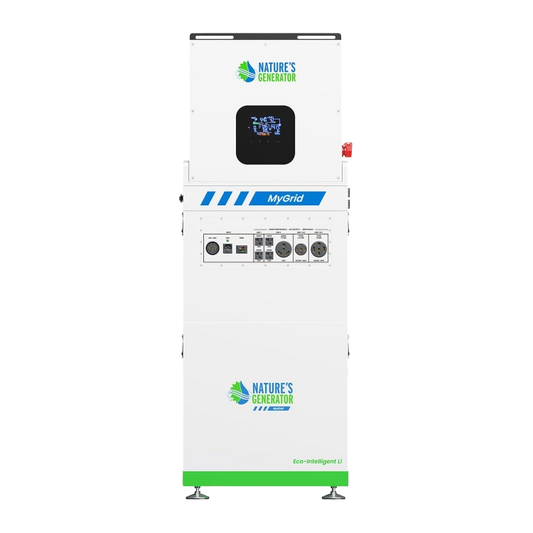
Our Powerhouse systems are specifically designed to meet and exceed these requirements. For instance, a Powerhouse system with additional Power Pods easily clears the 3kWh threshold, making the entire storage component eligible for the 30% credit. This makes it one of the most cost-effective ways to secure whole-home backup because the tax credit effectively subsidizes nearly a third of the hardware cost.

What specific solar equipment and labor costs are eligible for the 30% deduction?
When calculating your total project cost, many homeowners mistakenly only count the panels. The IRS allows you to include a wide array of associated expenses, which significantly increases the value of your 30% credit. Based on current guidelines, the following expenses are typically eligible:
-
Solar Photovoltaic (PV) Panels: Any panels used to power the home.
-
Battery Storage Technology: Systems with a capacity of 3kWh or greater (like the Powerhouse).
-
Balance-of-System Equipment: This includes wiring, inverters, and mounting hardware.
-
Labor Costs: This is a big one. You can include the costs for onsite preparation, assembly, and original installation.
-
Transfer Switches and Sub-panels: If you are installing an Automatic Transfer Switch to link your generator to your home’s existing circuits, the equipment and the electrician's labor are generally considered part of the qualified solar electric property expenditure.
Does the "Portable" nature of some generators disqualify them?
The IRS focuses on the use and installation of the equipment. If you are using a Nature's Generator system as a functional power source for your home and it is integrated into your home's electrical system (via a transfer switch or permanent solar mounting), it aligns with the intent of the Residential Clean Energy Credit. We always recommend consulting with a tax professional to ensure your specific configuration meets the most current IRS definitions of "installed" property.

How does the tax credit change the ROI of a whole-home backup system versus a portable setup?
When choosing between a traditional gas-powered generator and a solar-powered backup system, the "sticker price" can be misleading. A gas generator has a lower upfront cost but offers zero tax incentives and requires ongoing fuel and maintenance expenses.
In contrast, our team views the Nature’s Generator systems as long-term financial assets.
Nature’s Generator becomes the more affordable option. Furthermore, the solar system adds value to your property and provides silent, emission-free power that functions during fuel shortages. The 30% credit is the catalyst that makes this Return on Investment (ROI) happen much faster.

Is there a limit to how much I can claim or a deadline I need to meet?
One of the most pro-consumer aspects of the current Federal Solar Tax Credit is the lack of a maximum cap. Whether you spend $5,000 or $50,000 on a qualifying solar and storage system, you are entitled to the full 30% credit.
Timeline of the Credit Percentages:
-
2022–2032: 30% (The current "sweet spot")
-
2033: 26%
-
2034: 22%
-
2035: The credit is scheduled to expire unless renewed by Congress.
Based on our experience, waiting usually costs more than the potential technology improvements could save. Utility rates continue to climb, and the 30% incentive is at its absolute peak right now. By installing your system this year, you lock in the highest possible credit and start seeing "free" energy production immediately.
How do I actually file for the credit using IRS Form 5695?
Filing for the credit is a straightforward process that occurs when you file your annual federal income taxes. You will need to use IRS Form 5695, "Residential Energy Credits."
-
Calculate Costs: Total all your receipts for the Nature’s Generator equipment, solar panels, and any professional labor (like an electrician for the transfer switch).
-
Complete Part I: This section is for "Qualified Solar Electric Property Costs." You will enter your total expenditure here.
-
Apply the 30%: The form will guide you through multiplying your costs by 0.30 to determine your credit.
-
Transfer to Form 1040: The final credit amount is then moved to your main tax return form to reduce your liability.
Expert Tip: Keep all your invoices and receipts from Nature's Generator in a dedicated file. While you don't need to mail them with your return, you must have them on hand to substantiate the basis of your credit if the IRS ever requests more information.
Making the Decision for Energy Independence
The Federal Solar Tax Credit is a rare opportunity where government policy directly aligns with your personal goals for home security and financial savings. By choosing a Nature’s Generator system, you are investing in a sophisticated power plant for your home that the federal government is willing to subsidize by 30%.
Our team is dedicated to providing reliable solutions for home backup power. We recommend reviewing your tax situation with a professional and then selecting the Nature’s Generator system that matches your home’s load requirements. Don't let the 30% savings expire—take control of your power and enjoy the peace of mind that comes with a solar-backed home.


