


The transition to renewable energy is a necessity for homeowners seeking energy independence and security. When the grid goes down, the first question our customers ask is: "Can a solar generator run my AC or heater?" High-wattage appliances like air conditioners and space heaters are notorious for draining batteries quickly, making it essential to choose the best solar power generator for the job.
We, at Nature’s Generator, have spent years engineering systems designed to handle these heavy loads. Providing a solar backup generator that can sustain a comfortable home temperature requires an understanding of surge power, continuous wattage, and expandable capacity. In this guide, our team will break down exactly how you can power your HVAC systems using solar energy and which configurations offer the most reliable backup power during an emergency.

Will a Solar Generator Actually Start and Run a Central AC Unit?
One of the most common misconceptions in the solar industry is that all portable generators are created equal. When it comes to central air conditioning, the answer depends entirely on the "Starting Wattage" versus the "Running Wattage."
A standard central AC unit (3-ton) can require anywhere from 3,500 to 5,000 watts to run, but it may need up to 10,000+ watts just to kick the compressor into gear. This is known as the "surge." Most entry-level solar generators will simply trip their internal breakers when faced with this demand.
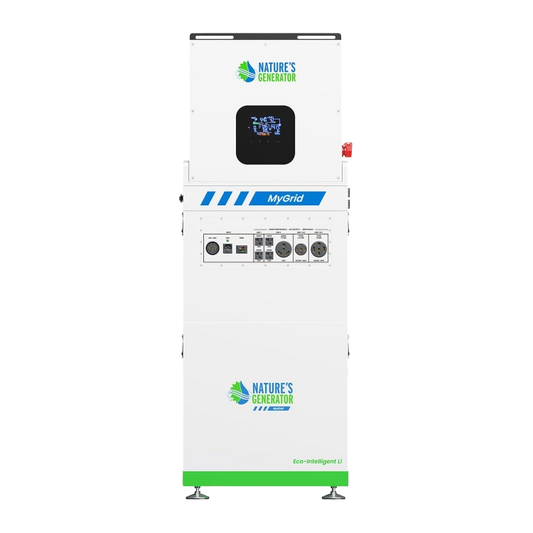
To run a central AC, you need a high-capacity system like the Nature’s Generator Powerhouse V2, which provides up to 120V/240V dual output and a massive 7200-watt peak.
Scenario: Imagine a summer blackout in Texas. A homeowner with a standard 1800W solar unit finds they can only run a box fan. However, a user with a Powerhouse system can link multiple Power Pods to sustain a window AC unit (1,200W) for several hours, or even a mini-split system throughout the night, ensuring the family remains safe from extreme heat.
How Many Watts Does a Space Heater or Electric Heater Need?
Heating is usually more energy-intensive than cooling. While an AC uses a compressor to move heat, an electric heater uses resistance to create it. A standard portable space heater usually has two settings: 750W and 1,500W.
If you are using a solar backup generator with a 2,000Wh (watt-hour) capacity, a 1,500W heater will drain that battery in less than 90 minutes. This is why capacity is just as important as output.
Energy Consumption Breakdown:
-
Small Space Heater: 750W – 1,500W
-
Electric Blanket: 100W – 200W (A much more efficient backup option)
-
Infrared Heater: 800W – 1,200W
-
Oil-Filled Radiator: 1,500W
To run these effectively, our team recommends the Nature’s Generator Elite. It offers a 3600W peak output, allowing it to handle the initial draw of a heater easily. However, for long-term heating during a winter storm, we always advise customers to supplement their setup with extra Power Pods to increase the total watt-hours available.
What Features Make the Best Solar Power Generator for Heavy Appliances?
When comparing options for the best solar power generator, you must look beyond the flashy marketing and focus on three technical specs:
1. Pure Sine Wave Inverter
Large appliances with sensitive electronics (like modern smart ACs) require clean power. Nature’s Generator uses Pure Sine Wave inverters to ensure that your appliances run smoothly without humming or overheating, which can happen with cheaper Modified Sine Wave units.
2. 240V Output Capability
Standard wall outlets in the US are 120V. However, many central AC units, well pumps, and clothes dryers require 240V. If your goal is whole-home backup, you need a system like the Powerhouse that can natively support 240V appliances.
3. Expandability (The "Daisy-Chain" Factor)
A fixed-capacity generator is a liability. If a storm lasts three days instead of one, you need more fuel (battery storage). Our systems are designed to be expandable. You can start with a gold-tier system and add pods as your budget and power needs grow.
Can You Run a Window AC Unit or Mini-Split Off-Grid?
The short answer is: Yes, and it is actually very efficient. Small window AC units (5,000 to 8,000 BTU) typically pull between 400W and 900W while running. This is the sweet spot for solar backup systems.
This one is someone in Florida who uses the Nature's Generator Gold System to power an 8,000 BTU window unit in their master bedroom during hurricane season. By keeping just one room cool, they can sleep comfortably while the rest of the house remains unpowered. They reported that with three 100W solar panels, they were able to recharge the unit during the day while the AC was running, creating a sustainable cycle of power.
Pro Tip: To maximize runtime, we recommend "pre-cooling" the room during the day when your solar panels are producing the most energy, then turning the AC to a lower setting at night to conserve the battery.
How Do I Calculate How Long My Generator Will Last?
To avoid being left in the dark (or the heat), you must perform a basic load calculation. We help our customers do this by using the following formula:
Total Watt-Hours (Wh) / Load Watts (W) = Runtime (Hours)
-
Example A (The AC Load): You have a 4,800Wh system (Powerhouse + 1 Pod). You want to run a 600W Window AC.
-
Calculation: 4,800 / 600 = 8 Hours of continuous run time.
-
Example B (The Heater Load): You have a 1,920Wh system (Elite). You want to run a 1,500W Space Heater.
-
Calculation: 1,920 / 1,500 = 1.2 Hours.
This comparison illustrates why we prioritize efficiency. For heating, we often suggest our customers use the solar backup generator to power an electric blanket or a high-efficiency heat pump rather than a standard space heater, as it can extend your runtime from one hour to over twelve hours.
Why Is Nature’s Generator the Reliable Choice for Home Backup?
Our philosophy at Nature’s Generator is built on reliability and accessibility. Many competitors offer "all-in-one" units that are impossible to repair or upgrade. We take a different approach.
-
Modular Design: We believe you shouldn't have to buy a whole new generator just because you need more power. Our pods allow you to grow your system over time.
-
Diverse Charging Inputs: Our generators don't just charge from the sun. You can charge via AC wall outlets or even Wind Turbines. This is critical for heating needs, as winter storms often bring wind but very little sunlight.
-
User-Friendly Interface: You don't need to be an electrician to use our products. With clear displays and simple plug-and-play ports, you can get your AC or heater running in seconds.
Comparison: Solar Generators vs. Gas Generators for HVAC
When a blackout hits, many reach for a gas generator. However, for running ACs and heaters, solar offers several distinct advantages:
|
Feature |
Gas Generator |
Nature’s Generator (Solar) |
|
Indoor Use |
NO (Carbon Monoxide Risk) |
YES (Safe for Bedrooms) |
|
Noise Level |
Very High (70-80 dB) |
Silent |
|
Fuel Source |
Gasoline (Expires/Hard to get in a crisis) |
Sunlight/Wind (Infinite & Free) |
|
Maintenance |
Oil changes, spark plugs, carburetors |
Maintenance-free |
|
Cost over time |
High (Continuous fuel costs) |
Zero (One-time investment) |
For long-term survival and comfort, the best solar power generator is one that doesn't rely on a dwindling supply of gasoline.
Preparing Your Home for Extremes
Is it possible to power air conditioning units or space heaters using a solar generator? Absolutely—if you have the right system. To successfully manage high-wattage appliances, you must prioritize a system with high peak-wattage output and expandable battery capacity. A single battery might get you through a few hours, but a robust, modular setup from Nature’s Generator can keep your home habitable for days on end.
When choosing your setup, remember:
-
Calculate your surge: Ensure the generator can handle the "start-up" power of your AC.
-
Plan for capacity: Add Power Pods if you intend to run heating elements for more than an hour.
-
Diversify your intake: Consider adding a wind turbine for 24/7 charging capability.
Explore our whole-home backup solutions today and ensure your family stays cool in the summer and warm in the winter, no matter what happens to the grid.


