


You are sitting in the dark, wondering if the food in the fridge is about to pull a disappearing act, and wishing we’d pulled the trigger on a better backup plan. Fast forward to 2026, and everyone’s talking about the green revolution.But the question remains: is a solar power generator actually beefy enough to handle the whole house, or is that just marketing fluff?
Honestly, finding reliable backup power used to mean dealing with the deafening roar of a gas engine, but the tech has finally caught up. At Nature’s Generator, we’ve spent years in the trenches of energy tech, and we’re here to give you the straight talk on whether a whole home power generator fueled by nothing but the sun is a pipe dream or your next best investment.
Can You Really Keep the Whole House Humming on Solar?
If you asked me this five years ago, I’d have told you to keep a flashlight and a prayer handy. But things have changed. In 2026, the realism of solar backup isn't about whether it can work—it’s about how you set it up. The big bottleneck used to be the "surge"—that massive gulp of electricity an AC unit takes when it first kicks on.
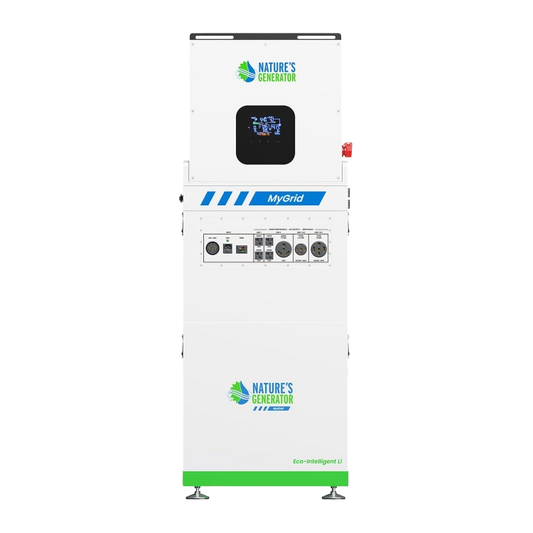
Nowadays, we’re seeing inverters that don't just whimper and shut down when the heavy-hitters start up. To make a whole-home setup a reality, you’ve got to look at something like the Nature’s Generator Powerhouse V2. The secret sauce here is the 120V/240V split-phase output. Most of those "lunchbox" style generators you see on social media only give you 120V. That’s fine for charging a phone or a laptop, but if you want to run your well pump or your dryer? You need that 240V heft. Without it, you’re not backing up a home; you’re just running a glorified power bank.
In our experience, the folks who are happiest with their solar transition are the ones who understand three basic things:
-
Your inverter needs to handle the grunt work (starting watts).
-
Your battery bank needs to be deep enough to get you through a string of cloudy Tuesdays.
-
You need enough panels to actually fill that tank back up before the sun goes down.
Breaking Down the Math: How Many Watts Are We Actually Talking About?
Let’s get into the nitty-gritty. Most people have zero clue how much juice their life actually requires until the grid goes kaput. If you want to keep the lights on, the Wi-Fi screaming, and the fridge cold, you're looking at a critical load. But if you want to live like the power never went out—hot showers, laundry, the works—you’re stepping into "total load" territory.
Based on the data we’ve pulled from real-world setups, a standard 2026 suburban home usually sips around 5,000 to 7,000 watts when things are running normally. But "normally" is a trap. You have to account for the spikes.
|
The Energy Vampires |
Running Watts (The Marathon) |
Starting Watts (The Sprint) |
|
That 3-ton Central AC |
3,500 - 4,000 |
6,500+ |
|
The Deep Freezer |
500 |
1,200 |
|
Well Pump (The big one) |
1,200 |
3,000 |
|
Coffee Maker (Essential!) |
1,500 |
1,500 |
|
House-wide LED Lights |
150 |
150 |
Here’s the thing: a realistic solar setup isn't a one-size-fits-all box. It’s more like a LEGO set. You might start with the main hub, but if you realize your family uses more juice than a small stadium, you’ve got to be able to stack more "expansion pods." That’s why we lean so hard into modularity at Nature’s Generator. It takes the guesswork (and the fear of running out of juice) out of the equation.
Why Portable Solar Units Often Leave People in the Dark
We see it all the time. Someone buys a whole home unit from a big-box store, the power goes out, and they realize they can't even plug their furnace into it. Why? Because most portable units are designed for van-life or camping, not the complex wiring of a 21st-century home.
If you want to avoid that "I’ve been had" feeling, you need to look for these three things:
-
The 240V Jump: I can’t stress this enough. If the unit doesn't have a four-prong 240V outlet, it’s not a whole-home solution. Period.
-
Battery Stacking: You don't want to be stuck with whatever capacity came in the box. You want a system that grows with you.
-
Pro-Grade Solar Input: You want to be able to use the big, rigid panels that sit on your roof, not just the flimsy fold-up ones that blow away in a stiff breeze.
Getting It Hooked Up: Do You Really Need an Electrician?
This is where the rubber meets the road. You can have the most powerful generator in the world, but if it’s just sitting in your garage while your house is dark, it’s a very expensive paperweight. You need a way to get that power into your walls.
The "Weekend Warrior" Route: If you’re the type who isn't afraid to open a breaker panel (and you know what you’re doing), you can install a manual transfer switch. It’s basically a sub-panel that lets you pick and choose which circuits get the solar "treatment." It’s a solid DIY project that saves you a ton of cash.
The "Set It and Forget It" Route: If the thought of touching a copper wire makes you sweat, call in the pros. An automatic transfer switch is the gold standard. It’s like having a digital brain watching the grid. The second the power lines go down, it snaps the solar system into gear. You might see the lights flicker for a millisecond, and that’s it. Back to business.
The Cold, Hard Cash: Solar vs. Gas in 2026
Let's talk about the elephant in the room: the price tag. Yes, a gas-guzzling standby generator looks cheaper on paper when you’re standing in the aisle at the hardware store. But let’s look at the "hidden" costs of those old-school clunkers.
-
The Fuel Headache: Gas goes bad. It gets expensive. And when a storm hits, the lines at the gas station are five miles long. Solar fuel? It’s delivered to your roof for free, every single morning.
-
The Maintenance Grind: Gas engines need oil changes and spark plugs. They need to "exercise" (which is just a fancy way of saying they burn fuel for no reason once a week). Solar generators have zero moving parts. No oil, no noise, no fumes.
-
The Tax Man: In 2026, the government is still handing out some pretty juicy tax credits for battery storage. You won't get a dime back for buying a gas generator. In fact, with some of the new emissions laws, they might eventually become a liability.
What Does This Actually Look Like When the Grid Fails?
We chatted with a customer out in the Midwest who lived through a nasty five-day outage last winter. They were running a Nature's Generator Powerhouse with a couple of extra batteries.
On Day 1, they didn't even realize the neighbors were in the dark until they looked out the window. They kept the pellet stove running, the fridge humming, and even watched a movie. By Day 4, after three days of gray, snowy skies, they had to get smart. They stopped using the toaster and let the house get a few degrees cooler to save juice. But when the sun finally poked out on Day 5, their panels kicked into high gear, and they were back to 100% before dinner.
That’s the "reality check." It’s not about having infinite power; it’s about having smart power. It’s about not having to worry if your family is going to be cold or hungry.
The AC Question: Can Solar Handle the Heat?
"But can I run my AC?" It's the million-dollar question. In the old days, the answer was "maybe for ten minutes." But with the Zone Cooling Method, we’ve cracked the code.
Instead of trying to cool the guest bedroom and the basement you never use, you point all that solar energy toward a high-efficiency mini-split or a window unit in your main living space. It’s about being surgical with your power. By using a Powerhouse system, you’ve got the 240V muscle to run these units without breaking a sweat—or your batteries.
Is It Time to Cut the Cord?
So, is a solar powered generator for whole house backup realistic? If you’re looking for a "magic box" that lets you leave every light in the house on while running the dishwasher three times a day during a storm, you’re going to be disappointed.
But if you’re looking for a sophisticated, quiet, and incredibly reliable way to keep your life moving when the grid gives up? Then yes, it’s more than realistic—it’s the future.
To get it right, you just need a plan:
-
Know your numbers. Don't guess on your wattage.
-
Go big on the inverter. 240V is the only way to go for a real home.
-
Think in modules. Start with what you can afford and add batteries as you go.
-
Connect it properly. Use a transfer switch so you aren't tripping over extension cords in the dark.
Nature’s Generator has been in this game a long time, and we’ve built our systems to be the backbone of a resilient home. Whether you're worried about the next big hurricane or you're just tired of your local utility company’s rising rates, a Nature’s Generator setup puts the power back where it belongs: in your hands. It’s quiet, it’s clean, and most importantly, it actually works


