


You open your monthly electric bill, expecting a standard number, and instead, you’re hit with a figure that feels more like a mortgage payment. At Nature’s Generator, we’ve spent years in the trenches of the energy industry, and we’ve seen the writing on the wall: the "powers that be" are making it harder—and much more expensive—to just live your life.
This blog breaks down how you can avoid getting trapped by predatory rates and use smart technology to protect your money and make better financial moves. We’re going to dive deep into how a reliable backup power strategy, anchored by a high-capacity solar power generator, can effectively act as your personal firewall against the grid. Whether you’re looking for a full-home generator to keep everything running smoothly or a portable backup power solution for the essentials, our experienced team can help you take control and rely less on your utility company.
Why does my electric bill skyrocket right when I get home from work?
If you feel like you're being punished for cooking dinner or washing a load of laundry at 6:00 PM, you aren't imagining things. Most utility companies have moved to what they call Time-of-Use (TOU) pricing. In plain English? They charge you way more for juice when everyone else is using it. This is what the industry calls peak demand.
Think of it like Uber’s surge pricing, but for your house. When the sun starts setting and people head home to crank up the air conditioning and start the dishwasher, the grid gets stressed. To handle the load, utilities have to fire up peaker plants, which are expensive and inefficient to run. Instead of eating that cost, they pass it directly to you. In our experience, these peak rates can sometimes be three or four times higher than what you pay at midnight.
It’s a bit of a highway robbery situation, honestly. You're being squeezed right when you need power the most. To beat this system, you need a way to store cheap energy (or free energy from the sun) and use it during those high-priced windows. That’s where the Nature’s Generator philosophy comes in—giving you the tools to opt-out of the grid’s most expensive hours.
The "Duck Curve" and Why It’s Burning a Hole in Your Pocket
You might have heard experts talk about the “duck curve”. It sounds weird, but it’s just a graph showing how solar energy floods the grid during the day and then disappears exactly when demand spikes in the evening. This creates a massive gap that utilities fill with high-cost electricity. By having your own storage, you effectively flatten your own curve and keep your money in your wallet where it belongs.
How does the MyGrid 10K actually "shave" those costs off my monthly statement?
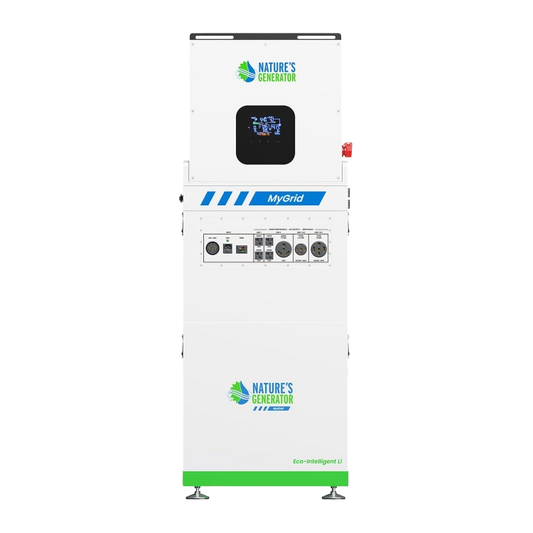
If you want to win the game against the utility companies, you need to understand peak shaving. The MyGrid 10K is essentially a massive energy reservoir. The smartest way to use this system isn’t just for when the lights go out—it’s for when the prices go up.
Here is the "back of the napkin" strategy:
-
The Fill-Up: During the day, your solar panels (or even the grid during low-cost morning hours) fill the MyGrid 10K’s batteries.
-
The Hand-Off: When that 4:00 PM to 9:00 PM danger zone hits and the utility rates spike, your system automatically switches over.
-
The Savings: Your home pulls its power from the stored energy in the MyGrid 10K instead of the grid.
You’re still using the same amount of electricity, but you’re effectively arbitraging the price. You’re using cheap electricity to power your life during expensive times. Because the MyGrid 10K has such a beefy inverter and massive storage capacity, it can handle the heavy lifting that smaller batteries just can't touch.
Can a solar-powered backup really keep my whole house running when the grid is being fickle?
We know what you’re thinking—"Can a battery really handle my AC, my fridge, and my TV all at once?" It’s a fair question. A lot of the stuff you see on the market is basically just a glorified phone charger. But when we talk about a whole home power generator setup, we’re talking about serious hardware.
The MyGrid 10K isn't some dainty piece of tech. It’s designed to be the heart of your home’s electrical system. In our experience, the key to true energy independence is capacity. If your battery is too small, you’ll run out of juice halfway through the peak window and be forced back onto the grid. The MyGrid 10K is built to go the distance.
|
Feature |
MyGrid 10K Capacity |
Why It Matters for Your Bill |
|
Output |
10,000 Watts |
Can start high-surge items like well pumps. |
|
Expandability |
Modular design |
Add more "fuel" (batteries) as you need them. |
|
Input |
Dual Charging |
Solar and Grid can work together to keep you topped off. |
By using an Automatic Transfer Switch (ATS), the transition is seamless. You won't even notice the grid "took a hike" while you're watching a movie or cooking dinner. That’s the level of reliability our team insists on.
What does the math look like? Real talk on ROI and monthly savings
Let’s get down to brass tacks. Is this worth the investment? We’ve seen customers in high-rate states like California, Massachusetts, and Hawaii who are paying upwards of $0.45 per kWh during peak times.
If your home is pulling 2,000 watts an hour during a 5-hour peak window, that’s 10 kWh of usage.
-
Without MyGrid: 10 kWh x $0.45 = $4.50 per day.
-
With MyGrid: 10 kWh x $0.00 (Solar) = $0.00 per day.
That’s $135 a month in "peak surcharges" alone. Over a year, you’re looking at over $1,600 in savings. And that doesn't even account for the fact that utility rates are rising faster than most people’s salaries. We’ve had feedback from users who say the system practically pays for itself just by dodging these "peak-time penalties," even before you factor in the peace of mind during a blackout.
Example Scenario: The Smith Family in Arizona
The Smiths were tired of their $500 summer electric bills. Most of that was from their AC running at 5:00 PM. They installed a solar power generator system with the MyGrid 10K. Now, they pre-cool their house in the morning when rates are low, and then let the MyGrid take over the AC load during the evening crunch. Their bill dropped by 60% in the first two months. That's not a fluke; that's just smart energy management.
Is the MyGrid 10K a "weekend project" or do I need to call the cavalry?
One of the things our team is most proud of is that we didn't build a black box that requires a secret society of technicians to install. We’re big fans of the DIY spirit.
The "Get Your Hands Dirty" Part: Setting up the solar panels and connecting the expansion batteries is honestly pretty straightforward. It’s mostly plug-and-play. If you can put together a piece of furniture, you can probably handle the bulk of the MyGrid setup. This saves you thousands in labor costs that other "pro-only" systems force you to pay.
The "Call the Pro" Part: Now, don’t go poking around your main breaker box if you don't know what you’re doing. For the final tie-in—specifically installing a transfer switch—we always recommend calling a local electrician. It’s a quick job for a pro, and it ensures everything is up to code. By doing the "heavy lifting" of the setup yourself and just hiring a pro for the final hookup, you get a world-class reliable backup power system for a fraction of the traditional cost.
Will this thing actually start my AC or will it just fizzle out?
This is where the wheat is separated from the chaff. Starting an air conditioner or a well pump requires a massive kick of energy known as a surge load. Many portable units will simply give up the ghost when an AC compressor tries to kick in.
Based on our experience, the pure sine wave inverter in the MyGrid 10K is the secret sauce here. It’s built to handle those massive spikes without breaking a sweat. This means you don't have to choose between saving money on your bill and staying cool in July. You can do both.
And because it’s a pure sine wave, it’s clean power. Your sensitive electronics—like that fancy OLED TV or your high-end gaming rig—won’t be fried by dirty electricity. It’s the same quality (often better) than what comes out of your wall.
Taking Control of Your Energy Future
At the end of the day, the grid isn't getting any younger, and utility rates aren't getting any lower. You can either keep paying the peak demand tax every month, or you can take a stand. Managing your load with a MyGrid 10K isn't just about being green, it's about being smart with your hard-earned money.
Whether you're looking to completely cut the cord or just want a reliable backup power system that pays for itself over time, Nature’s Generator has the gear to get you there.


