


When designing an eco-friendly energy setup, finding a reliable backup power solution that seamlessly manages high demands is paramount. Whether you want to integrate a solar power generator for daily savings or establish a robust whole home power generator for blackout security, flexibility matters. Many homeowners believe transitioning away from traditional fossil-fuel options requires permanent modifications, but modern portable backup power technology completely redefines this experience.
In this comprehensive guide, our team answers exactly how you can establish a robust, eco-conscious energy ecosystem using the latest innovation from Nature’s Generator. We will outline how this system operates, how to pair it with renewable sources, and whether it can handle heavy household appliances. If you are considering getting the MyGrid 10K, this deep dive reveals everything you need to know about its performance, setup, and return on investment.
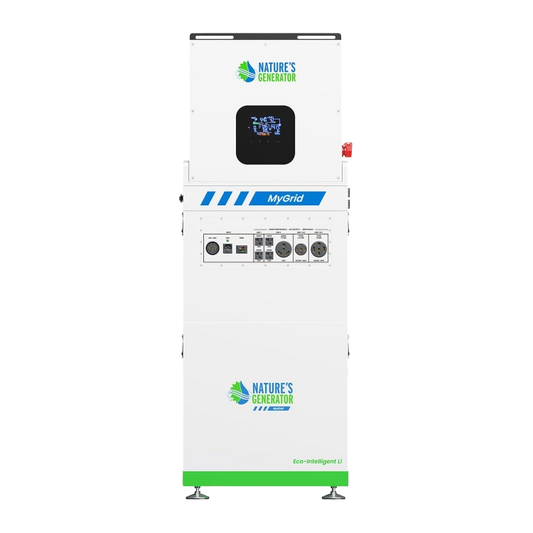
Why Choose the MyGrid 10K for a Sustainable Home Charging Station?
Homeowners today face a dual challenge: skyrocketing utility rates and increasingly frequent grid outages due to severe weather events. To solve these vulnerabilities, our team searches for energy solutions that balance raw muscle with sustainable input. The MyGrid 10K Whole Home Generator represents an evolutionary leap in standalone residential power systems, offering true energy independence.
What makes this unit different from traditional solar generators?
Conventional solar generators often fall into one of two categories: they are either too small to run heavy household loads or too rigid, requiring permanent, costly professional installations that cannot be moved. This system shatters those constraints. Operating as a standalone home electricity hub, it features industrial-grade Lithium Iron Phosphate (LiFePO4) cell chemistry capable of delivering over 6,000 lifecycles. Unlike traditional lithium-ion variants, LiFePO4 chemistry is exceptionally thermally stable, non-combustible, and retains its storage capability for over a decade.
Furthermore, our engineering assessments show that the primary point of differentiation lies in its split-phase capability. While standard portable power stations only output 120V, this system naturally outputs a clean pure sine wave at both 120V and 240V split-phase simultaneously. This matches the exact configuration of a standard utility hookup, turning your property into a localized microgrid. Pure sine wave output is vital because it protects delicate electronics—such as laptops, modern smart refrigerators with digital inverters, and medical equipment—from the electrical noise and distortion generated by modified sine wave alternatives.
Additionally, our technical reviews emphasize that the LiFePO4 battery array maintains a remarkably flat discharge curve. Standard lead-acid batteries suffer from substantial voltage drops as they empty, which can cause appliances to strain or shut down early. In contrast, this advanced lithium configuration delivers consistent, full-strength power from a 100% state of charge all the way down to zero.
How does the 10,000-watt power output handle high-demand residential loads?
To appreciate a 10,000-watt continuous power rating, one must understand how household loads behave. Appliances like central air conditioning units, deep well pumps, electric clothes dryers, and high-speed electric vehicle chargers demand a massive surge of electricity just to start up. This initial draw is known as surge or peak wattage.
Our field testing confirms that this unit delivers an impressive 20,000-watt peak output capacity. This means that when a 240V well pump kicks on alongside a kitchen refrigerator, the system absorbs the initial spike effortlessly without tripping its internal breakers. It provides 10,496Wh of built-in storage capacity, providing a steady stream of electricity that satisfies both sensitive electronic equipment and heavy machinery. When compared to wall-mounted alternatives that lock you into a single permanent location, this freestanding unit gives you industrial-tier power output with the added benefit of physical mobility.
How Do You Install and Connect the MyGrid 10K Without Permanent Wiring?
One of the most frequent queries we receive from property owners relates to setup friction. Traditional whole-house battery backups demand thousands of dollars in permitting, structural approvals, and invasive hardwiring inside your walls.
Is this home energy system safe and practical for renters?
Renters have historically been entirely locked out of the clean energy transition. Landlords rarely permit tenants to mount heavy battery racks or modify electrical panels permanently. Because this system utilizes a freestanding, compact cabinet design equipped with integrated mobility features, it represents a perfect renter-friendly solution.
If you decide to relocate to a new apartment, a different single-family home, or a temporary job site, you can simply disconnect the cords and wheel the unit right along with you. It provides complete power security without altering the physical infrastructure of the property, ensuring you do not forfeit your security deposit while protecting your family from unexpected blackouts. The robust metal enclosure also ensures that the internal components remain safe from external impacts, making it as durable on a temporary job site as it is in a suburban garage.
How does the plug-and-play design reduce traditional installation costs?
Our team emphasizes that the true cost of an alternative energy system includes installation labor. A traditional hardwired home battery system can easily add thousands of dollars in electrician fees alone. This system utilizes what we define as a point, plug, and power approach.
To integrate it into your household circuits safely, you can connect it to a manual or automatic transfer switch. For instance, pairing the unit with an automatic transfer switch provides a lightning-fast auto-switch transfer time of less than 20 milliseconds. During a grid failure, the system detects the interruption instantly and transitions your selected emergency circuits to battery power without human intervention. Your clocks will not even reset, and your home network stays fully operational. By eliminating the need to completely rebuild your main breaker panel, the plug-and-play architecture drastically reduces setup times and keeps hard earned money in your pocket.
What Elements Are Required to Build a Fully Renewable Charging Eco-System?
Raw battery capacity is only half of the sustainability equation; you must also consider how you replenish that stored energy cleanly. True off-grid resilience requires multiple charging pipelines to ensure your home station never runs dry.
How many solar panels can you connect to maximize daily charging inputs?
Based on our extensive field trials, matching your battery capacity with a robust solar array is critical for multi-day outages. The integrated Maximum Power Point Tracking (MPPT) solar charger in this system is an absolute powerhouse, supporting up to a massive 12,000W solar input capacity ranging from 120Vdc to 550Vdc.
By utilizing high-efficiency monocrystalline rigid solar panels, you can construct a solar canopy that feeds clean energy directly into the unit. MPPT technology is crucial here because it constantly tracks the voltage and current profile of the panels to maximize power delivery into the LiFePO4 cells, adjusting dynamically for real-time changes in cloud cover and ambient temperature. Contrast this with older PWM controllers that waste up to 30% of incoming solar power. Because of its advanced internal charging architecture, the generator can achieve up to an 80% charge in roughly two hours when maximized, ensuring that even during short winter days with limited peak sunlight, you can fully saturate your home storage system.
Can a wind turbine be used to maintain continuous power during cloudy days?
A common mistake homeowners make when switching to renewable energy is relying entirely on a single weather-dependent source. What happens when a severe storm front blocks the sun for four consecutive days, or during the middle of a dark winter night?
To solve this, the MyGrid 10K Solar and Wind Generator for Home includes dedicated internal circuitry to handle wind turbine charging. Our team highly recommends adding a 350W wind turbine to your layout. Wind speeds often pick up during stormy weather and overnight hours precisely when solar production drops to zero. This dual-source integration guarantees a continuous, 24-hour cycle of clean energy generation, creating an unshakeable sustainable home charging station.
Furthermore, for homes that already feature a rooftop grid-tied solar array, this generator supports AC coupling applications. Standard grid-tied solar systems automatically shut off during a blackout to prevent backfeeding electricity into the lines for lineman safety. By utilizing AC coupling, this unit acts as a local grid simulator, allowing your pre-existing rooftop panels to keep producing electricity and charging your backup system even when the main utility grid is completely dead.
What Real-World Households Benefit Most From This 10kW Standalone System?
When preparing to invest in a premium home energy solution, you need to understand how the system translates into everyday practical performance. Let’s look at real-world capabilities and scaling strategies.
How long will a 10,496Wh LiFePO4 battery run essential home appliances?
Every household has distinct power requirements based on geographic location, family size, and appliance choices. To give you a clear, transparent picture of what to expect, our team has compiled a data reference outlining typical appliance runtimes based on a single fully charged unit.
|
Appliance Type |
Average Wattage |
Estimated Continuous Runtime |
|
Energy Star Refrigerator |
150 Watts |
~70 Hours |
|
High-Efficiency Sump Pump |
800 Watts |
~13 Hours |
|
Modern LED Home Lighting (10 bulbs) |
100 Watts |
~104 Hours |
|
Household Wi-Fi Router & Modem |
20 Watts |
~500+ Hours |
|
Smart TV & Entertainment Console |
150 Watts |
~70 Hours |
|
Medical CPAP Machine |
60 Watts |
~174 Hours |
|
Efficient Split-System AC/Heat Pump |
1,500 Watts |
~7 Hours |
Customer feedback highlights how this translates to real security. For example, a family experiencing an extended winter ice storm reported that by managing their loads intelligently—running the refrigerator continuously while cycling their heating pump and well pump as needed—they maintained absolute comfort for three full days without ever touching public utility lines.
Another excellent real-world scenario involves EV to Home compatibility. Owners of electric vehicles can utilize the dual-voltage capabilities of this system to optimize their charging schedules. During off-peak night hours, you can charge the generator battery bank from the grid at the lowest possible utility rate, or accumulate clean solar energy throughout the afternoon. When peak utility pricing kicks in during the hot late afternoon hours, you can discharge the unit to power your household or transfer energy directly to your vehicle, effectively saving hundreds of dollars annually on your power bills.
Can you scale the system if your household power demands increase?
Our team recognizes that your power needs today might change completely a few years down the line. Perhaps you plan to buy an additional electric vehicle, add a mother-in-law suite, or build out a dedicated workshop in your garage.
Rather than forcing you to purchase an entirely new system, this ecosystem is built on a foundation of effortless scalability. If your continuous power demands exceed 10,000 watts, you can combine two separate units side by side. This dual-system configuration doubles your continuous output capacity to a staggering 20,000 watts, matching or exceeding the capabilities of commercial-grade standby diesel generators. This massive setup handles heavy workshop tools like table saws, large air compressors, and whole-house ducted HVAC systems simultaneously. Additionally, you can expand the raw battery storage capacity all the way up to 73,742Wh by chaining modular expansion batteries, enabling you to store enough off-peak or solar energy to sustain a home for weeks at a time.
Ready to Build Your Independent Energy Grid?
Transitioning your household to a clean, autonomous power model is no longer a futuristic concept reserved for remote off-grid cabins. With the right technology, any homeowner or renter can secure full protection against unstable utility grids while driving down operational electricity costs. By selecting a versatile standalone system that integrates high-capacity LiFePO4 storage, split-phase 120V/240V delivery, and multi-source renewable charging, you take complete ownership of your utility future.
The journey toward establishing a sustainable home charging station becomes straightforward when utilizing the engineered plug-and-play architecture offered by Nature’s Generator. Whether you begin with a simple backup setup or deploy a fully realized solar and wind microgrid, this platform adapts to your family's evolving lifestyle.
Explore the entire line of sustainable ecosystems at Nature’s Generator today to find the ideal match for your residential goals and secure your energy peace of mind.
MyGrid 10K Home Backup Power Setup Tutorial
This instructional walkthrough demonstrates exactly how to interface the generator with an automatic transfer switch and simulate a real-world power outage.


