


When severe weather knocks out the power, a couple of hours feels like a minor annoyance. But when days go by without electricity, it quickly becomes an emergency. To keep your family safe and comfortable, you need a plan for reliable backup power that goes way past the basics. While a smaller portable backup power unit is great for a quick fix, a multi-day crisis calls for a rugged whole home power generator. Adding a high-quality solar power generator means you can stop worrying about running out of fuel. In this guide, our team explains how to build a bulletproof emergency setup using systems like the Nature’s Generator MyGrid 10K.
How Much Power Does Your House Actually Need to Survive a Multi-Day Outage?
When the lights go out and stay out, trying to guess how much electricity you need can get you into trouble. Most of us don't think about how much power we use everyday until we don't have it anymore. During a long-term blackout, you have to change your mindset. You are no longer trying to run your entire house like normal; instead, you are trying to keep your essential systems alive.
Based on our experience helping homeowners prep for emergencies, the easiest way to figure out your power needs is to split your appliances into two categories: the must-haves and the nice-to-haves.
Separating the Must-Haves From the Nice-to-Haves
The must-haves are the things that keep your family safe, healthy, and warm. This includes your refrigerator and freezer so hundreds of dollars of food doesn't spoil. It includes medical devices like CPAP machines, your home Wi-Fi router to stay tracked with emergency updates, a few lights, and your water systems—like a sump pump to prevent flooding or a well pump if you get your water from the ground.
The nice-to-haves are things you can easily live without for a few days. Think about your clothes dryer, dishwasher, electric oven, and giant home theater system. Cutting these out during an emergency immediately slashes the size and cost of the backup system you need.
Understanding the Starting Kick of Your Appliances
One of the biggest mistakes people make when picking out a backup system is ignoring the difference between running watts and starting watts.
Think of it like pushing a stalled car. It takes a massive burst of energy just to get the car moving, but once it is rolling, it is much easier to keep it moving. Appliances with motors—like your refrigerator, air conditioner, or well pump—work the exact same way. They need a big surge of extra electricity just to start up. If your power station cannot handle that initial kick, it will instantly shut down to protect itself, leaving you in the dark.
|
Appliance |
Power to Keep It Running (Running Watts) |
Power to Start It Up (Starting Watts) |
|
Refrigerator / Freezer |
700W |
2,200W |
|
Sump Pump (1/2 HP) |
1,050W |
2,200W |
|
Well Pump (1/2 HP) |
1,000W |
2,100W |
|
CPAP Medical Machine |
120W |
120W |
|
Home Router & Modem |
20W |
20W |
|
5 LED Light Bulbs |
50W |
50W |
When you add up just the essentials for a typical family, you are usually looking at using around 3,000 to 5,000 watt-hours of energy per day. Knowing this exact number makes it much easier to choose a system that won't let you down when things get rough.
Why Do Traditional Gas Generators Let You Down in an Extended Blackout?
If you walk down any suburban street during a short power outage, you will probably hear the loud roar of gas-powered portable generators. While these gas units are fine for a few hours, they quickly become a massive headache—and sometimes a liability—when a blackout stretches into three, four, or five days.
The Gas Station Problem
The single biggest flaw with a gas generator is that it constantly needs to be fed. A standard 5,000-watt gas generator burns through about 10 to 15 gallons of gasoline every single day. If you are staring down a five-day power outage, you would need to store up to 75 gallons of fuel in your garage just to keep the lights on.
Storing that much gas is not only highly dangerous and a major fire hazard, but gas also goes bad after a few months unless you mix in expensive stabilizers.
Even worse, when a major storm or disaster hits your entire town, the local gas stations lose their electricity too. If the gas stations don't have power, their pumps won't work. If you run out of the gas you have stored at home, your generator becomes a giant metal paperweight.
The Maintenance and Noise Nightmare
Gas generators are essentially small car engines, which means they need regular maintenance. Most of them require you to change the oil after every 50 to 100 hours of use. During a multi-day emergency, that means you have to shut down your power, head out into the pouring rain or freezing snow, wait for the engine to cool down, and change the oil in the dark.
On top of the work, they are incredibly loud and smell like exhaust fumes. You cannot run them indoors or even near an open window because of deadly carbon monoxide gas. Plus, that constant roaring sound tells everyone for blocks around that your house is the only one with working electricity, which can create safety and security concerns if things get tense in your neighborhood.
How Does the Nature’s Generator MyGrid 10K Keep Your Lights On Indefinitely?
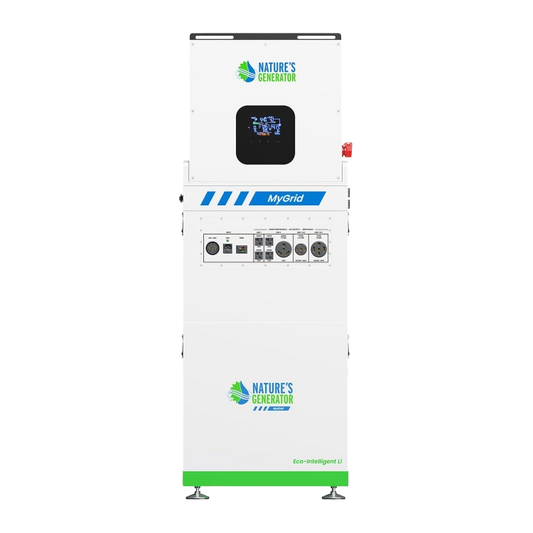
If you want true peace of mind during a long-term grid failure, you need a system that doesn't rely on a trip to the gas station. This is where high-capacity solar setups change the game. The Nature’s Generator MyGrid 10K is built specifically to handle the heavy lifting of a whole house for days at a time, without any of the noise, smell, or fuel hassles of gas.
Enough Power for the Big Stuff
The standout feature of the MyGrid 10K is its ability to push out 10,000 watts of continuous power. Most smaller solar options can only handle things like laptops, phones, and small appliances because they only output 120 volts.
But your home's heaviest-hitting equipment—like a deep well pump, your central heating system, or a water heater—runs on a 240-volt circuit. Because this system provides true split-phase 120V/240V power, it can run those heavy-duty appliances effortlessly. You get to keep running water and a warm house without needing to rig up dangerous extension cords.
Clean Energy That Grows With Your Needs
Instead of watching a gas tank slowly empty out, this system uses solar panels to catch energy from the sun and store it in high-capacity batteries. As long as the sun comes up, you can keep making your own electricity for free. Even on cloudy or winter days, modern solar setups are smart enough to pull in usable power from daylight to keep your batteries topping off.
Another huge benefit of the Nature's Generator lineup is that it is completely modular. Every home is a little different, and your power needs might change over time. With this setup, you can easily plug in extra battery pods and more solar panels whenever you want. If you start out prepping for a two-day outage and later decide you want enough backup power for two weeks, you can just expand your existing system without buying a whole new generator.
Real-World Example: Weathering a Massive Ice Storm
To see how this works in real life, look at how homeowners use these systems when things get bad. A few winters ago, a homeowner named Sarah faced a brutal ice storm that brought down power lines across three counties. The grid was dead for six straight days. While her neighbors were freezing and dealing with burst water pipes, Sarah had her solar-powered backup system running inside her home.
Because the system doesn't create any exhaust or emissions, she kept it safely inside her basement utility room. Her solar panels outside caught enough light during the day to completely recharge the electricity she used overnight. She kept her refrigerator running, her house warm, and her family safe without ever having to step foot outside into the freezing storm to hunt down gasoline.
How Do You Connect a Whole-Home System to Your House Safely?
Getting a great backup system is a huge first step, but you also need to make sure it connects to your house the right way. You don't want to be tripping over extension cords in the dark when an emergency hits.
The Right Way to Hook It Up
To get power directly to your wall outlets and hardwired appliances, our team always recommends having a licensed electrician install a transfer switch or an interlock kit.
-
Manual Transfer Switch: This is like a mini breaker box that sits right next to your main electrical panel. You choose the most important circuits ahead of time—like your fridge, well pump, and living room outlets. When the power goes out, you just flip a big switch (for manual transfer switches) to safely disconnect those circuits from the power company and connect them to your generator. If you’re using an automatic transfer switch, it will switch to backup power instantly. No manual action required.
-
Breaker Interlock Kit: This is a simple mechanical safety slide that goes directly onto your main breaker panel. It makes it physically impossible for your main power line and your generator line to be turned on at the same time. This lets you choose exactly which breakers you want to turn on anywhere in the house, up to the maximum power your generator can handle.
Why Safety Is a Major Deal
Isolating your house from the utility grid isn't just a good idea—it is a strict safety rule. If your generator sends power backward out into the street lines (a dangerous mistake called backfeeding), it can easily electrocute the utility linemen who are working hard to fix the wires. Using a transfer switch or interlock kit completely cuts off the outside lines, keeping those workers safe and ensuring your backup power stays exactly where it belongs: inside your home.
What Is the Best Plan to Stretch Your Power When the Grid Stays Down?
Having a ton of battery storage is great, but managing how you use that power is what guarantees you will make it through a long-term blackout without running dry. You want to practice smart energy budgeting.
Step 1: Cut the Waste Immediately
The second the grid goes down, treat your stored battery power like cash in the bank. Go to your breaker panel and turn off the switches for anything you don't absolutely need. Unplug items that draw phantom power even when turned off, like TVs, coffee makers, and game consoles. Keep your fridge and freezer doors shut as much as possible to trap the cold air inside so the compressors don't have to work overtime.
Step 2: Live with the Sun
When the sun is shining bright during the middle of the day, that is your cue to do your heavy lifting. If you need to run your well pump to fill up water jugs or run a medical machine, do it between 10:00 AM and 3:00 PM. By using that power right when your solar panels are producing it, you run your appliances directly off the sun and save your battery reserves for the dark night ahead.
Step 3: Wind Down at Night
Once the sun goes down, your solar panels stop making power, and you are living entirely off your battery reserves. Turn off any lights you aren't using and switch over to small, battery-powered LED lanterns for reading. If it is winter, drop your thermostat a few degrees and use heavy blankets to stay warm. By reducing your nighttime power draw to a whisper, you ensure you will wake up the next morning with plenty of battery life to spare.
Choosing Real Peace of Mind
Planning for a multi-day power outage means moving past old-school gas generators that leave you stranded when local gas stations shut down. By calculating your actual power needs, accounting for starting surges, and relying on a heavy-duty option like the MyGrid 10K, you can protect your home and family from any grid failure.


