


When you live near dry brush, open fields, or wooded areas, a power outage can turn into a bigger problem fast. You may need to keep the refrigerator running, charge your phone, or power a well pump. But bringing home a gas generator also means dealing with fuel, exhaust, and a hot engine when fire danger is already high.
That's why more homeowners are looking at reliable backup power that doesn't depend on gasoline. A solar power generator with battery storage can keep essential devices running without burning fuel, while a larger whole home power generator can cover more of the house when properly sized and installed. For smaller loads, portable backup power may be enough.
Nature's Generator offers solar and wind power systems worth considering for these situations. This guide looks at the risks around wildland-urban interface (WUI) homes, explains what solar and wind backup can actually do, and helps you choose a setup that fits your household. Just as important, we'll cover what these systems don't protect you from.
Why are homes near wildland areas at greater risk during a Red Flag Warning?
Homes near forests, grasslands, and other undeveloped areas can face a different kind of fire risk. Dry vegetation may surround the property, wind can carry embers toward buildings, and nearby combustible materials can give a fire more ways to spread.
These areas are often called the wildland-urban interface, or WUI. The National Weather Service issues a Red Flag Warning when weather conditions are favorable for dangerous fire behavior. Low humidity, strong winds, and dry fuels can create a particularly bad combination, though the exact warning criteria vary by location. You can learn more through the National Weather Service's fire weather guidance.
Now add a power outage to the situation.
Your refrigerator may stop cooling. A well pump may no longer supply water. Phones and internet equipment need power, and medical devices may be essential. If you're relying on a gasoline generator, you'll also need to think about where the fuel is stored, how the generator is operated, and whether it's safe to refuel.
That's a lot to manage when you're already watching weather alerts and preparing for a possible evacuation.
The better approach is to plan ahead. Know what needs electricity, have a way to power those essentials, and follow local fire restrictions and evacuation orders. Backup power can make an outage easier to manage, but it should never become a reason to delay leaving when authorities tell you to evacuate.
How does a solar + wind power station avoid gasoline generator hazards?
The main difference is simple: a battery-based power station can supply electricity without burning fuel.
A conventional portable generator runs an engine. Depending on the model, it needs gasoline, propane, or another fuel source. That means fuel storage, refueling, hot engine parts, and exhaust all come with the setup.
A solar-and-battery system works differently. Solar panels generate electricity when conditions allow, and a compatible wind turbine may provide another charging source. The battery stores that energy for later use. When the grid goes down, the system can power connected appliances from the energy already stored.
Here's how the two approaches compare:
|
Gas-powered generator |
Solar + battery power station |
|
Needs a suitable fuel supply |
Can run on stored electricity |
|
Requires fuel handling and refueling |
No refueling is needed during battery-powered operation |
|
Produces engine exhaust, including carbon monoxide |
Produces no engine exhaust while supplying battery power |
|
Has hot engine and exhaust components |
Has no combustion engine |
|
Runtime depends partly on fuel availability |
Runtime depends on stored energy and appliance demand |
Carbon monoxide deserves particular attention. The U.S. Consumer Product Safety Commission warns that portable generators can cause fatal carbon monoxide poisoning. Its guidance says fuel-powered portable generators should operate outdoors, at least 20 feet from the home, with exhaust directed away from windows, doors, and vents. See the CPSC's generator safety guidance.
A battery system avoids that engine-exhaust hazard during normal battery-powered use. It also means you don't have to store or handle gasoline just to keep your essential appliances running.
There is a limit to that advantage, though. Batteries and electrical equipment can still overheat, damaged cables can create hazards, and improper installation can cause electrical problems. Some power stations can also be charged with a fuel-powered generator, which brings fuel handling and exhaust risks back into the picture.
For a home in a fire-prone area, a renewable-powered system makes the most sense when it's charged safely before an outage and used according to the manufacturer's instructions. It removes certain hazards. It doesn't remove every hazard.
Is solar enough during a wildfire-related outage, or should you add wind power?
Solar can be a practical charging source, but it isn't available at the same output all day. Panels need adequate sunlight, and production changes with cloud cover, shading, panel angle, and daylight hours. Smoke and heavy cloud cover can reduce the energy reaching the panels, too.
Wind offers another option. A compatible turbine may produce electricity when sunlight isn't available, including overnight. But it only helps when the wind resource is suitable and the equipment can operate safely under the prevailing conditions.
Don't assume that strong winds during a Red Flag Warning automatically mean more useful charging. Wind turbines have operating limits, and severe weather may require shutdown or other precautions. Never try to adjust a turbine or work on outdoor electrical equipment in dangerous conditions.
A solar-and-wind setup is worth considering if your property has usable sunlight and suitable wind conditions, and you want more than one way to recharge. Before buying, check the system's supported charging inputs, the turbine's compatibility, and the manufacturer's operating limits.
Which Nature's Generator systems are worth comparing?
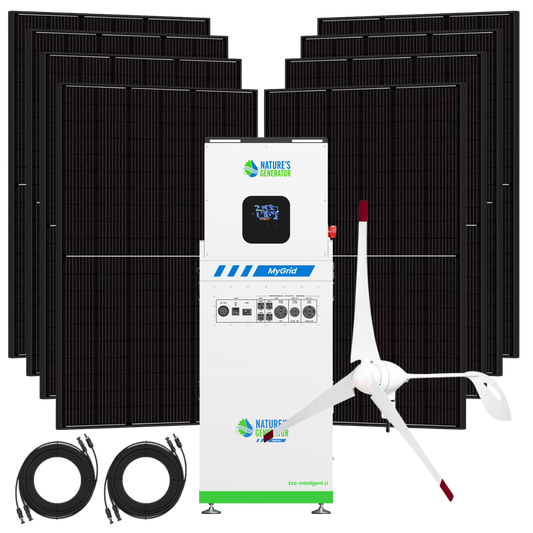
The Nature's Generator MyGrid 10K Gen 2 is designed for larger home-backup needs. Its published specifications list 10,000 watts of continuous output, a 10,496Wh LiFePO4 battery, support for up to 12,000 watts of solar charging, and a 350W wind input. It also supports battery expansion.
That makes it worth a look if you need to power several household circuits and want options for replenishing the battery. Still, output and storage are two different things. The inverter's wattage tells you how much power the system can supply at once. Battery capacity gives you a better idea of how much energy is available over time.
The Nature's Generator Powerhouse Gen 2 is another system to compare. Its published specifications list 7,200 watts of continuous output and a 4,800Wh AGM battery, with solar-and-wind options. Its battery chemistry and storage capacity differ from the MyGrid 10K Gen 2, so don't compare the two on output alone.
Before making a decision, look at your expected appliance loads, battery capacity, startup surges, charging options, and expansion needs. The most powerful system isn't always the best fit. What matters is whether it can run the equipment you need for as long as you need it.
Which appliances should you prioritize when the power goes out?
Start with what your household genuinely needs. You may not need to power the entire house during an emergency, especially if your main goal is to get through the night safely.
A sensible priority list includes:
-
Refrigerator: It cycles on and off, so its energy use depends on the model, temperature, and how often the door is opened.
-
Phones and communication equipment: Keep phones charged and maintain power for essential communications. Remember that internet service itself may go down even when your router has electricity.
-
Lighting: A few LED lights can cover the rooms you use without drawing much power.
-
Medical equipment: Identify the equipment that must stay on, check its power requirements, and arrange a backup plan for a longer outage.
-
Well pumps: These can draw significant power when starting up. Check both running wattage and startup surge before connecting one to a backup system.
Here's a basic example. Say your household's average load is 150 watts for communications, 100 watts for lighting, and another 100 watts for refrigeration. That's 350 watts total.
Over eight hours, the estimated energy use is:
350 watts × 8 hours = 2,800Wh
A system with 10,496Wh of rated battery capacity has more than enough nominal energy for that example on paper. Actual runtime will be lower or higher depending on the real loads, usable battery capacity, inverter losses, and operating conditions. The calculation also doesn't account for extra appliances that may be added later.
Make your own list before buying. Note each appliance's wattage, how many hours you'll use it, and whether it needs extra startup power. That gives you a much more useful basis for comparing systems than a headline wattage rating.
Where should you place a solar-and-battery system near wildfire-prone land?
A backup system needs a suitable location. Don't assume that equipment is safe outdoors simply because its solar panels or wind turbine are meant to operate outside.
For example, Nature's Generator states on its MyGrid 10K product page that the unit is designed for indoor use and is not IP65 rated. That matters if you were planning to leave it exposed to rain or weather. Check the manual for your exact model before deciding where it belongs.
Follow the manufacturer's requirements for temperature, ventilation, clearances, and electrical connections. Keep the system away from combustible materials and protect it from water and physical damage as directed. Don't cover ventilation openings or place equipment somewhere it can't be accessed safely.
Panels, wind turbines, wiring, and mounting hardware have their own installation requirements. Use suitable mounts and cables, and have a qualified professional handle electrical work that requires it. Local rules may also affect where and how equipment can be installed.
The surrounding property matters, too. A battery system won't keep a house safe if dry leaves, dead vegetation, or combustible clutter are piled against the structure. CAL FIRE's defensible-space guidance recommends paying particular attention to the first five feet around a building, where easily ignited materials can pose a risk.
Plan the equipment location before fire season, not while the wind is picking up. And if a wildfire threatens your home, don't stay behind to move the system, unplug cables, or protect your equipment. Follow evacuation directions.
How should you prepare your backup system before a Red Flag Warning?
Don't wait until an outage to find out the battery is nearly empty or the equipment can't handle your refrigerator. A few checks beforehand can prevent a lot of frustration.
-
Charge the battery ahead of time. Use the charging methods permitted by the manufacturer. Don't count on being able to recharge once conditions deteriorate.
-
Test your essential appliances. Confirm that they work with the system and estimate how much energy they use.
-
Inspect cables and connections. Damaged wiring and loose connections need attention before you rely on the equipment.
-
Check the outdoor components in advance. Follow the manufacturer's instructions for panels, mounts, and wind equipment. Don't inspect or adjust them in dangerous weather.
-
Prepare for communication failures. Keep phones charged, have battery-powered lights available, and know how you'll receive official alerts.
-
Keep evacuation plans separate from your power plan. Know your routes and transportation options. Don't wait for the battery to charge before leaving when authorities issue an evacuation order.
The goal is to make backup power routine. You should already know what it can run, how long it may last, and how to use it safely.
Is solar + wind backup worth it for a home in a wildfire-prone area?
It can be, especially if you want backup electricity without storing gasoline or running a combustion engine during an outage. Solar may cover much of your charging when sunlight is available, while compatible wind equipment can add another source where local conditions support it.
But the right system depends on the home. A smaller portable power station may be enough for phones, lights, and communications. A larger system may make more sense if you need selected household circuits, refrigeration, or a well pump. Check storage, continuous output, startup surges, charging options, and installation requirements before choosing.
Also consider how long outages typically last in your area. A battery that handles an evening outage may not meet your needs through several cloudy days. The ability to recharge is just as important as the amount of energy stored.
How can you cut fuel hazards without giving up backup power?
A solar-and-battery power station can keep essential appliances running without the gasoline storage, refueling, hot engine, and exhaust hazards associated with a conventional generator. A compatible wind turbine may provide another charging option when conditions allow.
That doesn't make the system risk-free. Battery safety, electrical installation, weather limits, and defensible space still matter. So does having a clear plan to leave when a wildfire threatens your home.
Start by deciding which appliances you need to run, how much energy they use, and how you'll recharge the system during a prolonged outage. Then compare products against those needs instead of choosing by wattage alone. Nature's Generator is one option to evaluate as you build a backup plan that fits your property, your budget, and the conditions you may face.


