


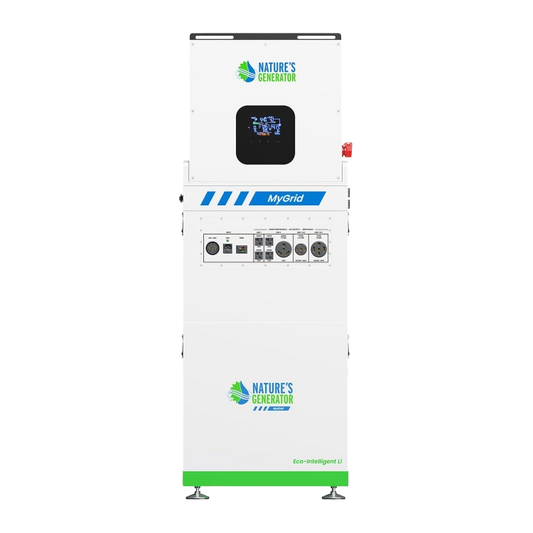
When safeguarding your property against unpredictable grid blackouts, selecting a reliable backup power solution is paramount. Our team recognizes that a top-tier solar power generator must deliver robust output alongside flexible, intelligent energy replenishment options. As a comprehensive whole home power generator, the Nature’s Generator Lithium 6000 is engineered to satisfy these demanding operational profiles. A cornerstone feature of this heavy-duty portable backup power architecture is its dual-mode alternating current charging capability.
This comprehensive technical analysis answers exactly how the system modulates between its 800W and 1800W intake settings, detailing the underlying electrical engineering, thermal consequences, and practical deployment strategies to optimize your residential resilience strategy.
What Is the Core Difference Between Normal and Quick Charge Modes?
At its fundamental layer, managing the electrical intake of a high-capacity energy storage system requires a balance between speed and application context. The underlying architecture of our premier power station features a dedicated Quick Charge toggle interface. This control allows homeowners to regulate the rate of electrical current flowing from a standard residential 120V alternating current circuit into the internal chemical cell matrix.
Normal Charge Mode (800W)
When set to its standard profile, the system draws approximately 800 Watts of continuous power from the wall outlet. Our engineering evaluations indicate this steady configuration is perfect for scenarios where rapid turnaround times are unnecessary.
Quick Charge Mode (1800W)
Activating the fast-charging switch elevates the power draw to approximately 1800 Watts. By maximizing the current limits of standard residential infrastructure, this setting accelerates the incoming power flow to rapidly replenish depleted reserves.
|
Specification Parameter |
Normal Charge Setting |
Quick Charge Setting |
|
Average Power Consumption |
~800 Watts |
~1800 Watts |
|
Typical Amperage Draw (at 120V) |
~6.6 Amps |
~15.0 Amps |
|
Primary System Use Case |
Long-term standby & storage |
High-frequency cycling |
|
Thermal Output Profile |
Low / Passive Bias |
Moderate / Active Cooling |
How Does the 800W Normal Charge Setting Protect Battery Longevity During Long-Term Storage?
To understand how a steady 800W intake preserves system health, it helps to examine the internal electrochemical environment. Lower electrical current flows experience minimal resistive impedance within the internal cell links. According to Joule's First Law, the heat generated in a conductor is proportional to the square of the current multiplied by the resistance (P = I2 R). By maintaining a moderate current draw of approximately 6.6 Amperes, the normal setting dramatically lowers internal heat generation.
Our team has found that keeping the system on the 800W Normal Charge profile is ideal when maintaining the system for seasonal storm patterns or occasional rolling blackouts. Because the battery matrix is not subjected to elevated thermal or physical stress during long-term maintenance cycles, the atomic structures within the positive and negative electrodes undergo smooth intercalation with minimal degradation. This approach ensures your backup energy reserve remains fully functional and ready to deploy at a moment's notice over years of standby operation.
Why Choose the 1800W Quick Charge Setting for Daily Off-Grid Operations?
For active off-grid homesteads or mobile work crews, power demands require rapid operational readiness. In active usage scenarios, a slow recharge rate can cause prolonged system downtime, stalling essential tools or household appliances. The 1800W Quick Charge setting directly resolves this issue by accelerating current throughput.
Based on our extensive field trials, delivering 1800 Watts of energy into the system dramatically compresses the charging timeframe. This configuration allows homeowners to rapidly cycle their energy reserve. If you run high-draw appliances during morning hours, switching on the high-speed charge mode lets you fully replenish the unit during narrow midday utility windows or brief generator run-times. This ensures the system is ready for heavy evening loads without requiring a long, multi-hour wait.
Can Your Home Electrical Circuit Handle the 1800W Quick Charge Power Draw?
A critical element of operating high-wattage hardware is understanding your home's electrical panel capacity. Standard American residential infrastructure relies on 120-Volt circuits protected by either 15-Ampere or 20-Ampere circuit breakers.
Amperage = Watts / Volts
Applying this basic electrical formula to the Quick Charge mode highlights why mindful circuit placement is necessary:
1800 Watts / 120 Volts = 15.0 Amperes
Because the Quick Charge profile draws a continuous 15 Amps, it utilizes the entire maximum load capacity of a standard 15-Amp breaker. If you plug another appliance—such as a refrigerator, vacuum cleaner, or microwave—into the exact same circuit run, the total load will immediately exceed 15 Amps, causing the breaker to trip.
To ensure continuous operation, our team recommends plugging the unit into a dedicated 20-Amp circuit whenever Quick Charge is active, or verifying that no other secondary appliances are drawing power from that breaker line simultaneously. Conversely, the 800W Normal Charge mode pulls roughly 6.6 Amps, leaving plenty of electrical overhead on a shared 15-Amp circuit for daily residential devices.
How Do Real-World Scenarios Dictate Which Charging Speed You Should Select?
Choosing the correct charging configuration depends heavily on your immediate environment and power requirements. Our community members frequently share practical insights that highlight the benefits of having dual-speed flexibility.
Scenario A: The Emergency Standby Strategy
Consider a household that keeps a Lithium 6000 Whole Home Generator connected in their garage via a manual transfer switch link. Their primary goal is maintaining preparedness for unexpected seasonal grid failures. For this application, the unit should remain on the 800W Normal Charge setting. The system can quietly top off its reserves using low current, keeping it ready without putting extra load on domestic circuits.
Scenario B: The Continuous Off-Grid Worksite
Now consider an off-grid construction site or a remote cabin utilizing the same unit, Lithium 6000. Throughout the morning, the system runs heavy power tools, table saws, and pumping systems. During a midday lunch break, an auxiliary gas generator or high-power AC outlet is activated to replenish the station. Selecting the 1800W Quick Charge speed allows the crew to pack hours of charging into a short break, quickly preparing the system for afternoon work.
What Role Do Thermal Management Systems Play During 1800W High-Speed Charging?
Pushing 1800W of electrical power into a compact chassis requires sophisticated internal thermal controls. As energy moves through the conversion circuitry and enters the cell structure, the minor electrical resistance that is present converts into thermal energy. To keep internal temperatures within safe guidelines, the intelligent battery management system monitors real-time feedback from internal sensors.
When you activate the 1800W profile, the internal cooling fans engage to pull fresh air across the internal components and exhaust warm air out of the chassis. This active cooling cycle is a normal part of safeguarding the internal electronics. It prevents heat build-up and ensures components operate well within their structural parameters. When using the lower 800W setting, the cooling fans run less frequently or at lower speeds, resulting in much quieter overall operation.
Balancing Charge Speed and Power Requirements
Optimizing your backup power setup comes down to choosing the right tool for your specific situation. The dual AC charging system on this unit provides the flexibility needed to balance long-term equipment preservation with rapid operational turnaround.
-
Choose the 800W Normal Charge setting for emergency standby storage, gentle maintenance cycles, and shared home electrical circuits.
-
Choose the 1800W Quick Charge setting when running frequent daily cycles, managing heavy off-grid workloads, or whenever you need to restore your power reserves as quickly as possible.
By matching the charging speed to your immediate operational environment, you can maximize your equipment's utility while maintaining a reliable source of independent household power. If you are ready to expand your energy security or explore dedicated clean-energy upgrades, discover our complete line of eco-conscious emergency hardware at Nature's Generator.


