


When preparing for unexpected grid failures, establishing reliable backup power becomes your top priority. The Nature’s Generator MyGrid 10K is an industrial-grade solar power generator designed to deliver complete energy independence. Homeowners looking for a heavy-duty whole home power generator find themselves balancing charging speeds and equipment configurations. Transitioning from standard options to portable backup power requires knowing how different input line voltages impact your system.
We will break down how a 120V input compares to a 240V dual-voltage connection, detailing recharge durations, efficiency gains, and practical generator pairings. Based on our experience, making the right choice directly determines how prepared you are when the grid goes down. By reviewing the physical limitations of your electrical supply alongside your underlying backup strategy, we ensure you can pick the most effective method for replenishing your reserves.
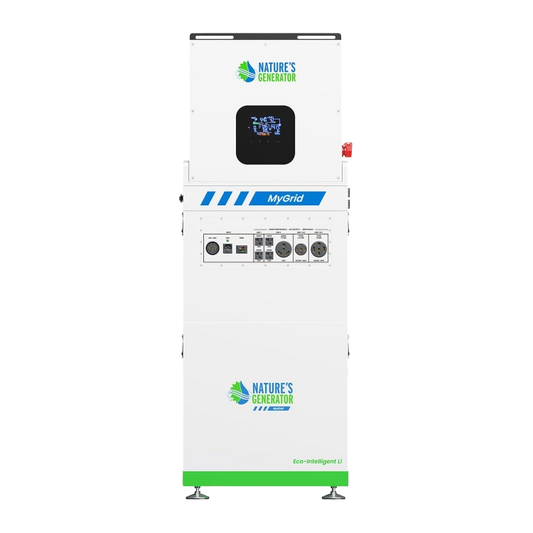
What Is the Difference Between 120V Standard Charging and 240V Fast Charging on the MyGrid 10K?
To understand how these two charging topologies operate, we must look at the underlying electrical parameters built into the core design of the power station. A standard 120V input utilizes conventional single-phase alternating current electrical lines found throughout standard residential properties. Conversely, a 240V input leverages split-phase electrical architecture, delivering a higher voltage potential that allows for significantly increased energy transfer rates.
How Do the Charging Wattages Compare for Each Input Voltage?
When you connect the system to a standard 120V AC source, the internal charging hardware limits the power consumption to a continuous threshold of 1,000 Watts. This conservative power draw ensures that the unit can safely operate on a typical 15-Ampere or 20-Ampere household branch circuit without risking an overcurrent situation that could trip your residential circuit breakers.
When you transition to a 208V or 240V AC connection, the multi-voltage charging input unlocks a much larger electrical pathway. Under a 240V configuration, the system activates its high-capacity fast charging mode, scaling the input acceptance up to a continuous 4,500 Watts. In high-demand multi-unit commercial deployments or specialized configurations, the AC charging threshold can scale even further up to 10,000 Watts, allowing the battery bank to ingest power at an extraordinary rate.
What Are the Expected Recharge Times for the 10,496Wh Battery?
The centerpiece of this power station is its massive Lithium Iron Phosphate battery pack, which boasts a total usable storage capacity of 10,496 Watt-hours. Replenishing a battery of this scale requires a clear understanding of the mathematical timelines associated with each voltage profile.
Using the 120V standard AC connection at 1,000 Watts, a complete recharge from an entirely depleted state to 100% capacity requires approximately 10.5 hours of continuous power delivery, assuming ideal thermal conditions and normal conversion efficiency parameters.
By contrast, when utilizing the 240V fast charging circuit operating at 4,500 Watts, the system enters its super charging phase. This allows the massive 10,496Wh battery bank to achieve a full 100% state of charge in just about 2.5 hours. Our field testing confirms that this represents an exceptional turnaround time for a whole-house class battery storage system.
|
Charging Metric |
120V Standard Input |
240V Fast Input |
|
Continuous Input Wattage |
1,000 Watts |
4,500 Watts (Up to 10,000W Max) |
|
Total 0-100% Charge Time |
Approximately 10.5 Hours |
Approximately 2.5 Hours |
|
Circuit Requirement |
Standard NEMA 5-20R Outlet |
Split-Phase NEMA L14-30R / 14-50R |
|
Primary Operational Focus |
Daily maintenance, off-peak grid storage |
Rapid emergency recovery, limited fuel runtime |
Why Choose a 120V Input for Everyday Standard Charging Needs?
While fast charging speeds offer undeniable advantages during severe emergencies, the standard 120V charging pathway serves a vital role in everyday energy management and preventative storage maintenance.
Can You Use Household Outlets to Top Up the Power Station?
Yes, complete out-of-the-box flexibility is one of the foundational benefits of this system's plug-and-play architecture. Our engineers have observed that many users prefer the standard 120V input configuration because it requires absolutely zero electrical retrofitting or expensive modifications to your home electrical panel.
Whether you are a homeowner, a temporary renter, or utilizing the system across a variety of remote job sites, you can simply plug the unit into any conventional residential wall outlet. This feature makes it incredibly straightforward to keep the battery topped off during normal blue-sky days when the grid is entirely stable, ensuring you are always prepared for sudden blackouts.
What Are the Real-World Scenario Constraints of a 1,000W Input?
Relying exclusively on a 1,000W standard input introduces specific operational constraints during a long-term grid failure scenario. In our professional assessment, if you are actively powering high-draw household appliances while concurrently attempting to charge the battery bank via a 120V source, your net power accumulation may lag behind your consumption.
For example, if your home's active emergency loads—such as a well pump, multi-stage refrigeration networks, and medical equipment—draw a combined continuous load of 1,500 Watts, a 1,000W input will not be able to offset the demand. The system will continue to experience a net discharge of 500 Watts per hour. Therefore, we recommend designating the 120V standard option for non-urgent preventive upkeep and steady off-peak grid replenishment rather than high-turnaround crisis management.
How Does 240V Fast Charging Achieve Maximum Efficiency and Super Charging Speeds?
Unlocking the fast charging capabilities of the system fundamentally alters how you manage emergency power allocations by introducing rapid energy throughput.
What Exactly Is the Super Charging Mode on the MyGrid 10K?
The super charging mode represents the system’s ability to maximize its advanced dual-voltage input architecture to compress charging timelines down to the absolute minimum. When connected to a high-voltage split-phase system, the internal charging hardware safely pushes 4,500 Watts directly into the battery management infrastructure.
Our team highlights that this speed is invaluable when dealing with rolling blackouts or intermittent power availability. If you only have access to utility power or generator runtime for a few brief hours a day, the capability to capture 100% of your home's daily power reserve in a single 2.5-hour window ensures that your household comfort remains completely uninterrupted.
How Does the 4,500W Capacity Protect LiFePO4 Cell Health?
A frequent concern among prospective buyers is whether injecting a massive 4,500 Watts of continuous power will result in overheating, premature cell degradation, or safety hazards. Our technical diagnostic team emphasizes that the underlying chemistry solves this issue entirely. The unit utilizes premium Lithium Iron Phosphate cells, widely recognized for their excellent thermal stability, safety profile, and extended lifespan.
Because the system possesses a large base capacity of 10,496Wh, an input of 4,500 Watts translates to an internal charging rate well below a conservative 0.5C metric. This means the battery cells can comfortably absorb this volume of power without experiencing elevated thermal stress or accelerated wear. Managed by an intelligent onboard Battery Management System that continually regulates voltage, safeguards cell balancing, and monitors internal temperatures, the fast-charging pathway easily sustains the battery's signature rating of over 6,000 operational lifecycles.
How Do You Safely Connect a Gas Generator to Charge the MyGrid 10K System?
When an extended blackout blocks out solar and wind generation capabilities for days at a time, incorporating a traditional gas generator as an auxiliary charging input becomes necessary. Doing so safely requires adhering to rigorous electrical guidelines.
What Type of Generator or Inverter Output Is Safest for Dual-Voltage Inlets?
When interfacing a combustion engine generator with a sophisticated solar powerhouse, power purity is critical. Conventional, budget-friendly construction generators frequently produce a modified sine wave or dirty power characterized by high Total Harmonic Distortion. Sensitive electronic inverters and lithium management chips can detect this electrical noise and may refuse to accept the charge to protect internal components.
Our team strongly advises utilizing a high-quality inverter generator that provides a clean pure sine wave output. To harness the rapid 240V fast charging pathway, your inverter generator must support a dedicated 120V/240V split-phase output connection, typically delivered through a NEMA L14-30R or NEMA 14-50R locking receptacle. The generator must also possess sufficient continuous running capacity to effortlessly handle the 4,500W charging load alongside its own mechanical efficiency curve.
Should You Run a Transfer Switch Configuration for Backup Maintenance?
For a reliable and completely integrated residential power installation, deploying a robust transfer switch infrastructure is highly recommended. The system features an automated switching capability that transitions power sources in less than 20 milliseconds, ensuring that desktop computers, home servers, and smart appliances experience no interruption or reboot cycles when primary power drops.
By routing your gas generator or utility line through a premium transfer switch option, such as those available in the comprehensive lineup on the Nature's Generator official portal, you can build a highly resilient hybrid microgrid. This configuration allows you to operate your loud, fuel-consuming gas generator for just 2.5 hours at a 240V fast-charging setting to completely pack the system's battery storage. Once the unit hits full capacity, you can shut down the generator completely, saving substantial money on fuel and eliminating exhaust fumes while living off silent, clean battery storage for the rest of the day.
Standard vs. Fast Charging: Which Input Setting Fits Your Home Backup Strategy Better?
Deciding which configuration to implement depends entirely on your specific household infrastructure, geographic risk factors, and financial considerations.
When Should an Emergency Scenario Dictate Selecting Fast Charging?
In our professional experience, certain geographic and environmental variables make the 240V fast-charging configuration mandatory. If your region is prone to severe weather patterns—such as heavy winter blizzards, hurricanes, or extended seasonal storms—solar panel arrays may face prolonged periods of limited sunlight.
If you are forced to rely on a gas generator or sporadic grid windows during these climate crises, a slow 120V standard charging profile can leave your home vulnerable. Having the capability to rapidly pull 4,500 Watts via a fast-charging connection ensures that your emergency power reserves are always filled ahead of subsequent weather fronts.
How Does Customer Feedback Highlight the Choice for Off-Grid Performance?
Analyzing historical customer feedback patterns highlights a consistent narrative: adaptability is paramount. Many homeowners initially deploy their system using the standard 120V household connection because of its simplicity and immediate ease of use. However, as their energy usage patterns grow to encompass high-load, heavy-duty appliances like central air conditioning systems, well pumps, or electric vehicles, they naturally transition to a dedicated 240V setup.
Users operating completely off-grid frequently express great satisfaction with combining these inputs. They utilize the massive 12,000W MPPT solar charger input during standard daylight hours, but rely on the 240V fast AC charging circuit to rapidly top off their system using a standby generator when bad weather sets in. This dual-input flexibility guarantees that your home energy framework remains resilient regardless of external conditions.
Guide for Optimizing Your System Configuration
Choosing between standard and fast charging configurations ultimately depends on your immediate environmental demands and infrastructure. For day-to-day utility optimization and preventative replenishment, the 120V standard input offers hassle-free usability across any conventional household framework. However, when an unexpected crisis strikes, unlocking the 240V fast-charging capabilities ensures your storage reserves are fully replenished in a minimal timeframe. Investing in proper transfer switches and high-quality inputs solidifies your resilience against extended blackouts.
By matching your operational habits with the advanced technical specs of the system, you maximize the efficiency, safety, and durability of your investment. Embracing this dual-voltage layout cements Nature's Generator as a versatile powerhouse for modern residential backup. Explore our full catalog of expanding energy solutions directly through Nature's Generator to secure your home's long-term independence.
Off-Grid EV Charging and Setup Guide with the MyGrid 10K
This video demonstrates the exceptional power output and flexible off-grid charging capabilities of the system when handling highly demanding electrical loads.


