


When evaluating options for a reliable backup power strategy, homeowners look to a traditional solar power generator. However, relying strictly on the sun can leave you vulnerable during extended storms or overnight blackouts. To achieve true energy independence, transitioning to a comprehensive whole home power generator that utilizes hybrid inputs is essential. While portable backup power units offer temporary relief, our team recommends a permanent, robust solution. The synergistic power of Nature's Generator Powerhouse and wind turbines ensures that your household remains completely energized regardless of meteorological shifts.
Let us dive into this blog and answer exactly how pairing these two renewable modalities solves energy intermittency, what technical components optimize this integration, and how you can select the ideal configuration for your home.
Why Should You Pair a Whole Home Power Generator with a Dedicated Wind Turbine?
Relying on a single source of clean energy is one of the most common pitfalls in off-grid planning. Solar collection relies entirely on clear skies and daylight hours, meaning peak production is compressed into a narrow window. Incorporating a wind turbine introduces a completely independent variable to your power generation matrix, creating a highly resilient hybrid microgrid.
Overcoming the Intermittency of Solar-Only Ecosystems
Solar panels produce zero electricity at night, and their output drops big time during heavy overcast conditions, rainstorms, or winter snow accumulation. Ironically, the very weather events that trigger prolonged grid blackouts are often the ones that render solar arrays least effective.
Weather systems characterized by thick cloud cover and intense low-pressure zones are almost always accompanied by elevated wind speeds. By installing a wind turbine alongside your solar array, you transform a meteorological liability into a generation asset. The kinetic energy from moving air masses keeps your system charging precisely when your photovoltaic panels go dark.
Maximizing Day and Night Energy Production Cycles
Wind resources usually follow a diurnal cycle that perfectly complements solar patterns. While solar energy peaks during midday, ambient wind speeds frequently increase during the late evening, night, and early morning hours due to thermal differentials as the earth cools.
By capturing this nighttime energy, you dramatically reduce the depth of discharge on your battery storage banks. Instead of drawing your batteries down to near-empty every night and waiting for the morning sun to begin the slow recovery process, the wind turbine continuously trickles power back into the reserve reservoir. This continuous cycle minimizes battery wear and guarantees a higher state of charge when you wake up.
How Does the Nature’s Generator Powerhouse Gen 2 Handle Hybrid Inputs?
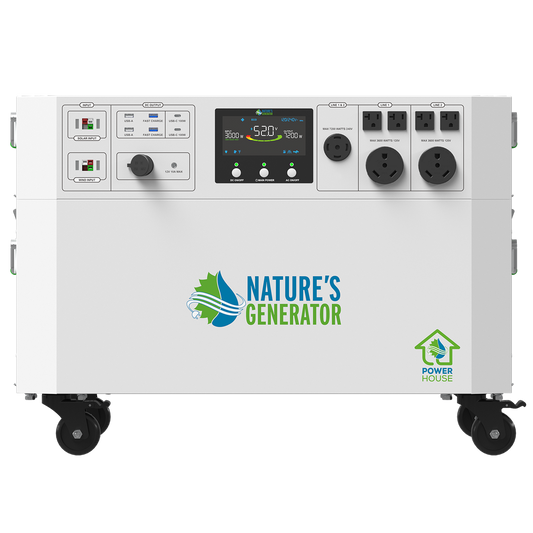
Managing disparate power inputs from both solar panels and wind turbines requires an advanced central brain. The Nature’s Generator Powerhouse Gen 2 is engineered explicitly to function as a multi-source integration hub, accepting simultaneous charging currents without requiring complex external charge controllers or custom wiring configurations.
Decoupled Charging Channels for Seamless Concurrent Input
A common challenge with lesser systems is that feeding multiple power sources into a single battery bank can cause electrical interference or damage the internal circuitry. The Powerhouse Gen 2 circumvents this obstacle by utilizing isolated, dedicated input channels.
The system features separate, clearly labeled ports for photovoltaic inputs and wind turbine connectivity. Inside the chassis, independent smart charge controllers continuously monitor the incoming voltage and current from each source. If the wind turbine is spinning at maximum output during a bright, gusty afternoon, the internal architecture balances both loads simultaneously, accelerating your time-to-full-charge without risk of overheating or electrical backflow.
Understanding the Split-Phase 120V/240V Power Delivery
Generating electricity is only half the battle; delivering it in a form your home can actually use is what defines a true whole-home solution. Our engineering reviews highlight that the Powerhouse Gen 2 delivers pure sine wave split-phase power natively. This means it supplies both standard 120V electricity for your lights, routers, and electronics, as well as high-voltage 240V power for heavy-duty appliances.
|
Feature / Appliance |
Standard 120V Output Systems |
Powerhouse Gen 2 (120V/240V Natively) |
|
Well Pumps (240V) |
Incompatible (Requires complex external inverter stacking) |
Fully Supported (Runs directly from the main output) |
|
Central AC / Heat Pumps |
Incompatible |
Fully Supported |
|
Sensitive Electronics |
Prone to distortion if modified sine wave |
Completely Safe (Pure Sine Wave engineering) |
|
Electric Dryers / Water Heaters |
Unsupported |
Supported up to max continuous wattage capacity |
This capability eliminates the need to buy duplicate inverters or deal with complex phase-matching hardware. You can link the system straight to your home's main breaker panel via a manual transfer switch, allowing you to flip a few toggles and keep your entire property functioning normally during a regional blackout.
What Are the Real-World Scenarios Where This Hybrid Solution Excels?
To fully appreciate the practical value of this setup, let us look at real-world applications where a single-source energy system fails, but a hybrid system thrives.
Surviving Seasonal Grid Failures and Coastal Storms
Consider a coastal property facing a multi-day late-autumn nor'easter or a tropical storm. As sub-freezing rain or heavy cloud cover moves in, solar irradiance plummets to less than 10% of its normal capacity. The power lines down the street snap due to falling limbs, cutting off grid power.
In a solar-only configuration, the homeowner would have to ration their remaining battery capacity severely, turning off refrigeration or heating to preserve electricity. However, because these storms generate sustained winds of 25 to 45 mph, a property equipped with the Nature’s Generator Wind Turbine can generate power at maximum capacity around the clock. The turbine works through the driving rain and dark skies, keeping the Powerhouse Gen 2 batteries topped off so the household can run space heaters, well pumps, and security systems without disruption.
Elevating Remote Off-Grid Cabins to Modern Standards
For individuals managing off-grid homesteads or mountain cabins, seasonal changes present a massive challenge. During the winter, shorter days and a lower sun angle significantly reduce solar energy production.
Based on our team's hands-on assessments of rural installations, relying solely on solar in the winter often forces people to run noisy, polluting fossil-fuel generators for hours on end just to bridge the gap. Adding a wind turbine leverages the natural wind tunnels created by mountain topography and winter weather fronts. This approach minimizes fuel expenses, reduces mechanical wear on backup combustion engines, and delivers a much quieter, cleaner living environment.
How Much Energy Can the Nature's Generator Powerhouse Wind Turbine Generate?
Evaluating a wind turbine requires looking past peak numbers to understand how kinetic energy translates into everyday power production. The Powerhouse Wind Turbine is designed specifically to capture a wide range of wind velocities efficiently.
Assessing Wind Velocity and Average Daily Kilowatt-Hour Yields
A common misconception among first-time buyers is that a wind turbine needs near-gale-force winds to work. This turbine features a low start-up wind speed of just 6 mph (2.7 m/s), meaning even a gentle breeze will start spinning the blades and trickling power into your system.
The system reaches its optimal performance curve in sustained winds between 12 and 27 mph. In locations with consistent wind paths—such as coastal regions, wide-open plains, or elevated ridge lines—a single turbine can generate several kilowatt-hours of clean electricity per day. When this output flows continuously into the Powerhouse Gen 2's expandable battery system, it can easily offset the daily electrical draw of critical appliances like high-efficiency refrigerators, LED lighting networks, and water filtration setups.
Structuring the Physical Setup for Maximum Kinetic Capture
To get the most out of your wind turbine, proper physical placement is critical. Wind behaves much like flowing water; it slows down and becomes turbulent when it hits obstructions like trees, roofs, or neighboring structures.
Our team recommends adhering to these core installation principles:
-
Elevation is Key: Ensure the turbine is mounted at least 15 to 20 feet above any physical obstruction within a 300-foot radius.
-
Utilize High-Quality Materials: The Powerhouse Wind Turbine comes with heavy-duty cast aluminum alloy body components and high-strength fiberglass composite blades designed to withstand severe weather up to 110 mph.
-
Secure Mounting Infrastructure: Mount the turbine using a sturdy, well-anchored pole kit or tower setup, checking periodically to ensure guy wires or anchors remain taut against seasonal ground shifts.
How Do You Choose the Right Expansion Configuration for Your Household?
Every home has unique energy needs, which is why a modular approach is so valuable. The Powerhouse ecosystem is designed to grow alongside your changing energy demands.
Balancing Modules for Your Specific Regional Climate
When planning your layout, look closely at your local environment. If you live in an arid, sun-drenched region with minimal wind, your setup should feature a higher ratio of solar panels to wind components. Conversely, if you live in a northern, heavily wooded, or coastal environment, a wind-heavy layout will serve you better.
The Nature’s Generator official portal offers access to various expandable Power Pods. These modules connect directly to the primary Powerhouse Gen 2 unit via simple heavy-duty daisy-chain cables, immediately increasing your total watt-hour storage capacity.
Adding these extra storage pods ensures that when the wind turbine produces massive amounts of power during an overnight storm, you have the storage capacity to hold that energy for subsequent calm days.
What Does Real Customer Feedback Reveal About the Hybrid System's Performance?
Analyzing real-world customer usage shows that shifting away from single-source setups dramatically improves user confidence and long-term satisfaction.
Eliminating the Practical Anxiety of Extended Power Outages
Many users who initially bought a solar-only system report feeling anxious during long stretches of rain or winter storms. They frequently noted that watching their battery levels drop steadily on dark winter afternoons made them feel insecure about their emergency preparedness plans.
Homeowners who upgraded their infrastructure by adding the Powerhouse Wind Turbine describe a significant shift in experience. They report that hearing the gentle hum of the turbine working at 2:00 AM during a heavy storm brings immense peace of mind. Knowing that their battery storage bank is actually charging while the grid is down and the sky is pitch black changes the dynamic of emergency survival entirely.
Reducing Maintenance Overhead Compared to Combustion Equipment
Another common theme in user feedback is the relief of moving away from gas-powered generators. Traditional mechanical backup generators require ongoing oil changes, fresh fuel stabilizer, and manual starting every few weeks to ensure they do not seize up. During a multi-day blackout, finding open gas stations with working pumps can be challenging and stressful.
Users highlight that the hybrid combination of solar and wind requires almost zero regular operational maintenance. The system sits ready to perform automatically, quietly harvesting ambient natural resources without requiring manual fuel refills or emitting toxic exhaust fumes near the home.
Conclusion
Combining solar panels with kinetic wind systems eliminates the single points of failure that plague standard off-grid setups. Based on our evaluation of residential microgrids, investing in a dual-source infrastructure guarantees that your household remains operational through the most severe grid disruptions.
Choosing a resilient framework from Nature's Generator allows you to capture clean energy around the clock. If you are ready to secure your property's electrical future, configuring a system around Nature's Generator hardware offers the flexibility, capacity, and reliability needed to achieve absolute energy self-sufficiency.


