


As families across the country open their monthly utility bills, a harsh financial reality is hitting home: electricity costs are surging at an unprecedented pace. Many homeowners are searching for ways to secure reliable backup power while keeping operational costs under control. Investing in a clean solar power generator has shifted from an eco-friendly trend to an absolute financial necessity. Whether you need a comprehensive whole home power generator to bypass grid volatility or a portable backup power system for targeted emergency readiness, the goal remains identical: breaking free from the traditional utility grid.
At Nature’s Generator, our team has monitored these shifting dynamics closely. We understand why families feel overwhelmed seeing their hard-earned money evaporate into the local grid. In this comprehensive guide, we will unpack exactly why electricity rates are skyrocketing in 2026 and outline a step-by-step blueprint to build a resilient energy independence strategy. We will dissect the underlying elements fueling these skyrocketing rates and outline practical, real-world methods to minimize your expenses.
Why Are Utility Companies Charging So Much More for Electricity This Year?
To understand the sudden escalation in your monthly bills, it is essential to look at the broader macro-economic factors pressing against the electrical grid. According to data from the U.S. Energy Information Administration (EIA), average residential electricity prices in the United States have climbed to approximately 19 cents per kilowatt-hour (kWh), marking a staggering 27% increase since 2019. In several states, rate hikes have outpaced standard economic inflation by wide margins, driven by an interconnected web of demand spikes, aging infrastructure, and shifting regulatory policies.
How Are Artificial Intelligence and Data Centers Impacting Your Bill?
The rapid deployment of artificial intelligence (AI), machine learning models, and hyperscale data centers has introduced an unprecedented strain on regional power grids. In recent years, utility providers have received interconnection requests totaling more than 700 gigawatts (GW) of power capacity specifically for data center development. To put this in perspective, that volume exceeds the entire electricity consumption of the United States for an entire calendar year just a few seasons ago.
Because standard power generation facilities cannot instantly scale to match this massive surge, utilities must spend billions of dollars constructing new natural gas turbines or delaying the retirement of aging coal plants. The upfront capital required for these installations is approved by state public utility commissions, which allow utilities to recover their developments by spreading the expenses across the entire customer base. Consequently, everyday residential ratepayers are left subsidizing the immense power infrastructure needed to run digital server farms.
Why Does Upgrading an Aging Grid Drive Up Residential Delivery Fees?
The physical infrastructure responsible for delivering electricity to your front door is reaching the end of its intended operational lifespan. Roughly 70% of transmission and distribution lines across the nation are more than 25 years old. This structural fragility is compounded by an escalation in extreme weather events, including prolonged heat waves and severe winter storms.
When regional grids suffer damage from natural disasters, utility entities are forced to finance multi-billion-dollar reconstruction projects. Furthermore, transitioning from centralized fossil fuel generation to distributed renewable assets requires extensive grid modernization, including smart substations and expanded transmission corridors. Because existing policies permit massive grid advancement expenses to be packed straight into your statement's transmission fees, power prices face a permanent baseline increase that is completely unaffected by shifting worldwide energy costs.
How Do Time-of-Use (TOU) Rates and Tiered Pricing Inflate Your Monthly Statement?
Even if your base utility rate appears manageable, the mechanisms that companies use to calculate your final bill can artificially balloon your expenses. Utilities have increasingly abandoned flat-rate billing structures in favor of sophisticated pricing models designed to penalize energy consumption during peak periods or beyond baseline limits.
Understanding the Pricing Divide Between High-Demand and Low-Demand Energy Hours
Time-of-Use (TOU) tariffs are pricing structures that vary based on the time of day. Under these models, utilities charge premium rates during high-demand windows—typically between 4:00 PM and 9:00 PM—when households return home, run cooling systems, and operate heavy appliances simultaneously. During these hours, the wholesale cost of electricity, often referred to as locational marginal pricing, surges due to the reliance on expensive peak power plants.
Our specialists have observed cases where peak electricity rates climb to double or triple the cost of off-peak morning hours. For instance, a household that runs a central air conditioning unit or a clothes dryer during peak hours could face localized rates as high as 40 to 50 cents per kWh. If your household schedule forces you to use electricity when the grid is most constrained, your monthly statement will quickly compound into an unaffordable expense.
Why Does Consuming More Power Move You Into a More Expensive Tariff?
In addition to TOU structures, many regional providers implement inverted block or tiered pricing. Under a tiered model, you receive a designated baseline allocation of electricity at a standard rate (e.g., the first 500 kWh). However, once your consumption crosses that threshold, the utility moves you into a higher tier, where the cost per kilowatt-hour increases dramatically.
This structure means that adding an electric vehicle (EV), accommodating a growing family, or running supplemental heating during a cold snap does not merely increase your billing proportionally—it elevates the unit cost of all the extra energy you consume. Many homeowners discover that a minor 20% increase in total energy usage results in a 40% or greater jump in their final bill because that additional consumption occurred entirely within the utility's premium pricing tier.
What Is an Energy Independence Strategy and How Does It Protect Your Home?
Faced with a system engineered to extract higher fees year after year, the only reliable countermeasure is to establish a comprehensive energy independence strategy. Rather than remaining a passive consumer completely vulnerable to utility rate hikes, an effective strategy transforms your home into a self-sustaining microgrid capable of generating, storing, and managing its own power.
Integrating alternative power inputs helps insulate your household finances from the ongoing grid crisis. For a visual understanding of how clean hardware acts as the bridge to true energy autonomy, the following diagram illustrates how modern clean equipment connects directly to your home's ecosystem:
Comprehensive residential alternative energy microgrid setup. Source: ser_igor / Getty Images
Download the image here: https://drive.google.com/file/d/1fXTyG40zsZani9FEYtRnHjsItU0E3yM0/view?usp=drive_link
Can a Solar Generator System Completely Replace Grid Power?
Achieving full off-grid autonomy is an achievable objective, but it requires a strategic approach to load balancing and storage capacity. A standalone system uses heavy-duty photovoltaic panels to harvest solar energy during daylight hours, storing the excess power inside specialized lithium or lead-acid battery banks for use overnight or during extended grid failures.
In our deployment experience, most homeowners prefer a hybrid, step-by-step approach. By utilizing an advanced system as a primary power source for your high-demand appliances, you can systematically shave off the expensive peak hours of your utility's TOU schedule. This allows you to leverage grid power exclusively during cheap off-peak hours while relying on your stored solar energy when utility prices spike.
What Component Configurations Do You Need for a Whole-Home Hybrid Strategy?
Building an effective strategy requires evaluating the technical characteristics, long-term costs, and limitations of different home backup methodologies. To assist in your decision-making stage, our team has compiled a comparative overview of standard approaches to home energy security:
|
Backup System Type |
Initial Capital Investment |
Fuel/Operational Dependency |
Vulnerability to Utility Rates |
|
Grid-Tied Solar (No Battery) |
Moderate to High |
Completely dependent on active grid signal |
High during peak hours and grid blackouts |
|
Fossil Fuel Generators |
Low to Moderate |
Ongoing reliance on gasoline, propane, or diesel fuel |
Moderate due to retail fuel price volatility |
|
Whole-Home Solar Generators |
Moderate |
Zero fuel costs; powered by solar and wind harvesting |
Zero vulnerability; complete operational isolation |
As the comparison highlights, traditional grid-tied solar systems without battery storage fail to provide power during a grid blackout because their inverters automatically shut down for utility worker safety. Fossil fuel alternatives offer temporary relief but introduce recurring operational costs and emission hazards. A solar power generator equipped with expandable battery storage offers the ultimate protection against rising grid costs and unexpected power outages.
How Do You Select the Right Backup Power System Based on Your Household Consumption?
Before deciding on a specific gear configuration, you need a clear and accurate breakdown of your family's everyday power demands. Our technical team always advises customers to focus on specific appliance ratings rather than relying on generalized square-footage estimates.
Sizing Your System: How Many Kilowatt-Hours Does Your House Actually Need?
To determine the size of the backup system your home requires, you must distinguish between critical loads (appliances essential for health, safety, and basic comfort) and luxury loads. You can calculate the daily watt-hour consumption of any appliance by multiplying its running wattage by the number of hours it operates each day.
-
Critical Appliances: A standard residential refrigerator typically consumes between 1,200 and 2,000 watt-hours per day. Keeping a home security system, internet router, and efficient LED lighting active accounts for roughly 1,500 watt-hours daily.
-
Heavy Inductive Loads: High-voltage appliances like central air conditioners, deep well pumps, and electric water heaters require substantial starting surges, often called inrush current, and draw thousands of watts per hour of continuous operation.
Based on our fieldwork with thousands of installations, a household focused on maintaining critical medical devices, food preservation, and home communication can operate securely with a system providing 3,000 to 5,000 watt-hours of storage. Homeowners intending to run high-draw central climate systems or heavy tools must look toward heavy-duty split-phase configurations capable of delivering 240-volt output.
Comparing Scalable Whole-Home Systems vs. Portable Units for Critical Loads
If your objective is targeted emergency readiness or powering a mobile setup, a portable backup power unit provides excellent agility. These compact systems feature built-in handles, multiple AC outlets, and integrated solar charge controllers, allowing you to transport clean power directly to a job site or camp setup.
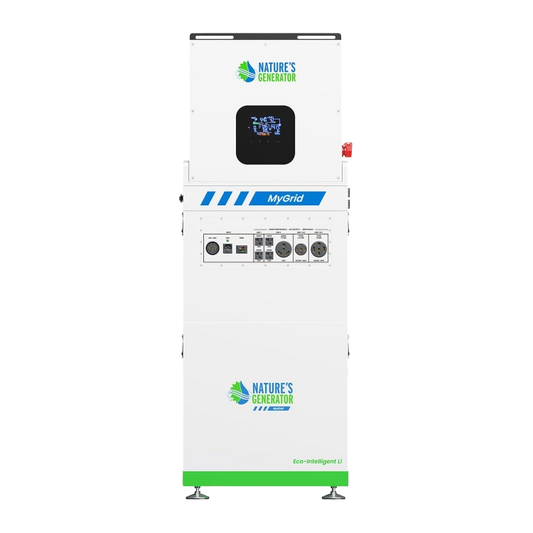
However, if your primary goal is insulating an entire residential property from utility rate increases, a centralized, expandable platform is required. Our premier Nature's Generator Powerhouse system is engineered specifically for this high-intent decision stage. Delivering up to 240 volts of true sine-wave power, the Powerhouse can connect directly to your home's electrical panel via a manual transfer switch.
Customer feedback from our user network highlights the practical value of this approach. For example, a homeowner in California recently shared their real-world usage scenario: by connecting their Powerhouse system to an isolated critical load sub-panel, they completely disconnected their refrigerator, home office, and water pump from the utility company during peak TOU hours. This strategic shift lowered their monthly utility bill by more than 40% while ensuring their family maintained uninterrupted power during regional rolling blackouts.
Step-by-Step Blueprint: How to Transition Your Home to True Energy Autonomy
Transitioning away from a total reliance on the electrical grid requires an orderly, systematic execution plan. Misordering these steps can lead to mismatched component sizing or unnecessary capital expenditure.
1.Conduct an Accurate Household Energy Audit: Prerequisite: Gather 12 months of utility statements to identify historical peak usage months..
Examine your past utility bills to locate your total kilowatt-hour usage across different seasons. Identify the specific appliances causing your billing spikes during summer cooling or winter heating cycles.
2.Implement Comprehensive Load Management to Eliminate Vampire Draw: Failing to address hidden energy waste will force you to over-size your battery system..
Identify and eliminate phantom loads—the power consumed by televisions, chargers, and entertainment systems that remain in standby mode. Transition your primary lighting fixtures to energy-efficient LEDs and ensure your major appliances are properly maintained to optimize their mechanical efficiency.
3.Install an Isolated Critical Load Sub-Panel:Safety Warning: Electrical panel modifications must comply with local building codes and be completed by a licensed professional..
Work with an electrician to separate your home's essential circuits—such as your refrigerator, lighting, well pump, and medical equipment—into a dedicated sub-panel. Connect this panel to a manual or automatic transfer switch linked directly to your alternative energy generator.
4.Scale Your Battery Storage and Renewable Harvesting Arrays: Ensure your chosen platform supports parallel battery expansion for future growth..
Deploy your centralized energy hub and pair it with an appropriate volume of solar panels or wind turbines. By utilizing the expandable framework within the Nature’s Generator official product ecosystem, you can start with a baseline battery capacity and systematically add power pods over time as your household budget permits.
Conclusion
The structural vulnerabilities, data center demand spikes, and infrastructure costs driving electricity rates upward in 2026 are long-term trends showing no signs of reversal. Continuing to rely exclusively on traditional utility companies leaves your household budget entirely exposed to unpredictable pricing models and escalating peak-hour fees. Taking control of your energy future requires shifting from a passive consumer profile to an active producer profile.
By executing a focused energy independence strategy centered around a high-capacity whole home power generator, you can insulate your family from grid instability and protect your hard-earned financial resources. Whether you choose to begin with a targeted portable configuration or deploy an advanced whole-house system, the decisions you make today will establish the foundation for permanent energy autonomy. When you are ready to secure a reliable, fuel-free backup option for your property, our team at Nature’s Generator is prepared to deliver the precise engineering and expandable hardware required to guarantee your absolute peace of mind.


