


Grid instability is no longer a rare headline, it is becoming a routine challenge of modern homeownership that demands a bulletproof strategy for reliable backup power. Finding the right whole home power generator or configuring a modern solar power generator ecosystem is the absolute best way to protect your electronics and major appliances. Depending on your property, you might need a heavy-duty stationary tower, or you might find that a flexible, portable backup power system fits your lifestyle much better.
In this easy-to-understand guide, our team breaks down the differences between the Nature's Generator Powerhouse Gen 2 and the MyGrid 10K. Looking closely at your property layout and daily electricity needs up front is the best way to choose a system that gives you true power independence. We will answer exactly how these two systems compare in size, strength, battery life, and setup so you can make the right choice for your property.
What Are the Main Features of the Powerhouse Gen 2 and MyGrid 10K?
To understand how these whole-home systems protect your property during an outage, it helps to look at their basic numbers side by side. Think of these systems as large smart batteries connected to power boxes that turn stored energy into standard household electricity.
The table below highlights the key differences between the standard, out-of-the-box setups for each system.
|
Feature |
Powerhouse Gen 2 (Base Setup) |
MyGrid 10K (Base Setup) |
|
Running Power (Continuous) |
Up to 7,200 watts |
Up to 10,000 watts |
|
Starting Power (Short Burst) |
Up to 7,200 watts |
Up to 20,000 watts |
|
Battery Storage Size |
4,800 watt-hours |
10,496 watt-hours |
|
Battery Type |
AGM (Heavy-Duty Sealed Lead Acid) |
LiFePO4 (Advanced Lithium) |
|
Solar Panel Input Limit |
Up to 2,000 watts |
Up to 12,000 watts |
|
Wind Turbine Input Limit |
Up to 1,000 watts |
Up to 350 watts |
|
Plug Types Out of the Box |
Standard 120V and Heavy-Duty 240V |
120V, 240V, and Commercial 208V |
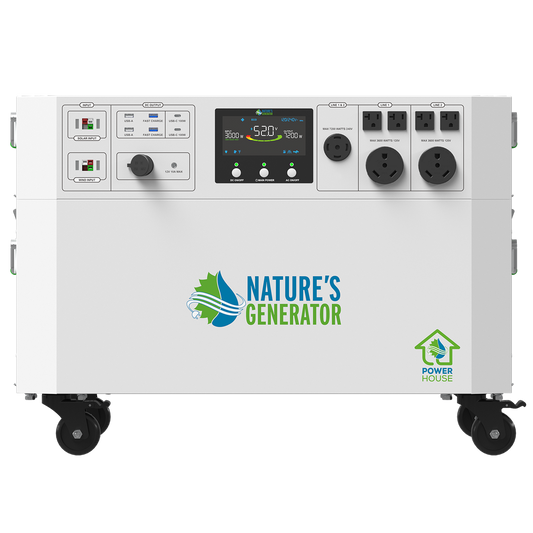
Equipped with a premium inverter, the Powerhouse Whole Home Generator delivers a stable and consistent supply of electricity.
On the other hand, the MyGrid 10K Whole Home Generator starts out with a larger physical size, giving you higher wattage limits and a much bigger initial tank of electricity from a single vertical tower setup.
How Do the Battery Types Differ, and Which One Lasts Longer?
Your backup unit's internal battery chemistry directly impacts its resilience to harsh temperatures, its maintenance schedule during storage, and its overall lifespan. Based on our experience, matching these battery traits to how often you plan to use the system prevents unexpected costs down the road.
Understanding the AGM Battery inside the Powerhouse Gen 2
The Powerhouse Gen 2 uses a time-tested battery technology called AGM (Absorbed Glass Mat). An upgraded take on conventional technology, this is a state-of-the-art, leak-proof version of a standard lead-acid battery.
-
The Practical Benefit: AGM batteries are incredibly tough and stable in extreme temperatures. They perform reliably whether your storage area drops down to 23°F or heats up to 111°F. If you keep your system in an unheated garage or an outdoor tool shed, this battery type starts up without requiring built-in heaters or loud cooling fans.
-
Maintenance Needs: When you are not using the system for a long time, our team recommends plugging it into the wall once every 4 months to top off the battery. This simple step keeps the internal parts healthy and ready for sudden emergencies.
The heavy-duty frame of the Powerhouse system features large tracking wheels, allowing you to move it easily across garage floors, driveways, or basement layouts.
Understanding the Lithium Battery inside the MyGrid 10K
The MyGrid 10K features an advanced lithium battery called LiFePO4 (Lithium Iron Phosphate). This is the same high-end battery technology used in modern electric cars and grid-scale storage systems.
-
Incredible Lifespan: This lithium chemistry can be drained completely and recharged over 6,000 times before it begins to lose its original storage strength. If you plan to use your system every single day to save money on your electric bill, this battery can easily last for decades.
-
Easy Storage: Lithium batteries lose very little charge on their own when sitting idle. When keeping it in storage between storm seasons, it only requires a routine top-off once every six months.
Can These Systems Run Your Heavy-Duty 240-Volt Appliances?
To understand how a backup system runs your home, you need to know the difference between standard 120-volt electronics (like laptops, lamps, and TVs) and heavy-duty 240-volt appliances (like well pumps, clothes dryers, and central air conditioners). Both of these generators are split-phase systems, which means they can send power to your regular household items and your large appliances at the same time.
How the Powerhouse Gen 2 Handles Your Home Load
The Powerhouse Gen 2 delivers up to 7,200 watts of continuous running power. To make this easy to picture, think of continuous power like the cruise control on your car—it is the steady amount of work the generator can handle for hours at a time.
With 7,200 watts of clean power, you can easily run:
-
A full-size kitchen refrigerator (uses about 800 watts).
-
A home internet router and security system (uses about 50 watts).
-
A standard household microwave (uses about 1,200 watts).
-
A home well pump or sump pump (uses about 1,500 to 2,000 watts).
Because its maximum short-burst power is also 7,200 watts, you just need to make sure you do not turn on too many large motorized appliances at the exact same millisecond.
How the MyGrid 10K Handles Extra Large Loads
The MyGrid 10K steps up the game by offering 10,000 watts of continuous power and a massive 20,000 watts of starting burst power. Starting power is the quick surge of extra energy needed just to get a heavy electric motor spinning when it first clicks on.
This massive surge cushion is highly beneficial if your property relies on:
-
Large central air conditioning units that require a heavy electrical kick to turn on.
-
Deep-well submersible water pumps that pull water from hundreds of feet underground.
-
Rapid Level 2 electric vehicle chargers that require a constant, heavy flow of electricity.
With 20,000 watts of peak surge capacity, the MyGrid 10K handles those sudden starting spikes effortlessly without causing your lights to flicker or your safety switches to trip.
How Fast Do They Recharge Using Solar Panels and Extra Batteries?
True off-grid independence means being able to refill your battery tank quickly using the sun. Our team always points out that understanding charging limits ensures you do not buy more solar panels than your generator can actually handle.
Powerhouse Gen 2 Expansion and Growth
The basic Powerhouse system allows you to connect up to 2,000 watts of solar panels directly into the main unit. It also features a separate, built-in 1,000-watt port specifically for a wind turbine, allowing you to capture clean energy even in the middle of a stormy night.
If you find that your family needs more storage over time, you can buy extra battery boxes called Power Pods. Every time you stack a Power Pod onto your system, you add more battery capacity. Even better, each pod lets you connect an extra 2,000 watts of solar panels and another 1,000 watts of wind power, allowing your recharging speeds to grow right along with your storage space.
MyGrid 10K High-Speed Solar Charging
The MyGrid 10K is built for massive solar arrays. Out of the box, it can accept an incredible 12,000 watts of direct solar power. It uses a highly advanced computer chip called an MPPT controller, which automatically adjusts the incoming electrical current to harvest the absolute most power possible from your solar panels, even on cloudy or overcast days.
Because it can take in so much power at once, you can recharge this massive system incredibly fast. If you also plug it into a standard 240-volt wall outlet when grid power is available, it can charge from completely empty up to 80% full in just about 2 hours. This rapid charging ensures you can capture plenty of energy even during short bursts of midday winter sunlight.
Which System Fits Best in Your Garage or Utility Room Layout?
Physical space, weight, and how easily you can move your equipment are major factors when picking a system for your property.
Easy Mobility with the Powerhouse Gen 2
The Powerhouse Gen 2 sits in a single cabinet that is about the size of a large storage cooler and weighs 434 pounds. While that sounds heavy, the entire unit is built onto a rugged steel frame with high-clearance tracking wheels and strong handles. You can easily roll it across flat garage floors, out onto a concrete patio, or into a backup shed. If you move to a new house or change cabins, the entire system rolls right into your truck without needing to be taken apart by an electrician.
Space-Saving Setup with the MyGrid 10K
The MyGrid 10K uses a clever modular tower design to keep your floor space open. The main control box weighs 152 pounds, and the separate, stackable lithium battery blocks weigh 213 pounds each.
-
Sleek Wall Profile: Instead of sitting wide on the floor, the components stack vertically against the wall. This slim profile fits perfectly into tight utility closets, basements, or compact garage bays.
-
Great for Rentals or Houses: Because it can run directly out of its built-in heavy-duty outlets or plug-and-play connections, you can get whole-home backup power without having to cut holes into your walls or make permanent structural changes. If your power needs grow in the future, you can easily stack extra battery cabinets to build an enormous home energy reserve.
The MyGrid 10K system utilizes a streamlined, space-saving vertical tower layout that mounts neatly against structural walls, integrating clean industrial aesthetics directly into utility rooms.
What Do Homeowners Say About Using These Systems?
Customer reviews show how these whole-home backup systems perform when a real storm hits. Our team tracks this real-world feedback closely to ensure our recommendations hold up in everyday life.
Suburban homeowners report that the Powerhouse Gen 2 gives them peace of mind during unexpected winter freezes. Users love how quietly it runs inside a basement or utility room compared to loud, traditional gas generators that rattle the windows. Families who live on smaller properties appreciate how easily they can start out with a basic setup and add extra battery attachments later as their budget allows.
For rural homesteads, off-grid cabins, and large properties, owners frequently praise the raw strength of the MyGrid 10K. Users confirm that the massive 12,000-watt solar input allows large rooftop panel arrays to refill the battery quickly, keeping critical home systems running for days on end. Customers also mention that the digital screen makes it incredibly simple to see exactly how much electricity their home is using in real-time.
Which System Should You Choose for Your Property?
The right choice comes down to your home's size, your largest appliances, and how you plan to use your system.
Choose the Powerhouse Gen 2 If:
-
You want a highly reliable, plug-and-play whole-home backup system with a lower upfront cost.
-
Your storage area experiences extreme cold or heat, where tough AGM batteries perform at their best.
-
You want to use solar panels during the day and a wind turbine at night to get around-the-clock power.
-
You want a mobile system with built-in wheels that can easily move around your property or travel with you if you relocate.
Choose the MyGrid 10K If:
-
You need to run heavy-duty appliances like central air conditioners, large electric dryers, or fast electric vehicle charging loops.
-
You want a premium lithium battery setup that can handle deep daily usage and last for thousands of charges.
-
Your property has a lot of roof space for a large solar panel array that can take advantage of super-fast charging speeds.
-
You prefer a slim, vertical tower layout that mounts neatly against the wall to save valuable floor space.
No matter which path you choose, both options provide excellent energy security without the noise, pollution, or maintenance of traditional fossil fuels. Nature's Generator continues to build top-tier home backup power and solar generator systems that keep modern households safe. By picking the model that matches your property's daily lifestyle, you ensure your home stays comfortable, bright, and fully powered through any unexpected outage.


