


When the power grid goes down, you need an energy system you can truly depend on. In this comparison, we look at the EcoFlow Delta Pro Ultra vs. Nature’s Generator Powerhouse Gen 2 to see which one keeps your lights on best. Whether you want reliable backup power, a clean solar power generator, a strong whole home power generator, or an easy-to-move portable backup power system, this guide has you covered. We will answer which system is better for your wallet, how easy they are to grow, and how they handle wind power.
Choosing a home backup system is a major decision. Our team has tested and evaluated these units to help you cut through the confusing marketing talk. While both brands promise to run your whole house, they do it in very different ways. Let us break down the real-world facts so you can choose the right option for your family.
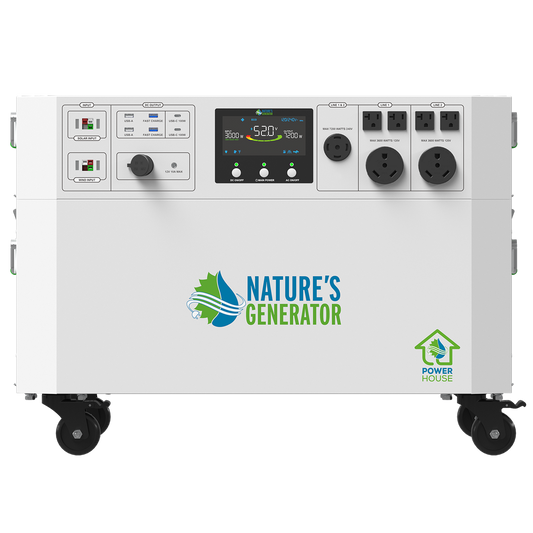
How Do the Continuous Power and Surge Capacities Compare Out of the Box?
To understand how these systems protect your home during a blackout, we first need to look at how much power they can output. Both the EcoFlow Delta Pro Ultra and the Nature’s Generator Powerhouse Gen 2 can run both 120V and 240V appliances at the exact same time. This means they can run standard household items (like lights and TVs) as well as heavy-duty items (like central air conditioning and clothes dryers) without needing any extra adapters.
Based on our experience, both systems are rated to output 7,200W of continuous power. Think of continuous power as a runner's jogging speed—it is the amount of energy the system can safely deliver for hours at a time.
Heavy-duty appliances with electric motors require a massive, short-duration burst of electrical current just to get their motors spinning. This initial rush of electricity is known as starting power, or surge capacity. Think of surge capacity as a runner's top sprinting speed.
Many household appliances have electric motors inside them. These include:
-
Refrigerators and freezers
-
Deep well water pumps
-
Air conditioning compressors
-
Sump pumps
If your generator cannot handle this quick starting burst, it will shut itself down to prevent damage.
-
EcoFlow Delta Pro Ultra: Offers 7,200W of continuous power and a peak starting power of 10,800W.
-
Nature's Generator Powerhouse Gen 2: Offers 7,200W of continuous power and a massive peak starting power of 14,400W.
Why does this difference matter in real life? Imagine it is the middle of the night during a storm. Your refrigerator cycles on at the exact same moment your well pump clicks on to get you water. With the EcoFlow system, that combined surge of power might trip the system and leave you in the dark. With the Powerhouse Gen 2, the extra 3,600W of starting room easily handles both appliances turning on at once without any issues.
What Is the Hard Truth About Scalability and Real-World Expansion Costs?
A common mistake homeowners make is only looking at the price of the base model. The base unit is just your starting point. You must ask yourself: what will it cost to add enough batteries to keep my house running for three, four, or five days of a power outage?
Let's look at a simple breakdown of how these two systems compare when you want to expand them:
|
Feature |
Nature's Generator Powerhouse Gen 2 |
EcoFlow Delta Pro Ultra |
|
Battery Power in Base Unit |
4,800 Wh |
6,144 Wh |
|
Continuous Running Power |
7,200W |
7,200W |
|
Starting Power (Surge) |
14,400W |
10,800W |
|
Wind Turbine Plug |
Built-in and ready to use |
None (needs extra parts) |
|
Battery Type |
Heavy-duty AGM (Lead-Acid) |
Lithium (LiFePO4) |
|
Cost to Add More Storage |
Low and budget-friendly |
Very high and expensive |
While the EcoFlow Delta Pro Ultra can technically hold more total batteries (up to a massive 90 kWh), the cost to get there is incredibly high. A single extra battery from EcoFlow costs thousands of dollars. By the time you buy the main unit, several extra batteries, and the special smart panel needed for your home, you can easily spend 15,000 to 20,000 dollars.
The Nature's Generator Powerhouse Gen 2 is designed to be much easier on your wallet. The base unit comes with 4,800 Wh of battery storage. If you want to store more power, you can easily stack extra battery boxes called Powerhouse Power Pods on top of each other, up to a total of 28.8 kWh.
Because the Powerhouse Gen 2 uses highly optimized, heavy-duty AGM batteries, adding more storage is highly affordable. Instead of spending a small fortune on a premium lithium setup, a homeowner can build a large, dependable backup system for a fraction of the cost. If you want practical emergency protection for your family without spending tens of thousands of dollars, the Powerhouse Gen 2 makes much more financial sense.
Why Does Native Wind Integration Redefine True Off-Grid Resilience?
Many people who buy solar generators forget one simple fact: the sun does not shine twenty-four hours a day. If you experience a power outage during a week of heavy winter storms, thick clouds, or at night, your solar panels will not be able to charge your batteries. This is why having a second way to charge is so important.
The Powerhouse Gen 2 comes with a dedicated wind turbine plug built right into the front of the machine. You do not need to be an electrician, buy extra parts, or worry about complicated wiring. You simply plug the Powerhouse Wind Turbine directly into the unit, and you are ready to generate power from the wind.
We strongly advise pairing wind and solar energy systems together for a few important reasons
-
Charging at Night: Wind turbines can generate electricity all night long while your solar panels are resting in the dark.
-
Storm Protection: The worst storms often bring heavy clouds but very strong winds. When solar panels fail, the wind turbine steps up.
-
Cold-Weather Energy: Winter brings shorter, cloudier days with weak sunlight, but it also tends to bring much stronger winds.
The EcoFlow Delta Pro Ultra does not have a wind turbine plug. If you want to use wind power with an EcoFlow, you have to buy a third-party turbine, buy a separate charge controller, figure out how to match the voltages, and wire it all together yourself. This is difficult to do, can easily damage your expensive generator, and might void your warranty. For true off-grid independence, the built-in wind port on the Powerhouse Gen 2 is a massive advantage.
AGM vs. LiFePO4: Which Battery Chemistry Best Handles Extreme Climates?
The internal batteries in these two systems use completely distinct chemical makeups. The EcoFlow Delta Pro Ultra uses Lithium Iron Phosphate (LiFePO4) batteries, while the Powerhouse Gen 2 uses heavy-duty Sealed Lead-Acid AGM batteries.
To learn more about these different battery types, you can read our easy guides on why LiFePO4 batteries are best for solar generators or check out our complete LiFePO4 battery guide.
While lithium batteries are light and last for many years, they have a major weakness: they cannot safely charge when the temperature drops below freezing (32 degrees Fahrenheit or 0 degrees Celsius). If you try to charge a freezing lithium battery, it will ruin the battery permanently and can even start a fire. Because of this, the EcoFlow system has to use its own battery power to run heaters to warm itself up before it can accept a charge. In a freezing winter storm, this wastes valuable electricity just to keep the battery warm.
AGM batteries, like the ones used in the Powerhouse Gen 2, are incredibly tough in the cold. These units function and recharge safely in freezing conditions as low as -20°C (-5°F) without needing any heating systems.
This makes AGM batteries perfect for backup systems kept in unheated places like:
-
Garages
-
Basements
-
Outdoor tool sheds
-
Off-grid cabins
AGM batteries are also incredibly safe, require zero maintenance, and cost much less upfront. If you want a backup system that sits ready in your garage and will work instantly in a freezing winter blizzard, the AGM technology in the Powerhouse Gen 2 is the more reliable choice.
How Do These Systems Connect to Your Home's Electrical Panel?
Having a strong generator is only helpful if you can easily send that power to the appliances inside your house. To do this safely, you must connect the generator to your home's breaker panel using a transfer switch. This prevents electricity from accidentally flowing back into the power lines, which is highly dangerous for utility workers.
Our team has mapped out the simple, safe steps to connect the Powerhouse Gen 2 to your home:
1. Install the Transfer Switch: Mount the switch next to your main panel.
Have a local electrician mount a manual transfer switch right next to your home's main breaker panel.
2.Choose Your Critical Circuits: Select your most important appliances.
Choose the most important household items—like your refrigerator, water pump, heating fan, and living room lights—and wire them directly to the transfer switch.
3.Plug in the Generator: Use the included heavy-duty cord.
Using the heavy-duty cord, plug the Powerhouse Gen 2's 120V/240V outlet directly into the transfer switch inlet.
4.Activate Emergency Power: Toggle the switches to bring the lights back on.
When the grid goes down, turn on your generator and flip the switches on the transfer panel from LINE to GEN. Your selected household appliances will turn back on instantly.
EcoFlow encourages users to buy their Smart Home Panel 2, which uses a smartphone app to switch your power automatically. However, this smart panel is very expensive, requires a highly complicated installation, and relies on software and internet connections to work. If the software glitches during an emergency, you could be left without power.
Nature’s Generator offers simple, manual transfer switches that are easy to install and highly reliable. There are no software updates to worry about, no internet connections needed, and no expensive smart parts that can break. It is a straightforward, heavy-duty solution that works exactly when you need it to.
Making the Right Call for Your Home
When we compare the EcoFlow Delta Pro Ultra and the Nature's Generator Powerhouse Gen 2, the right choice depends on your budget and your off-grid goals. The EcoFlow system is a high-tech, premium option, but it comes with a very high price tag and cannot easily use wind power.
If you want a home backup system that can easily charge using both sun and wind, works perfectly in freezing winter weather, and fits your household budget, the Powerhouse Gen 2 is the clear winner. By choosing a rugged Nature's Generator package, you can keep your family safe and warm through any storm without spending a fortune.


